
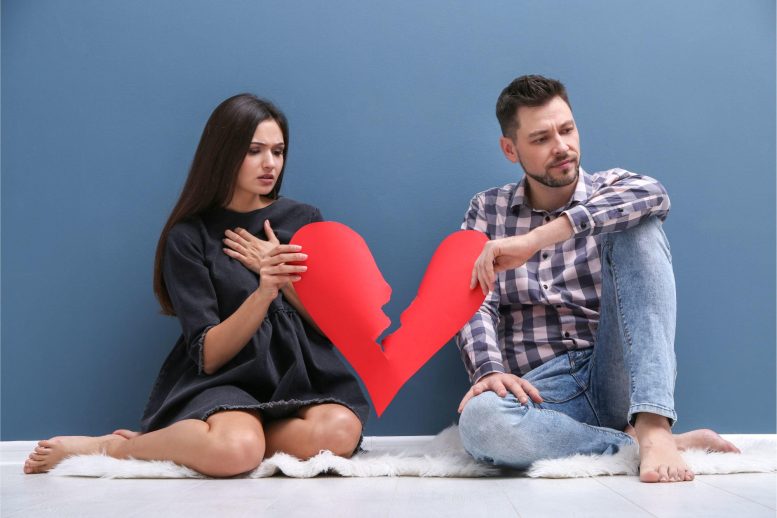
Breakups seem predictable in hindsight, but research reveals this is a cognitive illusion shaped by bias.
When we reveal the breakup news of a known couple, we frequently hear, “I figured they wouldn’t make it!”
However, a new study published in the journal Social Psychological Bulletin suggests that people might want to think twice before assuming they could have seen the break-up coming. It turns out, their memory might be distorted by the tricks of hindsight bias.
Having conducted a series of surveys among over 1,000 college students and community adults in total, a research team from the University of Wisconsin-Eau Claire (USA) concludes that it is only after someone learns about a couple’s break-up that they perceive a break-up as more obvious.
How Breakup Knowledge Affects Judgment
Furthermore, it is at this point that the observer is more likely to focus on the negative qualities of the relationship instead of the positive ones and evaluate the relationship more unfavorably, thereby justifying the “logical” outcome.
To test the role of hindsight bias, the researchers ran two studies. In both studies, they gave each of the survey participants a story that described a seemingly happy and loving couple who had a number of good things going for them, such as a great emotional connection, but also a number of bad things, such as different religious beliefs.
Then, in each study, the researchers split the respondents into three groups, and each of the groups was given different information about the couple’s relationship status six months later. One group was given no information. One group was told that the couple broke up. And the third group was told a positive outcome: that the couple simply “stayed together” (in the first study) or “got engaged” (in the second study). The researchers wanted to find out if people would evaluate the couple and their relationship differently when they knew the couple had broken up as opposed to staying together.
After the respondents were given the whole fictional scenario, they were asked about how they had thought the relationship would develop when they first read about the couple. They were also asked to rate the quality of the described relationship.
Clear Evidence of Hindsight Bias in Breakup Perception
As a result, the researchers report, there was not much of a difference in the responses between the groups that received either no information or a positive scenario. However, there was a stark contrast between those two groups and the group who were told the couple broke up. Those who were told the couple was no more rated a break-up as more obvious than the other groups did, and rated the couple’s relationship more negatively.
The researchers suggest that once a break-up has happened, “signs of the impending break-up that were ignored or unnoticed in foresight may become more relevant, as they now supply ideas for how things could have been different.”
“As individuals update their knowledge and use newly acquired outcome information to make sense of experiences, they may forget or reinterpret thoughts and predictions they previously had,” explain the researchers.
“Thus, memory might be reconstructed with more weight placed on the negative elements of the relationship. Likewise, aspects of the relationship might be reinterpreted to make sense of the outcome. After a breakup, for instance, what was previously interpreted as constant attention and affection may be reinterpreted as the neediness of an overbearing partner. Similarly, differences in beliefs that were previously interpreted as opportunities for perspective-taking and negotiation may be reinterpreted as insurmountable barriers,” add the authors of the study.
In conclusion, the team points to their data as evidence that post-break-up self-blame and negative reactions from others – which pose a risk for depression and anxiety – might be unwarranted.
“We hope that future research will explore the psychological consequences of hindsight bias in romantic relationships, as well as the specific mechanisms that may operate to produce the bias,” they say.
Reference: “I “Knew” They Wouldn’t Last: Hindsight Bias in Judgments of a Dating Couple” by April Bleske-Rechek, Michaela M. Gunseor and Kai Nguyen, 15 May 2023, Social Psychological Bulletin.
DOI: 10.32872/spb.9967
Never miss a breakthrough: Join the SciTechDaily newsletter.
Follow us on Google and Google News.