
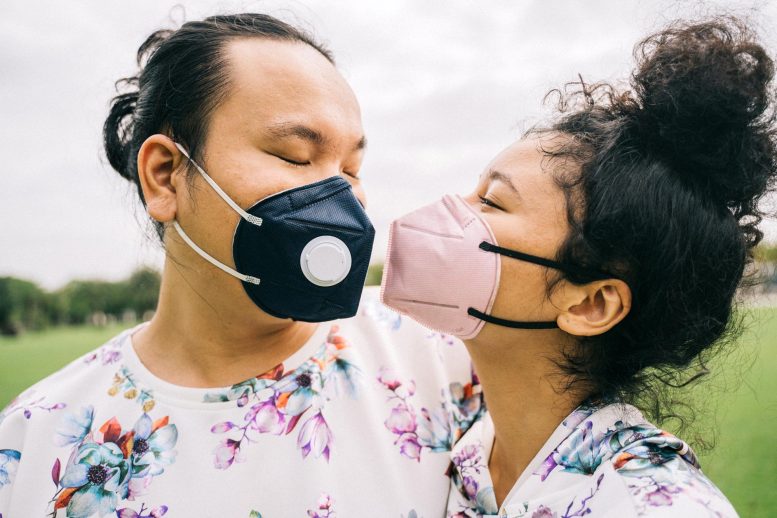
Couples who blamed COVID-19 for their stress, not each other, reported stronger relationships.
Relationships are often undermined by everyday frustrations like work stress or financial anxiety, but how do couples handle a challenge as unprecedented as the COVID-19 pandemic? People who blamed their stress on the pandemic more than on their partner were happier in their relationship, a new study in Social Psychological and Personality Science reports.
Previous research has shown that romantic partners tend to be more critical toward each other when experiencing common stress, but major events like natural disasters are not always associated with poor relationship functioning. Because these significant stressors are more noticeable than routine situations, people may be more aware that stress is affecting them.
Blaming the Pandemic vs. the Partner
“Because of this awareness, when major stressors occur, romantic partners may be less likely to blame each other for their problems and more likely to blame the stressor, which may reduce the harmful effects of stress on the relationship,” says Lisa Neff, an associate professor of human development and family sciences at The University of Texas at Austin and one of the study’s coauthors.
The COVID-19 pandemic, with its widespread impact, presents a unique context for testing this concept. Researchers analyzed data collected from 191 participants during the early weeks of the pandemic and again seven months later, examining whether blaming the pandemic for problems could reduce how much stress affected their relationship, known as stress spillover.
“As expected, people generally were more blaming of the pandemic for their current problems than they were blaming of their romantic partner,” Neff says, noting that this tendency came with important relationship benefits. “Individuals who were more blaming of the pandemic were more resilient to the harmful effects of stress.”
Participants completed a questionnaire assessing the degree to which they blamed the pandemic for their problems. This was followed by a 14-day daily survey, focusing on their daily life stressors, relationship satisfaction and their reports of negative behavior they exhibited toward their partner.
Limitations of Blame-Shifting as a Coping Mechanism
While blaming the pandemic can reduce the harmful effects of stress on a relationship, it does not eliminate them. If couples are aware of the impact stress is having on their relationship but the stressful circumstances exceed their coping abilities, the relationship may suffer. Still, the research demonstrates the importance of recognizing that stress can color the way partners perceive their relationship and interact with each other.
“When couples are aware that stress may be impacting their relationship, it’s easier for couples for shift blame for their problems away from each other and onto the stressor,” Neff says. “Doing so can help partners support each other more effectively, and ultimately, be more successful in weathering those difficult times.”
Reference: “Blame the Pandemic: Buffering the Association Between Stress and Relationship Quality During the COVID-19 Pandemic” by Lisa A. Neff, Marci E. J. Gleason, Erin E. Crockett and Oyku Ciftci, 21 June 2021, Social Psychological and Personality Science.
DOI: 10.1177/19485506211022813
Social Psychological and Personality Science (SPPS) is an official journal of the Society for Personality and Social Psychology (SPSP), the Association for Research in Personality (ARP), the European Association of Social Psychology (EASP), and the Society for Experimental Social Psychology (SESP). Social Psychological and Personality Science publishes innovative and rigorous short reports of empirical research on the latest advances in personality and social psychology.
Never miss a breakthrough: Join the SciTechDaily newsletter.
Follow us on Google and Google News.