
Close Menu
    Facebook X (Twitter) Instagram
    SciTechDaily
    • Biology
    • Chemistry
    • Earth
    • Health
    • Physics
    • Science
    • Space
    • Technology
    Facebook X (Twitter) Pinterest YouTube RSS
    SciTechDaily
    Home»Earth»Innovative New Model Reveals Previously Unrecognized Complexity of Oceanic Earthquake Zones
    Earth

    Innovative New Model Reveals Previously Unrecognized Complexity of Oceanic Earthquake Zones

    By University of TsukubaDecember 29, 2020No Comments3 Mins Read
    Facebook Twitter Pinterest Telegram LinkedIn WhatsApp Email Reddit
    Share
    Facebook Twitter LinkedIn Pinterest Telegram Email Reddit
    2020 Caribbean Earthquake
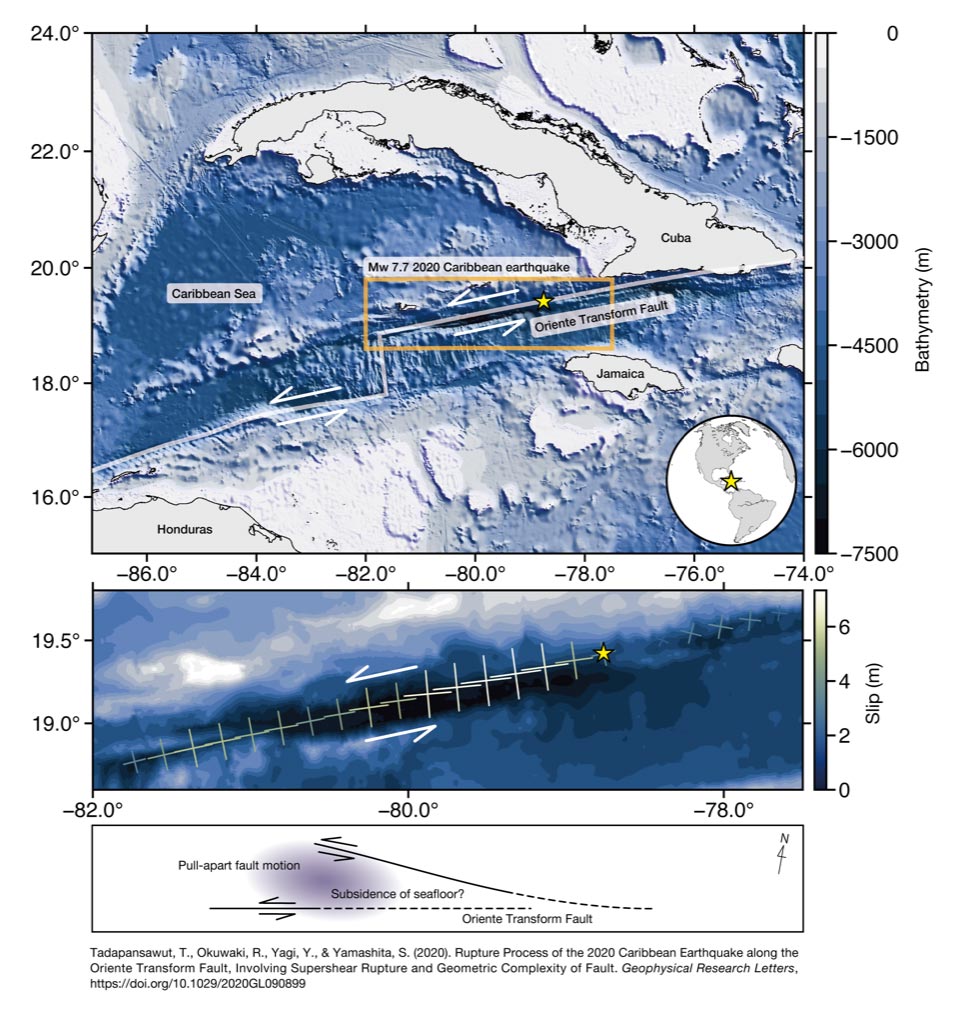
    Overview of the study area and the schematic illustration of interaction of fault motion and the seafloor subsidence. Credit: University of Tsukuba

    University of Tsukuba researchers have developed a state-of-the-art model, which has revealed major complexity in rupture processes even in simple oceanic faults.

    Researchers from the University of Tsukuba applied seismic data from around the world to build a model of the 2020 Caribbean earthquake. Oceanic transform faults are generally considered to be linear and simple and have been widely used in studies of earthquake dynamics. However, the research team found that high complexity in rupture speed and direction can occur even in a supposedly simple linear fault system.

    On 28 January 2020, a large oceanic earthquake with a magnitude of 7.7 occurred at the Oriente transform fault in the Caribbean Sea, between Jamaica and Cuba. It caused a minor tsunami of 0.11 m (0.36 ft) in height and was felt as far afield as Florida.

    A research team at the University of Tsukuba have developed a new finite-fault inversion method for building models based on teleseismic waveform data from earthquake monitoring stations. This new approach to using the data takes a more flexible approach to resolving the fault geometry. Rather than relying on prior assumptions, the faulting components are separately evaluated in a wider model in both time and space, allowing all possible rupture evolutions to be considered. The team were keen to use the Caribbean earthquake to help to understand the faulting processes that occur during these shallow oceanic quakes.

    “Some cases of complex rupture dynamics have recently been reported in previous earthquake studies, raising the question of whether or not we are correctly modeling these even in supposedly simple fault systems,” says study author Professor Yuji Yagi. “The initial monitoring of this January 2020 event suggested variations in the waveform shape between two stations at similar distances from the epicenter, suggesting that there remains complexity to be explored at this fault.”

    This was an excellent opportunity to test the new method developed by the team, which used data from 52 seismic stations to construct a detailed model of the geophysical processes within the fault that gave rise to the earthquake.

    “The results revealed complex rupture during the earthquake, caused by a bend in the fault that led to the changes in rupture speed and direction detected in the monitoring data,” explains author Professor Ryo Okuwaki. “These variations triggered several successive rupture episodes that occurred along the 300-km-long  (186-mi-long) fault.” The modeling approach also allows some suggestions to be made about the possible occurrence of subsidence and the shape of the surrounding seabed following the earthquake event.

    These findings reveal that oceanic transform faults, considered to be simple and linear, may be much more complicated than previously accepted, and therefore require a more comprehensive approach to earthquake modeling. This work will shed light on a possible interaction between the earthquake-fault motion and the evolution of the ocean floor around the transform boundary.

    Reference: “Rupture Process of the 2020 Caribbean Earthquake along the Oriente Transform Fault, Involving Supershear Rupture and Geometric Complexity of Fault” by Tira Tadapansawut, Ryo Okuwaki, Yuji Yagi and Shinji Yamashita, 6 December 2020, Geophysical Research Letters.
    DOI: 10.1029/2020GL090899

    Never miss a breakthrough: Join the SciTechDaily newsletter.
    Follow us on Google and Google News.

    Earthquakes Geography Geophysics Tectonic Plates University of Tsukuba
    Share. Facebook Twitter Pinterest LinkedIn Email Reddit

    Related Articles

    Solving a Tectonic Puzzle: Explaining “Silent Earthquakes” Along New Zealand’s North Island

    A Billion-Plus Years of Deep-Earth History Hidden Within African Diamonds

    Using Google’s 10,000-km-Long Underwater Fiber-Optic Cable as a Seafloor Seismic Sensor

    Largest Earthquakes and Their Tsunamis May Be Directed by Deep, Slow-Slip Action

    Strange Precariously Balanced Rocks Provide Earthquake Forecasting Clues

    Deep Underground “Rock-Melting” Forces Explain Quakes on San Andreas Fault

    Deep-Earth Structures Discovered That May Signal Enormous Hidden Metal Lodes

    New Clues to Deep Earthquakes Could Help Unravel One of the Most Mysterious Geophysical Processes on Earth

    Earthquakes Deform Gravity – New Algorithm Could Enable Early Warning Systems

    Leave A Reply Cancel Reply

    • Facebook
    • Twitter
    • Pinterest
    • YouTube

    Don't Miss a Discovery

    Subscribe for the Latest in Science & Tech!

    Trending News

    Bone-Strengthening Discovery Could Reverse Osteoporosis

    Scientists Uncover Hidden Trigger Behind Stem Cell Aging

    Scientists Find Way to Reverse Fatty Liver Disease Without Changing Diet

    Could Humans Regrow Limbs? New Study Reveals Promising Genetic Pathway

    Scientists Reveal Eating Fruits and Vegetables May Increase Your Risk of Lung Cancer

    Scientists Reverse Brain Aging With Simple Nasal Spray

    Scientists Uncover Potential Brain Risks of Popular Fish Oil Supplements

    Scientists Discover a Surprising Way To Make Bread Healthier and More Nutritious

    Follow SciTechDaily
    • Facebook
    • Twitter
    • YouTube
    • Pinterest
    • Newsletter
    • RSS
    SciTech News
    • Biology News
    • Chemistry News
    • Earth News
    • Health News
    • Physics News
    • Science News
    • Space News
    • Technology News
    Recent Posts
    • Europe’s Most Active Volcano Just Got Stranger – Here’s Why Scientists Are Rethinking It
    • Why Are Giant Ants Letting Tiny Ants Crawl All Over Them?
    • Revolutionary Technique Sends Healthy Mitochondria Exactly Where They’re Needed
    • This Student Recreated the Universe in a Bottle. What She Discovered Could Help Reveal How Life Started on Earth
    • Alzheimer’s Symptoms May Start Outside the Brain, Study Finds
    Copyright © 1998 - 2026 SciTechDaily. All Rights Reserved.
    • Science News
    • About
    • Contact
    • Editorial Board
    • Privacy Policy
    • Terms of Use

    Type above and press Enter to search. Press Esc to cancel.