
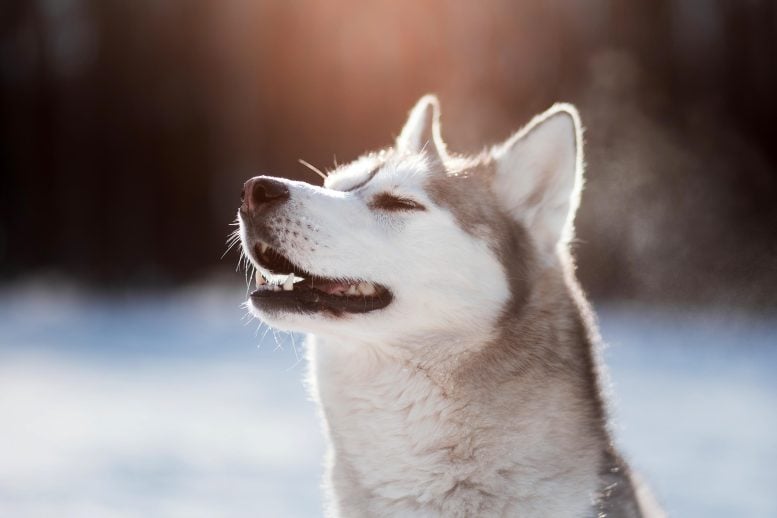
Researchers of the Department of Ethology, Eötvös Loránd University (ELTE) have been investigating dogs’ reactions to wolf howls. Are there dogs that are more prone to reply with howling? Are these dogs genetically closer to wolves? To answer these questions, the effects of the dogs’ breed, age, and sex on their behavior were tested in this study. Results of this extraordinary research will be published today in the journal Communications Biology.
When one hears a howl in the forest, the first thing that he associates that sound with is the wolf. And it’s true, howling is a characteristic communication form of wolves, but it is also widespread among canine species. They use it for long-distance communication with others, to mark territory boundaries, and also, to define the position of the other wolves, which in most cases, also reply with howling.
Among their domesticated relatives, our best friend the domestic dog, the situation seems a bit more complicated: some breeds, like wolf-like sled dogs, are widely believed to be “hard-howlers,” meaning that they howl frequently, even in ‘reply’ to irrelevant sounds like bells, sirens or music, while others never howl even once during their life, even though they are capable of producing them.
Dog breeds genetically closer to wolves reply to wolf howl playbacks more with howling and also show more stress than breeds genetically farther from the wild relatives – but interestingly, this genetic difference appeared only among older dogs.
Researchers of the Department of Ethology, Eötvös Loránd University aimed to solve the mystery of dog howling, and examine whether is it true that specific breeds are more prone to howl and whether this has anything to do with their genetic closeness to wolves.
To answer these questions, the researchers tested 68 purebred family dogs by playing back recordings of wolf howls and observing their reactions in a behavioral laboratory. To test the effect of the breed, the different breeds’ genetic similarity to wolves (so-called “root distance”) was used as a measure.
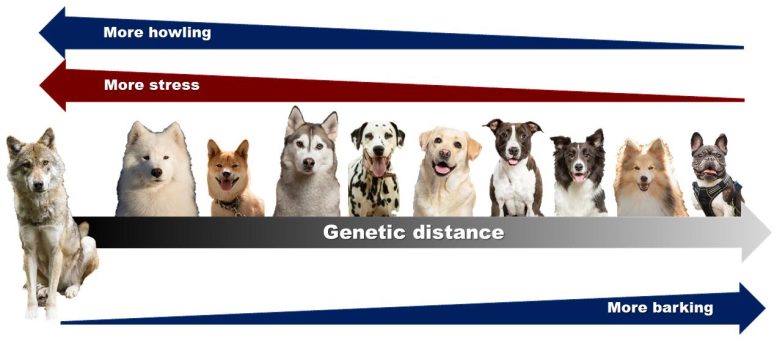
“According to our results, breeds which are genetically more similar to wolves (“ancient breeds”), are more prone to reply with their own howls to wolf howl playbacks. On the other hand, breeds more distantly related to wolves (“modern breeds”) typically reacted with barking instead of howls. It seems that although howling is present in most breeds’ repertoire, it lost its functionality due to the changed social environment, thus, modern breeds do not use it in adequate situations,” explains Fanni Lehoczki, the first author of the study.
“Additionally, we found that breeds which howl more also show more stress-related behaviours in this situation.”
We assume that more ancient breeds, which are genetically closer to wolves, can process the information encoded in wolf howls better than modern breeds. Thus, ancient breeds of our study might become stressed by intruding on a pack’s territory and use howling for the sake of avoidance, just as wolves do,” says Tamás Faragó, postdoctoral researcher at the Department of Ethology, ELTE and the senior author of the study.
“Interestingly, this genetic effect on howling occurs only among older dogs (>5 years), for which an experience- or some age-related personality effect can be a plausible explanation. It is possible that- in line with our hypothesis, that howling appearing with a higher level of stress is a fear reaction – older dogs are more fearful, which was already suggested by previous studies, but these speculations require further investigation.”
Besides the breed and age of the dog, the effect of other features like sex and reproductive status were also tested.
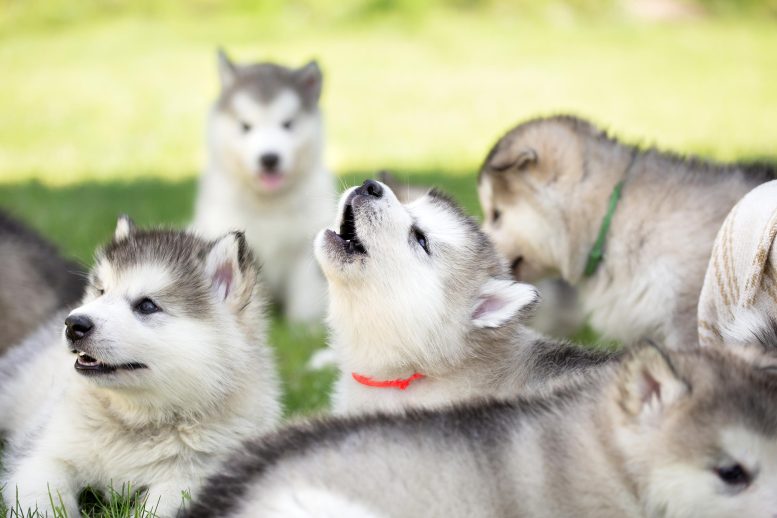
“What we found is that something is going on with the male sex hormones, as there is no difference between intact and spayed females, but intact and neutered males do behave differently. Neutered males, which are in lack of testosterone, howl more in response to the playbacks. As neutered males are suggested to be more fearful, this result can be in line with our findings about responsiveness and more stressed behavior. Thus, the dog howl may mean “I am scared, don’t come closer,” explains Fanni Lehoczki
This is the first study specifically investigating howling in domestic dogs.
The findings support the hypothesis that domestication and selective breeding by humans fundamentally changed dogs’ vocal repertoire and both the perception and production of howling in dogs. This insight brings us closer to understanding the history and impact of the profoundly important relationship between humans and their “best friends” the domestic dog.
Reference: “Genetic distance from wolves affects family dogs’ reactions towards howls” by Fanni Lehoczki, Attila Andics, Arik Kershenbaum, Eniko Kubinyi, Daniela Passilongo, Holly Root-Gutteridge, Friederike Range, Vicente Palacios Sánchez, Lori Schmidt, Simon W. Townsend, Stuart K. Watson and Tamás Faragó, 6 February 2023, Communications Biology.
DOI: 10.1038/s42003-023-04450-9
This research was funded by the Eötvös Loránd University; Eötvös Loránd Research Network; European Research Council (Horizon 2020); Hungarian Academy of Sciences (János Bolyai Research Scholarship, Premium Postdoctoral Scholarship, ’Lendület’ grant,); National Brain Programme; National Excellence Program; Austrian Science Fund (FWF); UK’s Biological and Biotechnology Research Council; Swiss National Science Foundation; NCCR Evolving Language, Swiss National Science Foundation Agreement.
Never miss a breakthrough: Join the SciTechDaily newsletter.
Follow us on Google and Google News.
2 Comments
Good and interesting article. Anybody who has a dog, or intends to have one, should read this one.
Here is a good website that goes into more details