
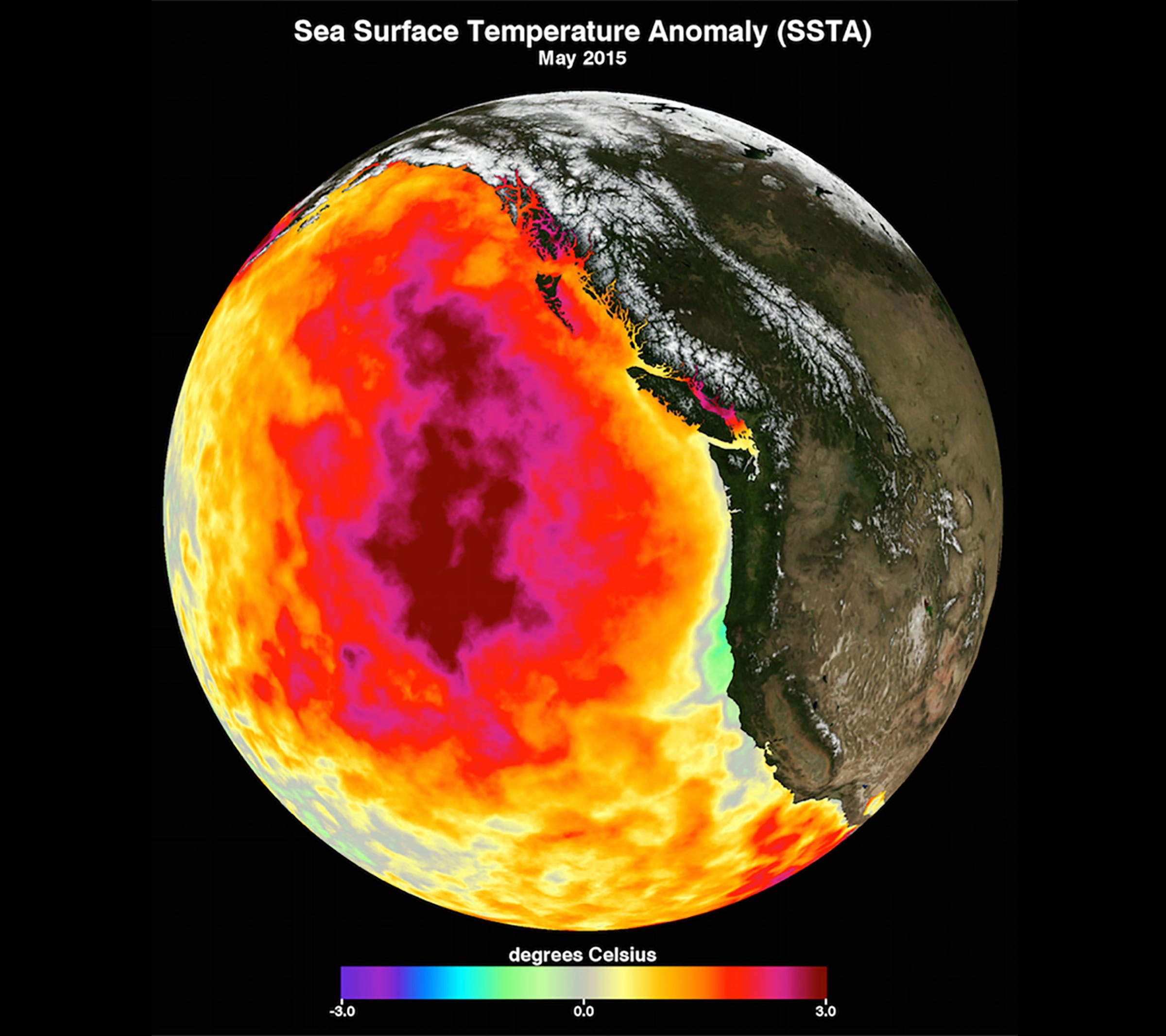
Heatwaves in the world’s oceans have become over 20 times more frequent due to human influence. This is what researchers from the Oeschger Centre for Climate Research at the University of Bern are now able to prove. Marine heatwaves destroy ecosystems and damage fisheries.
A marine heatwave (ocean heatwave) is an extended period of time in which the water temperature in a particular ocean region is abnormally high. In recent years, heatwaves of this kind have caused considerable changes to the ecosystems in the open seas and at the coast. Their list of negative effects is long: Marine heatwaves can lead to increased mortality among birds, fish, and marine mammals, they can trigger harmful algal blooms, and greatly reduce the supply of nutrients in the ocean. Heatwaves also lead to coral bleaching, trigger movements of fish communities to colder waters, and may contribute to the sharp decline of the polar icecaps.
Researchers led by Bern-based marine scientist Charlotte Laufkötter have been investigating the question of how anthropogenic climate change has been affecting major marine heatwaves in recent decades. In a study recently published in the well-known scientific journal “Science”, Charlotte Laufkötter, Jakob Zscheischler, and Thomas Frölicher concluded that the probability of such events has increased massively as a result of global warming. The analysis has shown that in the past 40 years, marine heatwaves have become considerably longer and more pronounced in all of the world’s oceans. “The recent heatwaves have had a serious impact on marine ecosystems, which need a long time to recover afterwards – if they ever fully recover,” explains Charlotte Laufkötter.
A huge increase since the 1980s
In its investigations, the Bern team studied satellite measurements of the sea surface temperature between 1981 and 2017. It was found that in the first decade of the study period, 27 major heatwaves occurred which lasted 32 days on average. They reached maximum temperatures of 4.8 degrees Celsius (8.1 degrees Fahrenheit) above the long-term average temperature. In the most recent decade to be analyzed, however, 172 major events occurred, lasting an average of 48 days and reaching peaks of 5.5 degrees Celsius (9.9 degrees Fahrenheit) above the long-term average temperature. The temperatures in the sea usually fluctuate only slightly. Week-long deviations of 5.5 degrees Celsius over an area of 1.5 million square kilometers – an area 35 times the size of Switzerland – present an extraordinary change to the living conditions of marine organisms.
Statistical analyses demonstrate human influence
For the seven marine heatwaves with the greatest impact, researchers at the University of Bern carried out what is referred to as attribution studies. Statistical analyses and climate simulations are used to assess the extent to which anthropogenic climate change is responsible for the occurrence of individual extremes in the weather conditions or the climate. Attribution studies typically demonstrate how the frequency of the extremes has changed through human influence.
Without ambitious climate goals, marine ecosystems might disappear
According to the findings of the attribution studies, major marine heatwaves have become more than 20 times more frequent due to human influence. While they occurred every hundred or thousand years in the pre-industrial age, depending on the progress of global warming, in the future they are set to become the norm. If we are able to limit global warming to 1.5 degrees Celsius (2.7 degrees Fahrenheit), heatwaves will occur once every decade or century. If temperatures rise by 3 degrees Celsius (5.4 degrees Fahrenheit), however, extreme situations can be expected to occur in the world’s oceans once per year or decade. “Ambitious climate goals are an absolute necessity for reducing the risk of unprecedented marine heatwaves,” emphasizes Charlotte Laufkötter. “They are the only way to prevent the irreversible loss of some of the most valuable marine ecosystems.”
Reference: “High-impact marine heatwaves attributable to human-induced global warming” by Charlotte Laufkötter, Jakob Zscheischler and Thomas L. Frölicher, 25 September 2020, Science.
DOI: 10.1126/science.aba0690
The Oeschger Centre for Climate Change Research (OCCR) is one of the strategic centers of the University of Bern. It brings together researchers from 14 institutes and four faculties. The OCCR conducts interdisciplinary research right on the frontline of climate change research. The Oeschger Centre was founded in 2007 and bears the name of Hans Oeschger (1927-1998), a pioneer of modern climate research, who worked in Bern.
Never miss a breakthrough: Join the SciTechDaily newsletter.
Follow us on Google and Google News.
2 Comments
REBEL’S DAILY REPORTS
WARNING!!!!! Read facebook.com/ron.mccune.3 to see the awful disaster that all of you will face in about 20 years!
Oceans are Earth’s canary in the cage! When the oceans are out of norm as they are now then all of Earth’s atmospheric conditions are affected in bad ways which leads to bad things! Oceans are mainly heating up because the Sun has since the 1960’s when jet airplanes, rockets, combustion engine vehicles and air-conditioning all started sucking the moisture out of our atmosphere which caused less moisture for clouds to form! With less clouds surrounding Earth the Sun had more opportunity to shine it’s hot deadly rays onto the Earth much more so because us humans in the 1960’s starting destroying clouds, the one and ONLY thing that protects the Earth from those hot, deadly Sun rays! The Sun can bake all live to death and evaporate all the water on Earth just as Suns have done everywhere! Go take a walk in any desert and you’ll see what I’m talking about! The desert has no water and no life on it’s surface. That’s because of the Sun’s hot rays. Clouds are necessary for life on Earth because they alone provide shade from the Sun as well as supply new water to the Earth from the clouds rain water to replace the water on Earth that is by the millions of gallons daily being evaporated by the Sun. The less clouds the quicker and stronger the force of the Sun’s evaporation ratio. In about 10-15 years the North Pole will be completely ice free and in about 20-25 years the South Pole will be completely melted! All hell will break loose worldwide in about 15-25 years as the Earth enters a new stage of existence as the Sun will bake all life and water from it’s surface!
Do you have these hallucinations frequently? In any event, I suggest that you discuss it with your physician, and give up using recreational drugs. You may harm yourself or others when you lose touch with reality.