
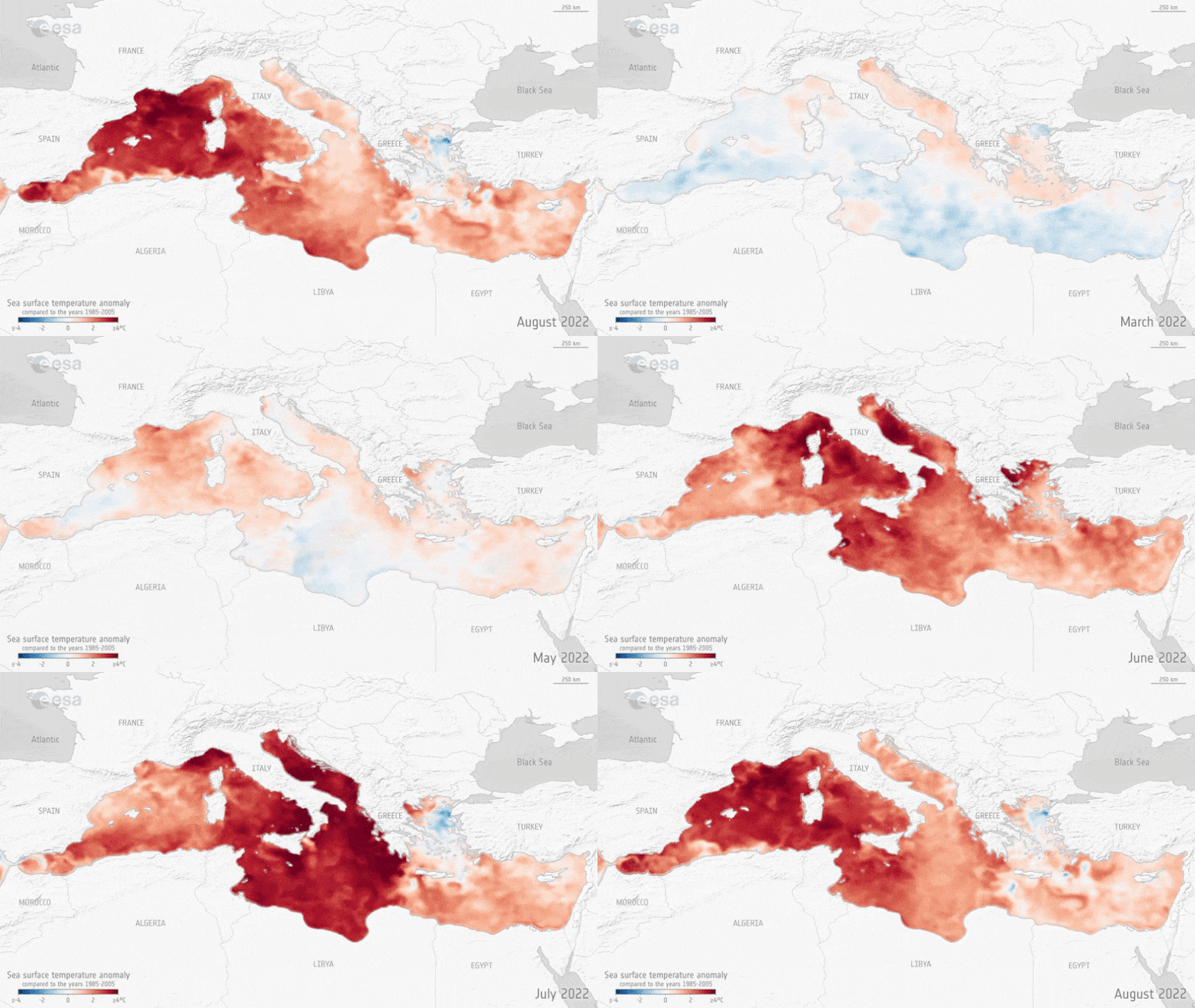
Many parts of Europe saw record-breaking temperatures over the summer. However, it wasn’t just the continental mainland that was affected, because the Mediterranean Sea also suffered a major marine heatwave. CAREHeat, an ESA-funded project, detected one of the most intense Mediterranean marine heatwaves observed during the satellite era – with sea surface temperatures reaching 5°C (9°F) higher than average.
Extreme rises in ocean temperature over an extended period of time are known as marine heatwaves. Their magnitude and frequency have harmful effects on marine ecosystems, threaten marine biodiversity and negatively impact fisheries, aquaculture, and tourism industries.
The Broader Impacts of Marine Heatwaves on Weather and Land
Higher water temperatures associated with marine heatwaves can also cause extreme weather events such as tropical storms and hurricanes. They can also disrupt the water cycle, making floods, droughts, and wildfires on land more likely.
Marine heatwaves have become more widespread as global ocean temperatures continue to rise. They are only expected to increase in intensity, duration, and frequency in the future due to human-induced climate change.
Predicting marine heatwave occurrence and duration is essential, as is understanding their impacts on marine ecosystems. This is necessary to help protect ecosystems and local communities.
CAREHeat (deteCtion and threAts of maRinE Heat waves) is an ESA-funded project that aims to develop novel strategies to identify marine heatwaves, assess their status and trends, and understand their impact on marine life.
The project, which began in March 2022, used near-real-time sea surface temperature data available from the Copernicus Marine Service, and has been able to detect and monitor the Mediterranean marine heatwave that occurred this summer.
The Mediterranean Sea suffered a major marine heatwave this summer with sea surface temperatures reaching 5°C (9°F) higher than average. This animation shows the development of the Mediterranean marine heatwave over time from March to August 2022 compared to averaged data during the same months from 1985 to 2005. The redder the observations, the more the sea surface temperatures different from the norm. Credit: ESA (Data: E.U. Copernicus Marine Service Information)
The research team discovered that this particularly extreme heatwave event started in the second half of April and stretched across the central and northwest Mediterranean Sea. In the area, sea surface temperature increases accelerated around May 10 and, in nearly 10 days, an abrupt change in temperature – from 16°C to 22°C (61°F to 72°F) – was observed.
Insights from the Ligurian Sea and Ongoing Monitoring Efforts
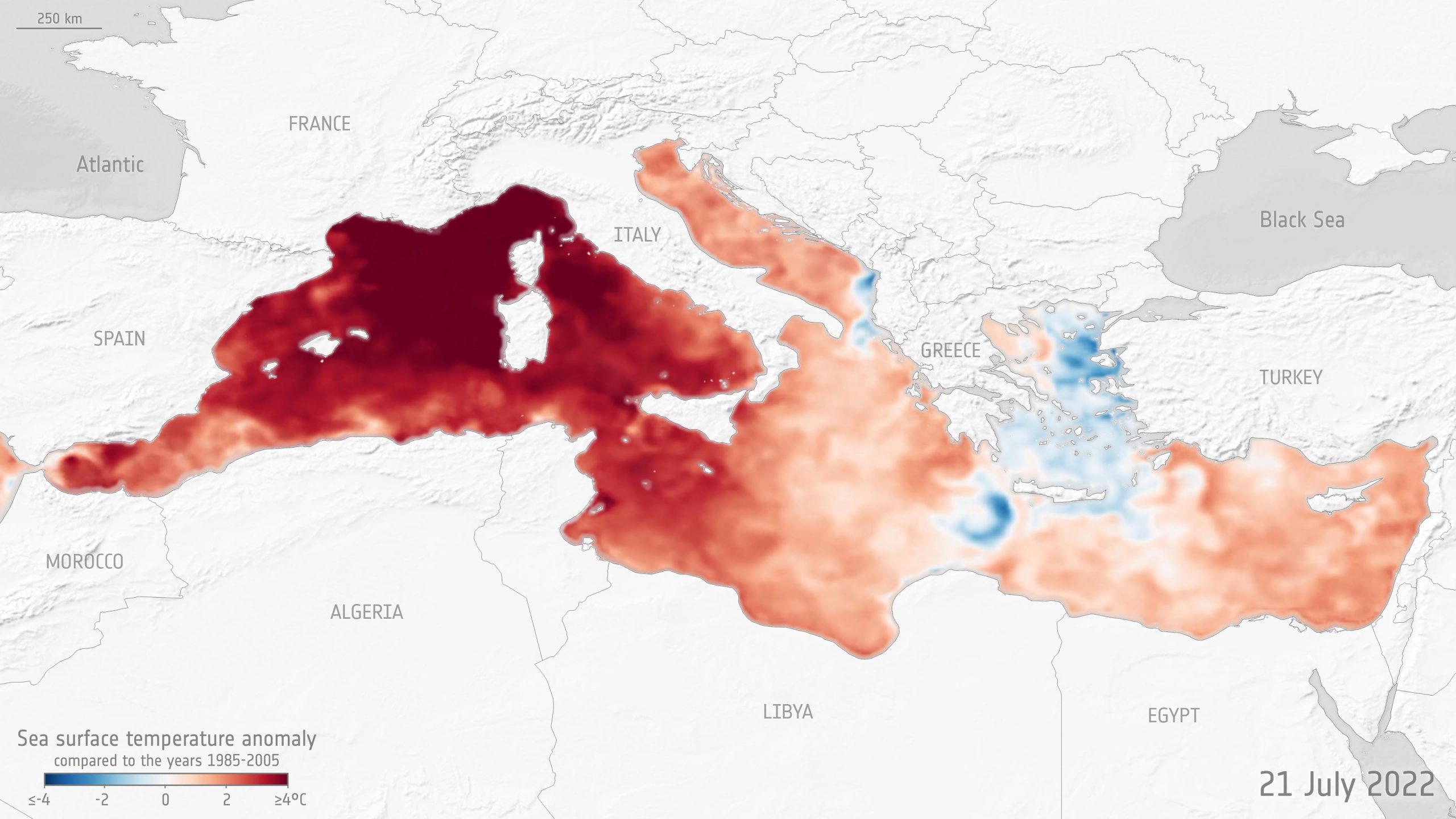
In the Ligurian Sea – an arm of the Mediterranean – the maximum intensity of the heatwave was reached on July 21, when the mean anomaly reached 5°C (9°F). As of September 13, the heatwave in the Mediterranean was still present.
“We are still observing an averaged sea surface temperature anomaly of around 2°C, which intensified in the northwest Mediterranean where the anomaly is higher than 4°C,” commented Rosalia Santoleri, CAREHeat Project Coordinator.
The team of scientists will continue to monitor the evolution of this heatwave with the aim to understand how the temperature signal propagates below the surface, what are the drivers of this long-lasting extreme event, and what impact it has on the Mediterranean marine ecosystem.
About CAREHeat
The CAREHeat consortium is led by the Institute of Marine Sciences of the Italian National Research Council (CNR-ISMAR). It includes the Italian National Agency for New Technologies, Energy and Sustainable Economic Development (ENEA), Collecte Localisation Satellites (CLS), the French Research Institute for Exploitation of the Sea (IFREMER), Mercator Ocean International (Moi), and +ATLANTIC CoLAB.
The team uses satellite observations, complemented with in situ measurements, biochemical ocean analyses, and modeling as well as machine learning techniques, to study and identify marine heatwaves and determine their effects on marine ecosystems. Projects like this demonstrate ESA’s responsibility to help European scientists understand our changing climate and the increasing frequency of extreme events.
Never miss a breakthrough: Join the SciTechDaily newsletter.
Follow us on Google and Google News.