
Close Menu
    Facebook X (Twitter) Instagram
    SciTechDaily
    • Biology
    • Chemistry
    • Earth
    • Health
    • Physics
    • Science
    • Space
    • Technology
    Facebook X (Twitter) Pinterest YouTube RSS
    SciTechDaily
    Home»Space»New ALMA Discovery Raises Questions About the Habitability of Proxima b
    Space

    New ALMA Discovery Raises Questions About the Habitability of Proxima b

    By Meredith MacGregor, Carnegie Institution for ScienceFebruary 26, 20182 Comments4 Mins Read
    Facebook Twitter Pinterest Telegram LinkedIn WhatsApp Email Reddit
    Share
    Facebook Twitter LinkedIn Pinterest Telegram Email Reddit
    ALMA Detects a Powerful Flare from Star Proxima Centauri
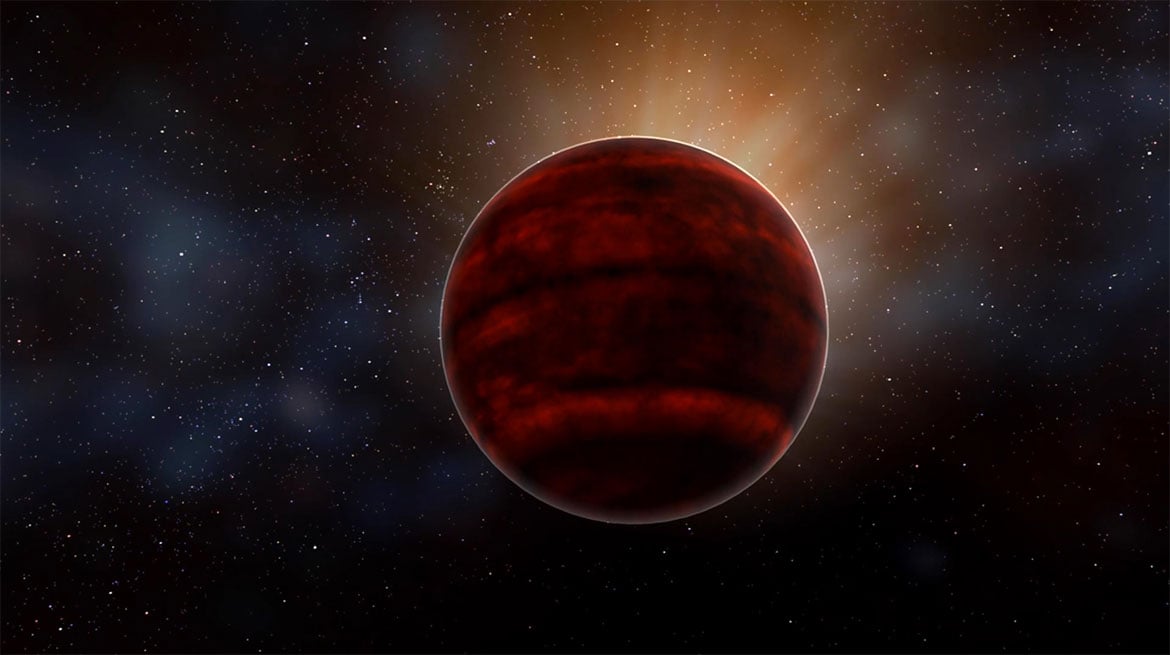
    Artist impression of a red dwarf star like Proxima Centauri, the nearest star to our sun. New analysis of ALMA observations reveal that Proxima Centauri emitted a powerful flare that would have created inhospitable conditions for planets in that system. Credit: NRAO/AUI/NSF; D. Berry

    Space weather emitted by Proxima Centauri, the star closest to our sun, may make that system rather inhospitable to life after all.

    Using data from the Atacama Large Millimeter/submillimeter Array (ALMA), a team of astronomers discovered that a powerful stellar flare erupted from Proxima Centauri last March. This finding, published in the Astrophysical Journal Letters, raises questions about the habitability of our solar system’s nearest exoplanetary neighbor, Proxima b, which orbits Proxima Centauri.

    At its peak, the newly recognized flare was 10 times brighter than our sun’s largest flares, when observed at similar wavelengths. Stellar flares have not been well studied at the millimeter and submillimeter wavelengths detected by ALMA, especially around stars of Proxima Centauri’s type, called M dwarfs, which are the most common in our galaxy.


    Artist animation of a red dwarf star similar to Proxima Centauri, the nearest star to our sun. New analysis of ALMA observations reveal that Proxima Centauri emitted a powerful flare that would have created inhospitable conditions for planets in that system. Credit: NRAO/AUI/NSF; D. Berry

    “March 24, 2017, was no ordinary day for Proxima Cen,” said Meredith MacGregor, an astronomer at the Carnegie Institution for Science, Department of Terrestrial Magnetism in Washington, D.C., who led the research with fellow Carnegie astronomer Alycia Weinberger. Along with colleagues from the Harvard-Smithsonian Center for Astrophysics, David Wilner and Adam Kowalski, and Steven Cranmer of the University of Colorado Boulder — they discovered the enormous flare when they reanalyzed ALMA observations taken last year.

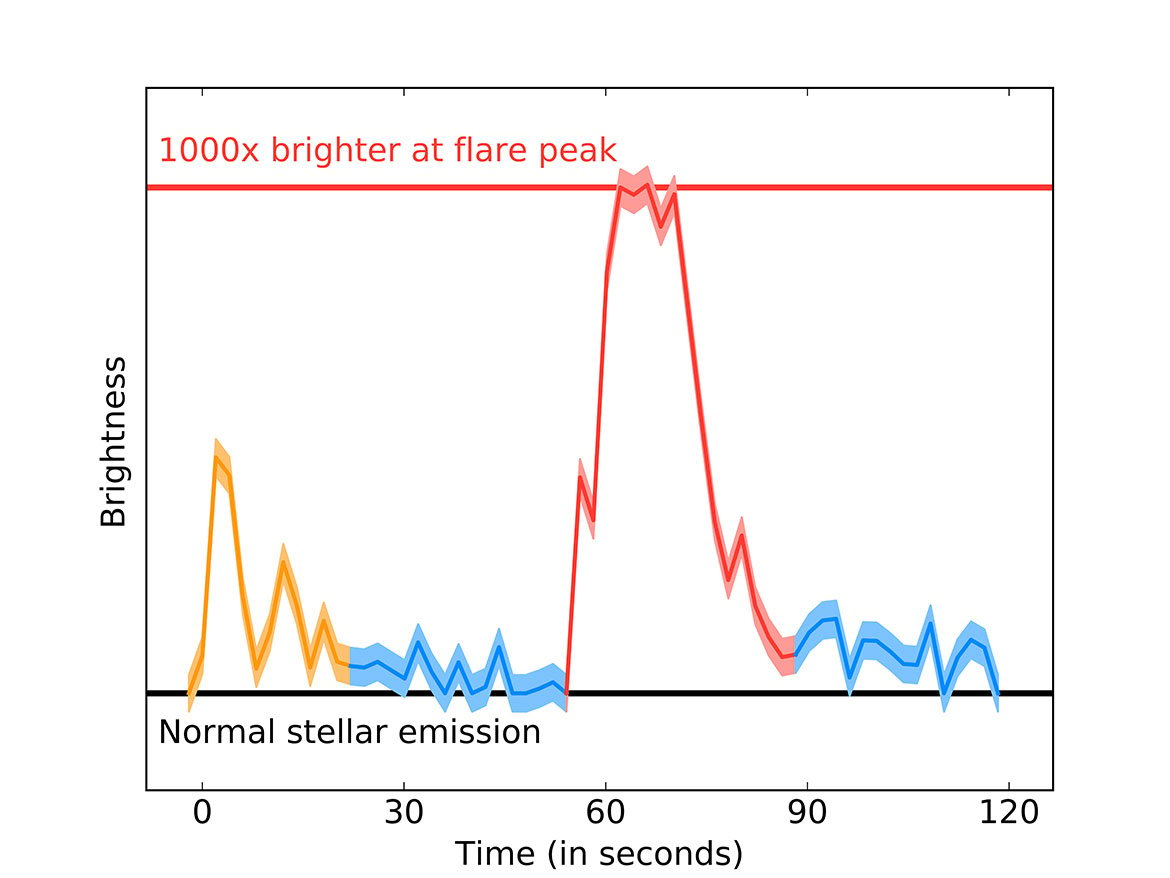
    The flare increased Proxima Centauri’s brightness by 1,000 times over 10 seconds. This was preceded by a smaller flare; taken together, the whole event lasted fewer than two minutes of the 10 hours that ALMA observed the star between January and March of last year.
    ALMA Detects Powerful Flare from Proxima Centauri
    The brightness of Proxima Centauri as observed by ALMA over the two minutes of the event on March 24, 2017. The massive stellar flare is shown in red, with the smaller earlier flare in orange, and the enhanced emission surrounding the flare that could mimic a disk in blue. At its peak, the flare increased Proxima Centauri’s brightness by 1,000 times. The shaded area represents uncertainty. Credit: Meredith MacGregor, Carnegie

    Stellar flares happen when a shift in the star’s magnetic field accelerates electrons to speeds approaching that of light. The accelerated electrons interact with the highly charged plasma that makes up most of the star, causing an eruption that produces emission across the entire electromagnetic spectrum.

    “It’s likely that Proxima b was blasted by high energy radiation during this flare,” MacGregor explained, adding that it was already known that Proxima Centauri experienced regular, although smaller, X-ray flares. “Over the billions of years since Proxima b formed, flares like this one could have evaporated any atmosphere or ocean and sterilized the surface, suggesting that habitability may involve more than just being the right distance from the host star to have liquid water.”
    ALMA Detects Massive Proxima Centauri Flare
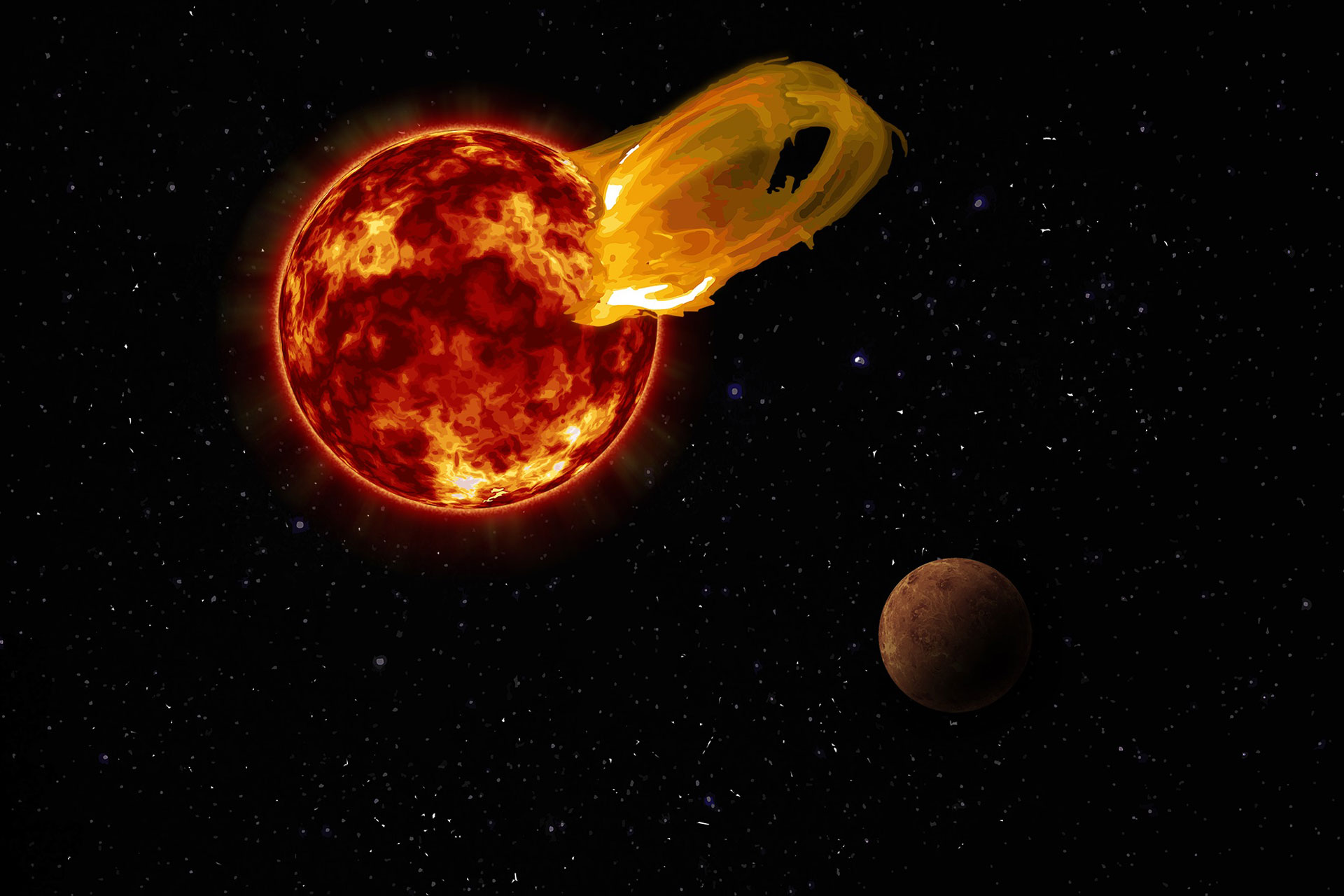
    An artist’s impression of a flare from Proxima Centauri, modeled after the loops of glowing hot gas seen in the largest solar flares. An artist’s impression of the exoplanet Proxima b is shown in the foreground. Proxima b orbits its star 20 times closer than the Earth orbits the Sun. A flare 10 times larger than a major solar flare would blast Proxima b with 4,000 times more radiation than the Earth gets from our Sun’s flares. Credit: Roberto Molar Candanosa / Carnegie Institution for Science, NASA/SDO, NASA/JPL

    An earlier paper that also used the same ALMA data interpreted its average brightness, which included the light output of both the star and the flare together, as being caused by multiple disks of dust encircling Proxima Centauri, not unlike our own solar system’s asteroid and Kuiper belts.

    But when MacGregor, Weinberger, and their team looked at the ALMA data as a function of observing time, instead of averaging it all together, they were able to see the transient explosion of radiation emitted from Proxima Centauri for what it truly was.

    “There is now no reason to think that there is a substantial amount of dust around Proxima Cen,” Weinberger said. “Nor is there any information yet that indicates the star has a rich planetary system like ours.”

    Reference: “Detection of a Millimeter Flare from Proxima Centauri” by Meredith A. MacGregor, Alycia J. Weinberger, David J. Wilner, Adam F. Kowalski and Steven R. Cranmer, 26 February 2018, Astrophysical Journal Letters.
    DOI: 10.3847/2041-8213/aaad6b

    Never miss a breakthrough: Join the SciTechDaily newsletter.
    Follow us on Google and Google News.

    Astronomy Carnegie Institution for Science Planetary Science
    Share. Facebook Twitter Pinterest LinkedIn Email Reddit

    Related Articles

    Scientists Uncover Strange New State of Matter Inside Uranus and Neptune

    JWST Reveals a “Forbidden” Planet With a Baffling Composition

    Webb Telescope Spots “Impossible” Atmosphere Around Ancient Super-Earth

    Distant Dwarf Planet Discovered Beyond the Known Edge of Our Solar System

    New Study Resolves a Decades-Old Paradox between Thermal History Models and Estimates of Mercury’s Contraction

    Recently Discovered Luhman 16AB System May Harbor Planet

    Newly Discovered Planetary Candidates are Nearly Skimming Their Host Star’s Surface

    How Jupiter and Saturn Formed and Evolved

    Diogenites Provide Clues of the Earliest Days of Our Solar System

    2 Comments

    1. dang. on February 26, 2018 3:50 pm

      Well, s#!t.

      Reply
    2. Edward Gazsi on April 13, 2019 11:16 am

      Oh, well, kiss our “neighbors” good bye. They’re all laying on the ground covered in blisters. Now we don’t have to send people there on a thirty thousand year journey to see if things are inhabitable. My dear Stephen Hawking, it looks like we are going to have to search elsewhere to find our next home.

      Reply
    Leave A Reply Cancel Reply

    • Facebook
    • Twitter
    • Pinterest
    • YouTube

    Don't Miss a Discovery

    Subscribe for the Latest in Science & Tech!

    Trending News

    First-of-Its-Kind Discovery: Homer’s Iliad Found Embedded in a 1,600-Year-Old Egyptian Mummy

    Beyond Inflammation: Scientists Uncover New Cause of Persistent Rheumatoid Arthritis

    A Simple Molecule Could Unlock Safer, Easier Weight Loss

    Scientists Just Built a Quantum Battery That Charges Almost Instantly

    Researchers Unveil Groundbreaking Sustainable Solution to Vitamin B12 Deficiency

    Millions of People Have Osteopenia Without Realizing It – Here’s What You Need To Know

    Researchers Discover Boosting a Single Protein Helps the Brain Fight Alzheimer’s

    World-First Study Reveals Human Hearts Can Regenerate After a Heart Attack

    Follow SciTechDaily
    • Facebook
    • Twitter
    • YouTube
    • Pinterest
    • Newsletter
    • RSS
    SciTech News
    • Biology News
    • Chemistry News
    • Earth News
    • Health News
    • Physics News
    • Science News
    • Space News
    • Technology News
    Recent Posts
    • Scientists Discover New Way To Make Drug-Resistant Cancer Treatable Again
    • This Simple Exercise Trick Builds Muscle With Less Effort, Study Finds
    • Middle Age Is Becoming a Breaking Point in America, Study Reveals
    • Scientists Discover How Coffee Impacts Memory, Mood, and Gut Health
    • How Cells Copy DNA Might Matter More Than We Ever Realized
    Copyright © 1998 - 2026 SciTechDaily. All Rights Reserved.
    • Science News
    • About
    • Contact
    • Editorial Board
    • Privacy Policy
    • Terms of Use

    Type above and press Enter to search. Press Esc to cancel.