
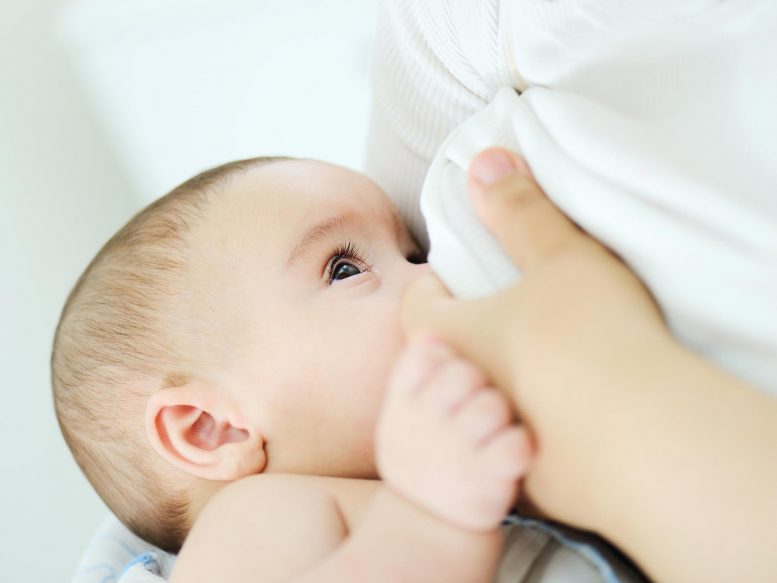
The findings are another piece of evidence suggesting that the breast milk of those vaccinated against COVID-19 may help protect babies from the illness.
A new study from the University of Florida provides more evidence that the breast milk of people vaccinated against COVID-19 provides protection to infants too young to receive the vaccine.
This latest study follows up on findings published in 2021 showing that the breast milk of vaccinated people contained antibodies against SARS-CoV-2, the virus that causes COVID-19. The new study, published today (January 12) in the Journal of Perinatology, analyzed the stool of infants that consumed this breast milk and found SARS-CoV-2 antibodies there as well.
“Our first study showed there were SARS-CoV-2 antibodies in the breast milk, but we couldn’t say if those antibodies were getting through the babies’ gastrointestinal tract and possibly providing protection there,” said Joseph Larkin III, senior author of the study and an associate professor in the UF/IFAS department of microbiology and cell science.
Using a technique called a neutralization assay, the researchers showed that the antibodies found in the infants’ stool offered protection against the virus. The assay begins by isolating antibodies from the stool and adding them to a special line of cells that have the kind of receptors the SARS-CoV-2 virus uses to enter the cell. The researchers then introduce a SARS-CoV-2 pseudovirus, which acts like the virus that causes COVID-19 but is safer to use in the lab. The pseudovirus is fluorescent, so when it binds to a cell, the cell lights up.
“We saw that when the antibodies were present, there were fewer fluorescent cells compared to our controls where no antibodies were present,” said Lauren Stafford, one of the study’s first authors and a UF/IFAS College of Agricultural and Life Sciences doctoral student in Larkin’s lab.
“The antibodies run interference and don’t let the virus get to the cells,” Larkin added.
Antibody Protection in the Gut
While the virus that causes COVID-19 is often thought of as mainly affecting the lungs, it can also invade the gut, which is why finding antibodies there is significant, the researchers said.
“The antibodies ingested through breast milk may provide a protective coating in the infants’ mouths and gastrointestinal tract,” said Dr. Vivian Valcarce Luaces, the study’s other first author and a postdoctoral fellowship trainee in neonatology.
The study also measured and tested antibodies found in the mothers’ blood plasma and breast milk soon after vaccination and then again about six months later. The researchers found that the antibodies in the plasma and milk of vaccinated people were better able to neutralize the virus, though they also observed that antibody levels decreased at the six-month mark, which other vaccine studies have found as well.
Dr. Josef Neu, one of the study’s co-authors and a professor in the UF College of Medicine department of pediatrics, division of neonatology, said the first and second studies together give a more complete picture of how vaccinating against COVID-19 during pregnancy and breastfeeding may be protective for parent and child.
The Protective Potential for Mothers and Infants
“In our research, we’re following the journey of the antibodies, from the time they are produced in mom after vaccination and now through the baby’s digestive system. The next question is whether those babies are less likely to get COVID-19,” Dr. Neu said.
The researchers say larger studies are needed to answer that question, as this latest study included 37 mothers and 25 infants, a relatively small number of participants.
However, this study adds to a growing body of research revealing how vaccination against COVID-19 during pregnancy and breastfeeding may protect newborns, the researchers say. Currently children under sixth months of age cannot receive the vaccine, so breast milk may be the only avenue for providing immunity.
Reference: “Detection of SARS-CoV-2 IgA and IgG in human milk and breastfeeding infant stool 6 months after maternal COVID-19 vaccination” by Lauren Stewart Stafford, Vivian Valcarce, Matthew Henry, Josef Neu, Leslie Parker, Martina Mueller, Valeria Vicuna, Taylor Gowen, Emilee Cato, Ivan Kosik, Jonathan Wilson Yewdell, Mark Atkinson, Nicole Cacho, Nan Li and Joseph Larkin III, 12 January 2023, Journal of Perinatology.
DOI: 10.1038/s41372-022-01581-5
The study was funded by grants from the Children’s Miracle Network and The Gerber Foundation.
The Centers for Disease Control and Prevention recommends COVID-19 vaccination for people who are pregnant, breastfeeding, trying to get pregnant or who may become pregnant in the future. According to the CDC, as of late November 2022, just over 70% of pregnant people in the United States had completed the primary series of COVID-19 vaccines, though only 14% had received the bivalent booster.
Never miss a breakthrough: Join the SciTechDaily newsletter.
Follow us on Google and Google News.
2 Comments
Could it also spread the attenuated adenovirus to the baby? That dreadful hepatitis on children was likely caused, indeed, by an adenovirus.
I have no doubts it helps the babies BE AT HIGHER RISK FOR BLOD CLOTS, HEART ATTACK, and “Sudden Death”!!!!!!