
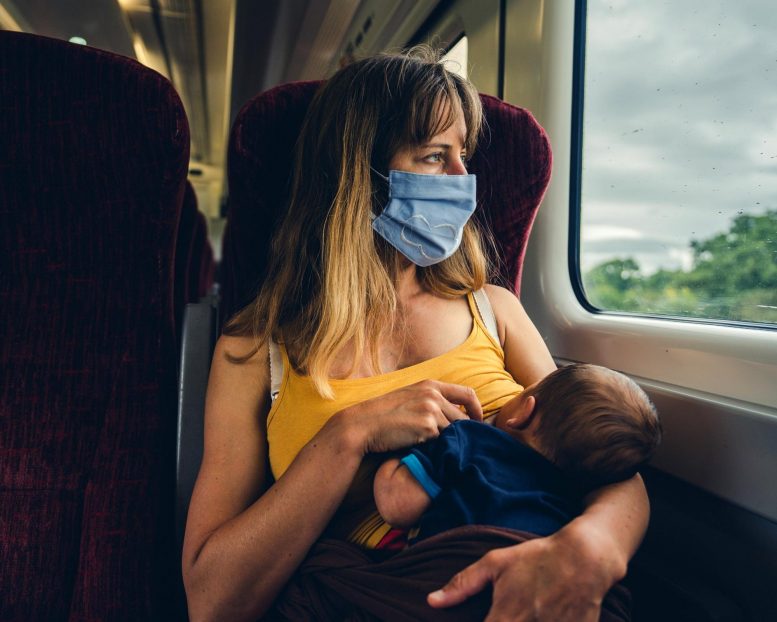
Major Boost in COVID-19 Antibodies Seen in Breast Milk After Vaccination
New research from Washington University School of Medicine in St. Louis suggests that nursing mothers who receive a COVID-19 vaccine may also protect their babies from the virus. The researchers found a major boost in antibodies against the COVID-19 virus in breast milk starting two weeks after vaccination, and this response was sustained for the course of the study, which was almost three months long.
Nursing mothers who receive a COVID-19 vaccine may pass protective antibodies to their babies through breast milk for at least 80 days following vaccination, suggests new research from Washington University School of Medicine in St. Louis.
“Our study showed a huge boost in antibodies against the COVID-19 virus in breast milk starting two weeks after the first shot, and this response was sustained for the course of our study, which was almost three months long,” said first author Jeannie Kelly, MD, assistant professor of obstetrics and gynecology. “The antibody levels were still high at the end of our study, so the protection likely extends even longer.”
Based on the small study, involving five mothers who provided frozen breast milk samples after receiving the two-dose Pfizer-BioNTech coronavirus vaccine, the research provides some of the first peer-reviewed evidence that breastfeeding confers a long-lasting immune response in the nursing infants and toddlers of vaccinated mothers.
Combating Misinformation with Science
“There is so much vaccine misinformation out there right now – really scary, misleading posts on social media that are designed to scare moms – so we felt like we needed to look at the science,” Kelly said. “We know that these types of antibodies coat babies mouths and throats and protect against disease when a baby is drinking breast milk. So, getting vaccinated while breastfeeding not only protects mom, but also could protect the baby, too, and for months.”
Published March 30 in the American Journal of Obstetrics and Gynecology, the study tracked levels of COVID-19 antibodies in breast milk from a baseline before the mothers’ first vaccinations and on a weekly basis for 80 days after those initial vaccinations.
While other recent research has shown that COVID-19 vaccines generate antibodies that are passed to nursing infants through breast milk, this is thought to be the first study to track specific levels of these antibodies in breast milk over an extended time period.
The babies of women included in the study ranged in age from one month to 24 months old. To gauge the immune response in breast milk, researchers monitored levels of the immunoglobulins IgA and IgG, which are antibodies deployed by the immune system to fight infections in babies.
Elevated IgA and IgG Antibody Levels
Findings confirm that breast milk contains elevated levels of the IgA and IgG antibodies immediately following the first dose of vaccination, with both antibodies reaching immune-significant levels within 14 to 20 days of first vaccination in all participants.
“Our study is limited by a small number of participants, but the findings provide encouraging news about the potential immune benefit to breast-feeding infants after vaccination,” said study senior author Misty Good, MD, an assistant professor of pediatrics, also at Washington University. “Our paper is the first that has shown COVID-19 antibodies persist in breast milk for months following the mother’s vaccination.”
The Washington University findings are similar to prior studies on maternal vaccination, which have shown high levels of antibodies in breast milk for up to six months following vaccination for influenza and whooping cough.
While further studies of maternal COVID-19 vaccination are needed to characterize the length of antibody production in breast milk and the effect on infant infection rates, recent research continues to confirm that the COVID-19 vaccine offers real benefits for protecting both mother and child.
“We do know that COVID-19 infection is more severe during pregnancy and the main benefit of vaccination is to provide protection for moms before they become really sick, which can also be dangerous to their fetus,” Kelly said. “There have now been almost 70,000 pregnant people vaccinated against COVID-19 with no evidence of harm.”
“We’re now seeing a cascade of new data that indicate maternal vaccines are also going to help protect babies — both through transfer of antibodies through the placenta during pregnancy and through the breast milk during lactation,” Kelly said. “This is information we didn’t have a few months ago and it’s really helping us better counsel our patients who are considering getting the vaccine. I’m telling my pregnant and breastfeeding moms that I strongly recommend that they get vaccinated as soon as possible.”
Reference: “Anti-SARS-CoV-2 antibodies induced in breast milk after Pfizer-BioNTech/BNT162b2 vaccination: SARS-CoV-2 antibodies in breast milk after vaccination” by Jeannie C. Kelly, MD, MS; Ebony B. Carter, MD, MPH; Nandini Raghuraman, MD, MS; Lila S. Nolan, MD; Qingqing Gong, PhD; Angela N. Lewis, MD and Misty Good, MD, MS, 30 March 2021, American Journal of Obstetrics and Gynecology.
DOI: 10.1016/j.ajog.2021.03.031
This research is supported, in part, by the Washington University Institute of Clinical and Translational Sciences which is, in part, supported by the NIH/National Center for Advancing Translational Sciences (NCATS) grant number UL1TR002345; the Foundation for Barnes-Jewish Hospital; The PEW Charitable Trusts Community Opioid Response and Evaluation (CORE); the National Institutes of Health (NIH) grant numbers 5T32HD043010 and R01DK118568; an American Academy of Pediatrics Marshall Klaus Award; the St. Louis Children’s Hospital Foundation; the Children’s Discovery Institute of Washington University and St. Louis Children’s Hospital; and the Department of Pediatrics at Washington University School of Medicine.
Never miss a breakthrough: Join the SciTechDaily newsletter.
Follow us on Google and Google News.
1 Comment
Alternative title: COVID-19 Vaccinations of Breastfeeding Moms has Unknown Side Effects in Babies – Major Concern over Antibodies
It’s not studied or tested, it’s not safe. How in the world no one seems to be concerned?