
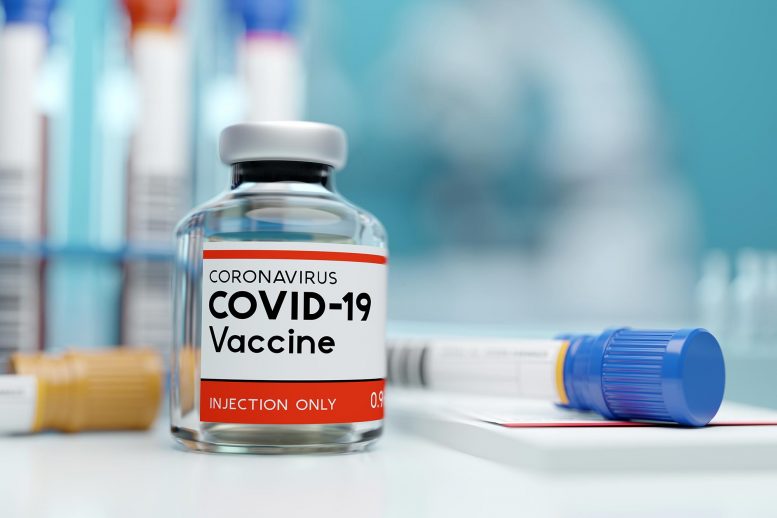
Vaccine prevents pneumonia, elicits high levels of protective antibodies in mice.
An experimental vaccine is effective at preventing pneumonia in mice infected with the COVID-19 virus, according to a study from Washington University School of Medicine in St. Louis. The vaccine, which is made from a mild virus genetically modified to carry a key gene from the COVID-19 virus, is described in the journal Cell Host and Microbe.
“Unlike many of the other vaccines under development, this vaccine is made from a virus that is capable of spreading in a limited fashion inside the human body, which means it is likely to generate a strong immune response,” said co-senior author Michael S. Diamond, MD, PhD, the Herbert S. Gasser Professor of Medicine and a professor of molecular microbiology, and of pathology and immunology. “Since the virus is capable of replicating, it can be grown to high levels in the lab, so it’s easy to scale up and should be more cost-effective than some of the other vaccine candidates. So while what we have shown is just the proof of concept, I think it’s very promising. Our vaccine candidate is now being tested in additional animal models with the goal of getting it into clinical trials as soon as possible.”
Diamond and colleagues – including co-senior author Sean Whelan, PhD, the Marvin A. Brennecke Distinguished Professor and head of the Department of Molecular Microbiology; and co-first authors Brett Case, PhD, a postdoctoral researcher in Diamond’s laboratory, and Paul W. Rothlauf, a graduate student in Whelan’s laboratory – created the experimental vaccine by genetically modifying vesicular stomatitis virus (VSV), a virus of livestock that causes only a mild, short-lived illness in people. They swapped out one gene from VSV for the gene for spike from SARS-CoV-2, the virus that causes COVID-19. The hybrid virus is called VSV-SARS-CoV-2.
Spike protein is thought to be one of the keys to immunity against COVID-19. The COVID-19 virus uses spike to latch onto and infect human cells, and the human body defends itself by generating protective antibodies targeting spike. By adding the gene for spike to a fairly harmless virus, the researchers created a hybrid virus that, when given to people, ideally would elicit antibodies against spike that protect against later infection with the COVID-19 virus.
The same strategy was used to design the Ebola vaccine that was approved by the U.S. Food and Drug Administration in 2019. That vaccine – which is made from VSV genetically modified with a gene from Ebola virus – has been safely administered to thousands of people in Africa, Europe and North America, and helped end the 2018 to 2020 Ebola outbreak in the Democratic Republic of the Congo.
As part of this study, the researchers injected mice with VSV-SARS-CoV-2 or a lab strain of VSV for comparison. A subgroup was boosted with a second dose of the experimental vaccine four weeks after the initial injections. Three weeks after each injection, the researchers drew blood from the mice to test for antibodies capable of preventing SARS-CoV-2 from infecting cells. They found high levels of such neutralizing antibodies after one dose, and the levels increased 90-fold after a second dose.
Then, the researchers challenged the mice five weeks after their last dose by spraying the COVID-19 virus into their noses. The vaccine completely protected against pneumonia. At four days post infection, there was no infectious virus detectable in the lungs of mice that had been given either one or two doses of the vaccine. In contrast, mice that had received the placebo had high levels of virus in their lungs. In addition, the lungs of vaccinated mice showed fewer signs of inflammation and damage than those of mice that had received the placebo.
The experimental vaccine is still in the early stages of development.
Mice do not naturally become infected with the COVID-19 virus, so to assess whether the vaccine elicited a protective immune response in them, the researchers used genetically modified mice or, in unmodified mice, employed a complicated technique to induce susceptibility to infection. The researchers are in the process of repeating the experiments in other animal models that are naturally susceptible to the COVID-19 virus. If the vaccine also protects those animals from COVID-19, the next step would be to scale up production under what the Food and Drug Administration refers to as “good manufacturing practice (GMP) conditions” and launch a clinical trial in people.
While the data are promising, this vaccine is still months behind in the race to develop a pandemic-ending vaccine. Six vaccines are in the final stage of testing in people, and Anthony Fauci, MD, director of the U.S. National Institute of Allergy and Infectious Diseases, has said he expects a vaccine to be ready for mass distribution early next year.
“It’s really going to depend on how successful the first vaccines that come out for COVID are,” Whelan said. “If they don’t produce a robust, durable immune response or there are safety issues, there might be the opportunity for a second-generation vaccine that could induce sterilizing immunity and interrupt the cycle of transmission.”
Reference: “Replication-competent vesicular stomatitis virus vaccine vector protects against SARS-CoV-2-mediated pathogenesis in mice” by James Brett Case, Paul W. Rothlauf, Rita E. Chen, Natasha M. Kafai, Julie M. Fox, Brittany Smith, Swathi Shrihari, Broc T. McCune, Ian B. Harvey, Shamus P. Keeler, Louis-Marie Bloyet, Haiyan Zhao, Meisheng Ma, Lucas J.Adams, Emma S. Winkler, Michael J. Holtzman, Daved H. Fremont, Sean P. J. Whelan and Michael S. Diamond, 30 July 2020, Cell Host and Microbe.
DOI: 10.1016/j.chom.2020.07.018
Case JB, Rothlauf PW, Chen RE, Kafai NM, Fox JM, Smith B, Shrihari S, McCune BT, Harvey IB, Keeler SP, Bloyet L-M, Zhao H, Ma M, Adams LJ, Winkler ES, Holtzman MJ, Fremont DH, Whelan SPJ, Diamond MS. Replication-competent vesicular stomatitis virus vaccine vector protects against SARS-CoV-2-mediated pathogenesis in mice. . July 30, 2020. DOI: 10.1016/j.chom.2020.07.018
This study was supported by the National Institutes of Health (NIH), contract numbers HHSN272201700060C and 75N93019C00062 and grant numbers R01AI127828, R37AI059371, U01AI151810, R01 AI130591 and R35 HL145242; the Defense Advanced Research Project Agency, grant number HR001117S0019; gifts to Washington University; and the Helen Hay Whitney Foundation.
Never miss a breakthrough: Join the SciTechDaily newsletter.
Follow us on Google and Google News.