
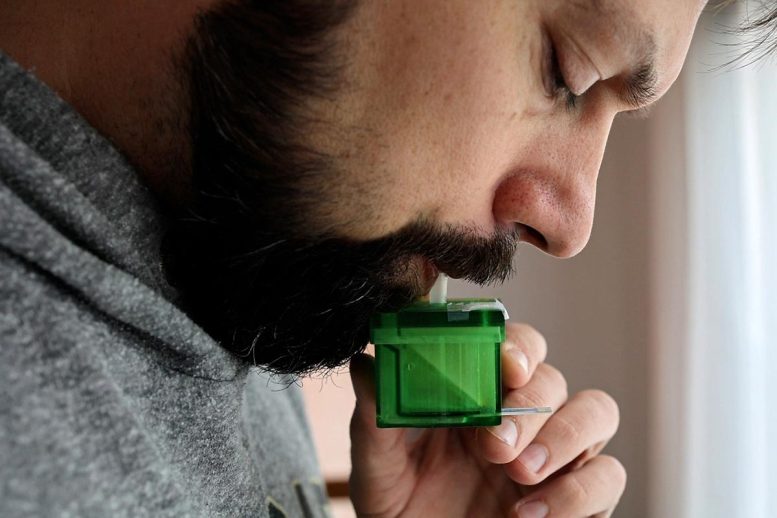
A fast-acting breath test for COVID-19, using a llama-derived nanobody, produces results in less than a minute.
Scientists at Washington University in St. Louis have developed a breath test that quickly identifies those who are infected with the virus that causes COVID-19. The device requires only one or two breaths and provides results in less than a minute.
The study is available online in the journal ACS Sensors. The same group of researchers recently published a paper in the journal Nature Communications about an air monitor they had built to detect airborne SARS-CoV-2 — the virus that causes COVID-19 — within about five minutes in hospitals, schools and other public places.
Breath Test Applications
The new study is about a breath test that could become a tool for use in doctors’ offices to quickly diagnose people infected with the virus. If and when new strains of COVID-19 or other airborne pathogenic diseases arise, such devices also could be used to screen people at public events. The researchers said the breath test also has the potential to help prevent outbreaks in situations where many people live or interact in close quarters — for example aboard ships, in nursing homes, in residence halls at colleges and universities, or on military bases.
“With this test, there are no nasal swabs and no waiting 15 minutes for results, as with home tests,” said co-corresponding author Rajan K. Chakrabarty, PhD, the Harold D. Jolley Career Development Associate Professor of Energy, Environment & Chemical Engineering at the McKelvey School of Engineering. “A person simply blows into a tube in the device, and an electrochemical biosensor detects whether the virus is there. Results are available in about a minute.”
Technology Behind the Test
The biosensor used in the device was adapted from an Alzheimer’s disease-related technology developed by scientists at Washington University School of Medicine in St. Louis to detect amyloid beta and other Alzheimer’s disease-related proteins in the brains of mice. The School of Medicine’s John R. Cirrito, PhD, a professor of neurology, and Carla M. Yuede, PhD, an associate professor of psychiatry — both also co-corresponding authors on the study — used a nanobody, an antibody from llamas, to detect the virus that causes COVID-19.
Chakrabarty and Cirrito said the breath test could be modified to simultaneously detect other viruses, including influenza and respiratory syncytial virus (RSV). They also believe they can develop a biodetector for any newly emerging pathogen within two weeks of receiving samples of it.
“It’s a bit like a breathalyzer test that an impaired driver might be given,” Cirrito said. “And, for example, if people are in line to enter a hospital, a sports arena or the White House Situation Room, 15-minute nasal swab tests aren’t practical, and PCR tests take even longer. Plus, home tests are about 60% to 70% accurate, and they produce a lot of false negatives. This device will have diagnostic accuracy.”
Development Journey
The researchers began working on the breath test device — made with 3D printers — after receiving a grant from the National Institutes of Health (NIH) in August 2020, during the first year of the pandemic. Since receiving the grant, they’ve tested prototypes in the laboratory and in the Washington University Infectious Diseases Clinical Research Unit. The team continues to test the device, to further improve its efficacy at detecting the virus in people.
For the study, the research team tested COVID-positive individuals, each of whom exhaled into the device two, four, or eight times. The breath test produced no false negatives and gave accurate reads after two breaths from each person tested. The clinical study is ongoing to test COVID-positive and -negative individuals to further test and optimize the device.
Strain Detection and Operation
The researchers also found that the breath test successfully detected several different strains of SARS-CoV-2, including the original strain and the omicron variant, and their clinical studies are measuring active strains in the St. Louis area.
To conduct the breath test, the researchers insert a straw into the device. A patient blows into the straw, and then aerosols from the person’s breath collect on a biosensor inside the device. The device then is plugged into a small machine that reads signals from the biosensor, and in less than a minute, the machine reveals a positive or negative finding of COVID-19.
Future Prospects
Clinical studies are continuing, and the researchers soon plan to employ the device in clinics beyond Washington University’s Infectious Diseases Clinical Research Unit. In addition, Y2X Life Sciences, a New York-based company, has an exclusive option to license the technology. That company has consulted with the research team from the beginning of the project and during the device’s design stages to facilitate possible commercialization of the test in the future.
Reference: “Rapid Direct Detection of SARS-CoV-2 Aerosols in Exhaled Breath at the Point of Care” by Dishit P. Ghumra, Nishit Shetty, Kevin R. McBrearty, Joseph V. Puthussery, Benjamin J. Sumlin, Woodrow D. Gardiner, Brookelyn M. Doherty, Jordan P. Magrecki, David L. Brody, Thomas J. Esparza, Jane A. O’Halloran, Rachel M. Presti, Traci L. Bricker, Adrianus C. M. Boon, Carla M. Yuede, John R. Cirrito and Rajan K. Chakrabarty, 27 July 2023, ACS Sensors.
DOI: 10.1021/acssensors.3c00512
The study was funded by the National Institutes of Health (NIH) RADx-Rad program. Grant numbers U01 AA029331 and U01 AA029331-S1. Additional funding from the National Institute of Neurological Disorders and Stroke Intramural Research Program, the Uniformed Services University of Health Sciences, and the NIH SARS-CoV-2 Assessment of Viral Evolution (SAVE) Program.
Never miss a breakthrough: Join the SciTechDaily newsletter.
Follow us on Google and Google News.