
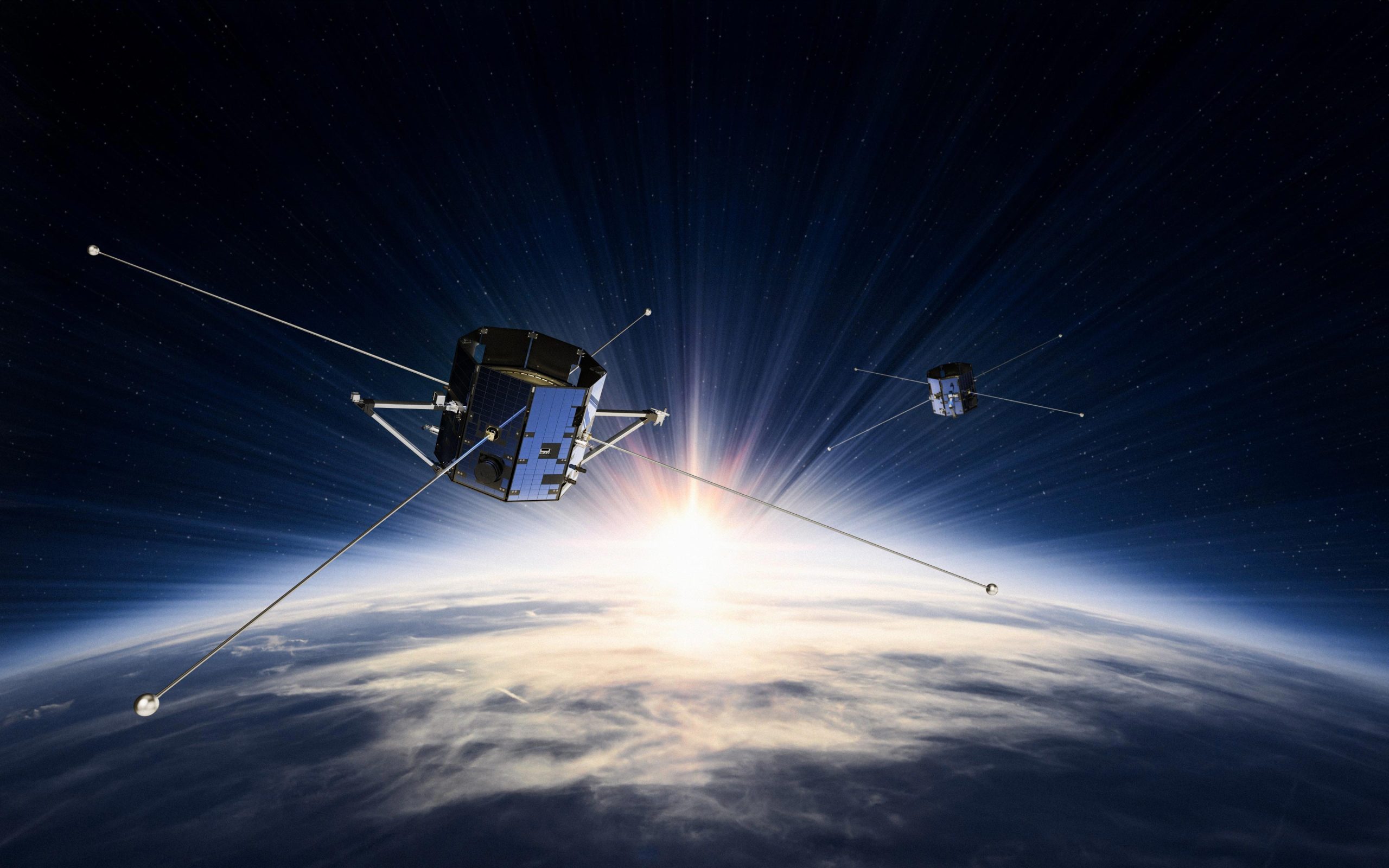
NASA’s upcoming TRACERS mission involves two satellites designed to study the interaction between solar wind and Earth’s magnetosphere through the lens of magnetic reconnection.
This phenomenon is crucial for understanding space weather, which affects modern technology and communication systems. The satellites, completed by Millennium Space Systems, will soon undergo testing before their 2025 launch, marking significant progress in our quest to safeguard technology from space weather impacts.
TRACERS Mission
NASA recently completed the twin spacecraft for its TRACERS mission, officially known as the Tandem Reconnection and Cusp Electrodynamics Reconnaissance Satellites, set to launch in 2025.
TRACERS consists of two satellites designed to study the interaction between the solar wind—a continuous stream of ionized particles emitted by the Sun—and Earth’s magnetosphere, the magnetic field that surrounds and protects our planet. This mission will explore how the Sun influences Earth’s environment, shedding light on the causes of space weather, which can affect technology and communications on Earth.

Exploring Magnetic Reconnection
One primary focus of TRACERS is the phenomenon of magnetic reconnection, a powerful release of energy that occurs when two magnetic fields intersect.
Magnetic reconnection happens throughout space but is of special relevance to us where the solar wind first meets Earth’s magnetosphere, a region known as the magnetopause. A reconnection event can shoot solar wind particles, normally diverted around our planet, directly into our atmosphere at high speeds. These particles ignite the beautiful northern and southern lights, known as aurora, and help drive space weather on Earth. Understanding space weather patterns is paramount in our increasingly technologically driven society, as space weather events can affect our power grids and communications satellites, and create potentially hazardous conditions for astronauts.
Satellite Configuration and Mission Strategy
To study magnetic reconnection at Earth’s magnetopause, TRACERS’ twin satellites will fly in tandem — one behind the other — through the polar cusps, funnel-shaped regions where Earth’s magnetic field opens over the north and south poles. This will allow scientists to observe how quickly reconnection changes and evolves by comparing data collected by each satellite.
Millennium Space Systems, a Boeing company, finished building the two satellites for the TRACERS mission in October 2024. The team is completing the integration of the TRACERS instruments, and the two satellites will enter the testing phase. Once testing is completed, the spacecraft will be shipped to Vandenberg Space Force Base in California for integration with the launch vehicle.
Progress and Preparations for Launch
“It’s exciting to see the TRACERS instruments and the two spacecraft come together. The team is making excellent progress toward launch,” said David Miles, TRACERS principal investigator at the University of Iowa in Iowa City.
In addition, the mission successfully passed a critical review, called Key Decision Point D, on August 8, 2024, preparing TRACERS to achieve a target launch readiness date no earlier than April 2025. With the successful review, TRACERS moved into Phase D, the official transition from the mission’s development stage to the delivery of the spacecraft, testing, assembly, and integration into the launch vehicle in preparation for launch.
Team Collaboration and Achievement
“This team has been truly incredible,” says Skyler Kleinschmidt, TRACERS program executive at NASA Headquarters in Washington. “Building a spacecraft is never easy, but seeing the team work together through all of the challenges that they have encountered is inspiring.
The TRACERS mission is led by David Miles at the University of Iowa and managed by the Southwest Research Institute in San Antonio. NASA’s Heliophysics Explorers Program Office at the agency’s Goddard Space Flight Center in Greenbelt, Maryland, provides mission oversight to the project for the agency’s Heliophysics Division at NASA Headquarters in Washington.
Never miss a breakthrough: Join the SciTechDaily newsletter.
Follow us on Google and Google News.