
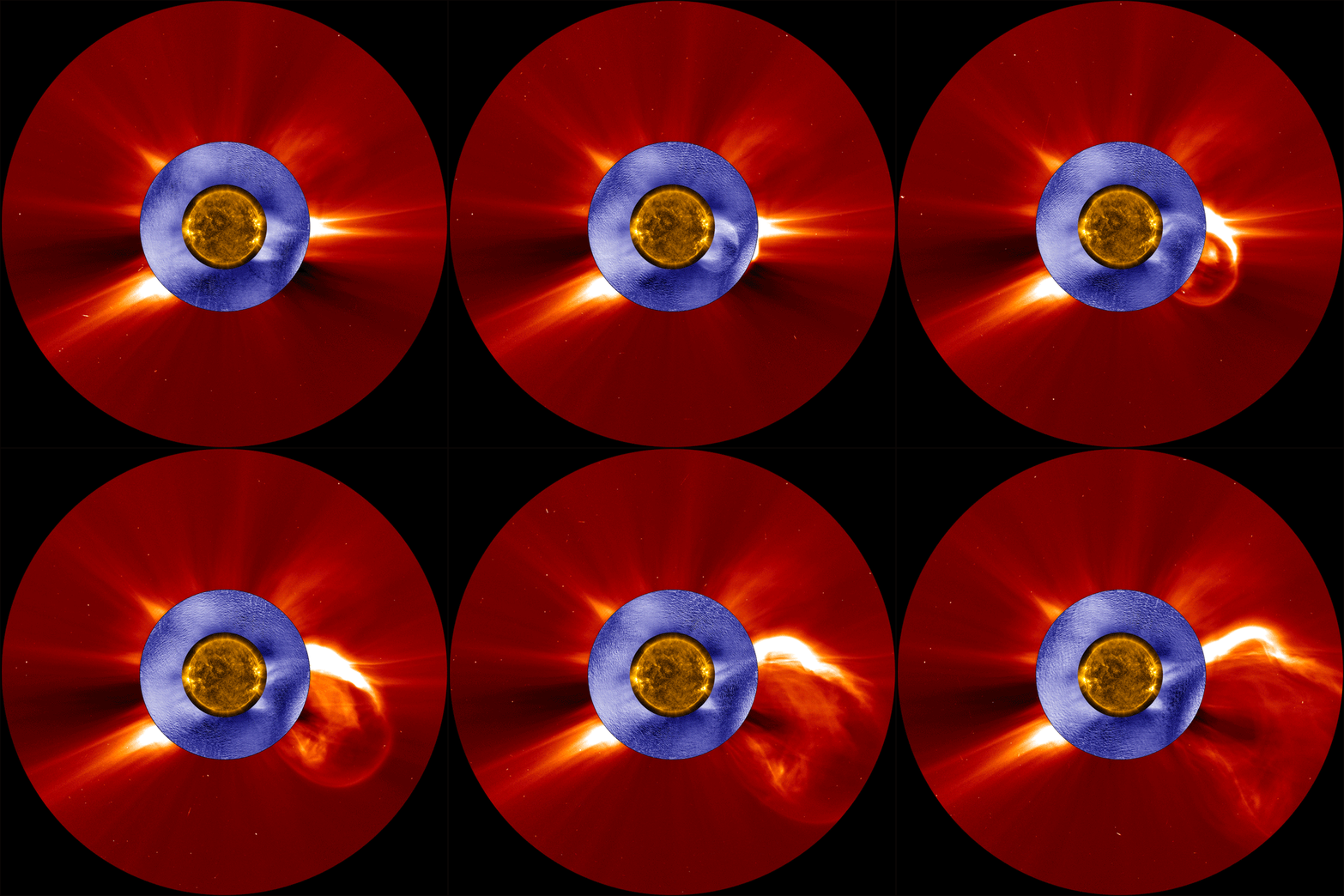
Scientists from NASA and the National Center for Atmospheric Research have shown that data from a ground-based instrument called K-Cor can give scientists early warning of a certain type of incoming space weather that can impact astronauts.
Our constantly-changing sun sometimes erupts with bursts of light, solar material, or ultra-fast energized particles — collectively, these events contribute to space weather. In a study published in the journal Space Weather, scientists from NASA and the National Center for Atmospheric Research, or NCAR, in Boulder, Colorado, have shown that the warning signs of one type of space weather event can be detected tens of minutes earlier than with current forecasting techniques – critical extra time that could help protect astronauts in space.
Earth’s magnetic field and atmosphere protect us on the ground from most of the harmful effects of space weather, but astronauts in low-Earth orbit — or even, one day, in interplanetary space — are more exposed to space weather, including bursts of fast-moving particles called solar energetic particles, or SEPs.
“Robotic spacecraft are usually radiation-hardened to protect against these kinds of events,” said Chris St. Cyr, a space scientist at NASA’s Goddard Space Flight Center in Greenbelt, Maryland, and lead author on the study. “But humans are still susceptible.”
So NASA wants to help improve systems that would provide future astronauts with advance warning of incoming SEPs. In the recent paper, scientists showed that tracking an associated kind of solar explosion — fast-moving clouds of magnetic solar material, called coronal mass ejections — can help.
Scientists observe coronal mass ejections using a type of instrument called a coronagraph, in which a solid disk blocks the sun’s bright face, revealing the sun’s tenuous atmosphere, called the corona. Space-based coronagraphs are more widely used in space weather research because of their wide-field solar views that are not interrupted by cloud cover or Earth’s rotation. But ground-based coronagraphs have their own advantages — while they can only observe the sun in the day during clear weather, they can return data almost instantly, and at a much higher time resolution than satellite instruments. This speed of data return could make a significant difference, given that SEPs can move at nearly the speed of light — so their total travel time can be less than an hour from the time they’re accelerated near the sun to when they reach Earth.
“With space-based coronagraphs, we get images back every 20-30 minutes,” said St. Cyr. “You’ll see the CME in one frame, and by the time you get the next frame — which contains the information we need to tell how fast it’s moving — the energetic particles have already arrived.”
For this study, scientists worked backward to see whether they could use a ground-based coronagraph to get that key information on the CME’s speed fast enough to lengthen the warning time. They selected a SEP event and then went back to check if the data was available from a coronagraph called K-Cor, which is part of NCAR’s High Altitude Observatory and sits on top of the Mauna Loa volcano in Hawaii. Their search confirmed that the necessary information to predict the arrival of the energetic particles was available about 45 minutes before the particles arrived at Earth — tens of minutes before they left the sun’s inner atmosphere.
The next step is to repeat this study over and over — using both archived data and future observations — in order to see if the early signatures of these energetic particles can be reliably detected in K-Cor’s images. This confirmation, along with planned improvements that would put K-Cor’s images online even faster, could make it possible for this technique to become a tool in space weather forecasting, such as is provided for the nation by the U.S. National Oceanic and Atmospheric Association.
“Currently, processed images from K-Cor are available on the internet in less than 15 minutes after they’re taken,” said Joan Burkepile, an author on the study based at NCAR and principal investigator for the K-Cor instrument. “We’re installing a more powerful computer at the observatory in Hawaii to process the images seconds after they are acquired and provide the data on the internet within a minute or two of acquisition.”
Reference: “Solar energetic particle warnings from a coronagraph” by O. C. St. Cyr, A. Posner and J. T. Burkepile, 10 January 2017, Space Weather.
DOI: 10.1002/2016SW001545
Never miss a breakthrough: Join the SciTechDaily newsletter.
Follow us on Google and Google News.