
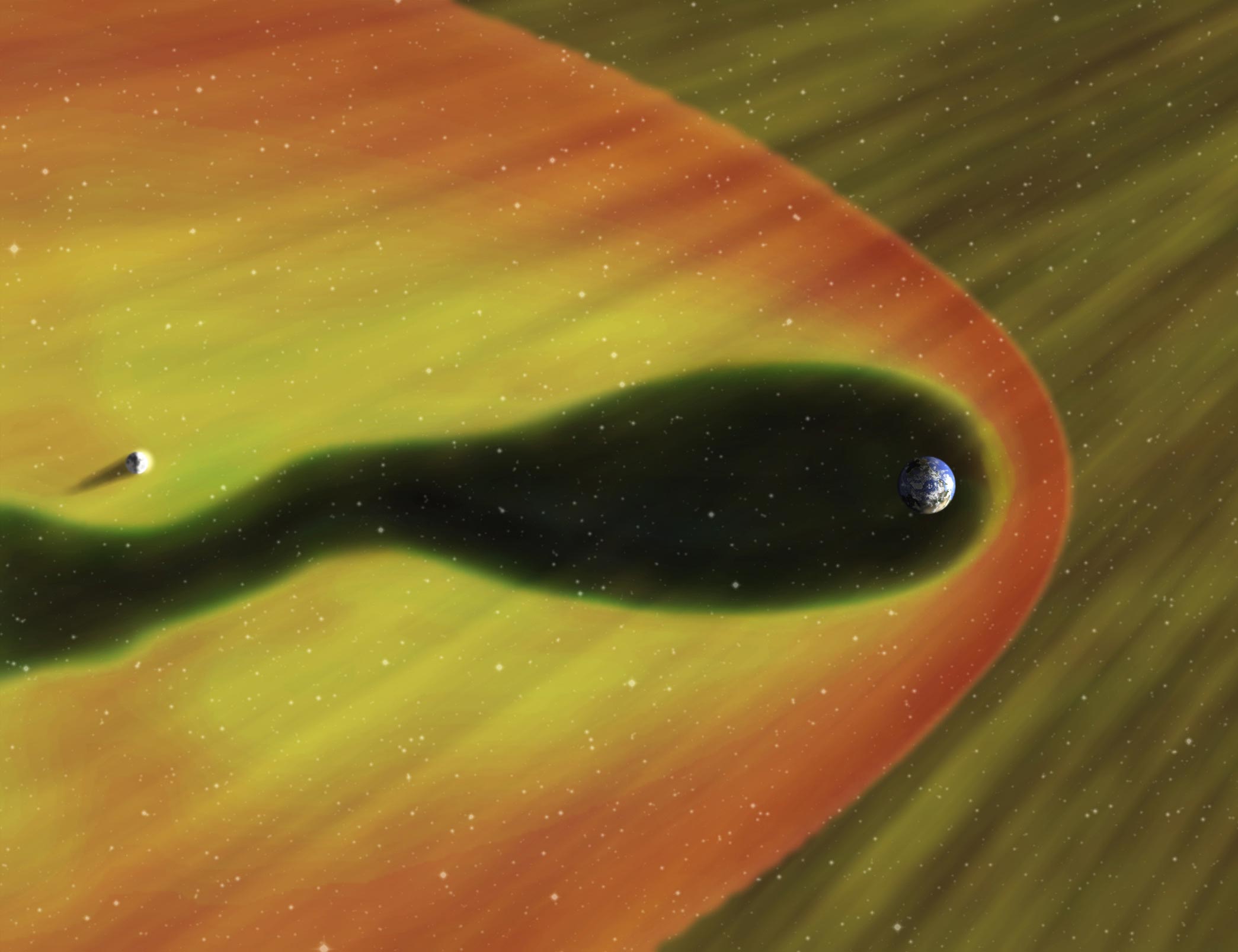
Which way the wind blows in space has new importance for astronaut safety at the Moon. Using data from several NASA missions, scientists discovered that wind created by high-speed particles from the Sun can cause the tail of Earth’s protective magnetic bubble to flap like a windsock in a strong breeze. This movement can pull the tail so far out of line that it exposes the Moon to potentially damaging charged particles at times it was previously thought to be protected. The finding, which reveals a new challenge of predicting when solar activity exposes the Moon, will help scientists and engineers prepare for future lunar missions.
Our Sun provides life-giving light, but it also spews out high-speed particles – the solar wind, in which some very high energy particle bursts can be damaging to satellites and humans in space. While Earth is safe inside its magnetic bubble – the magnetosphere – the Moon continually passes into and out of the stretched-out tail of this protective bubble as it orbits the planet. During the 25% of the time the Moon spends behind Earth – in the full Moon phase – it is inside the magnetosphere and thought to be protected. But this new research, published in the Journal of Geophysical Research: Space Physics, shows that’s not always the case.
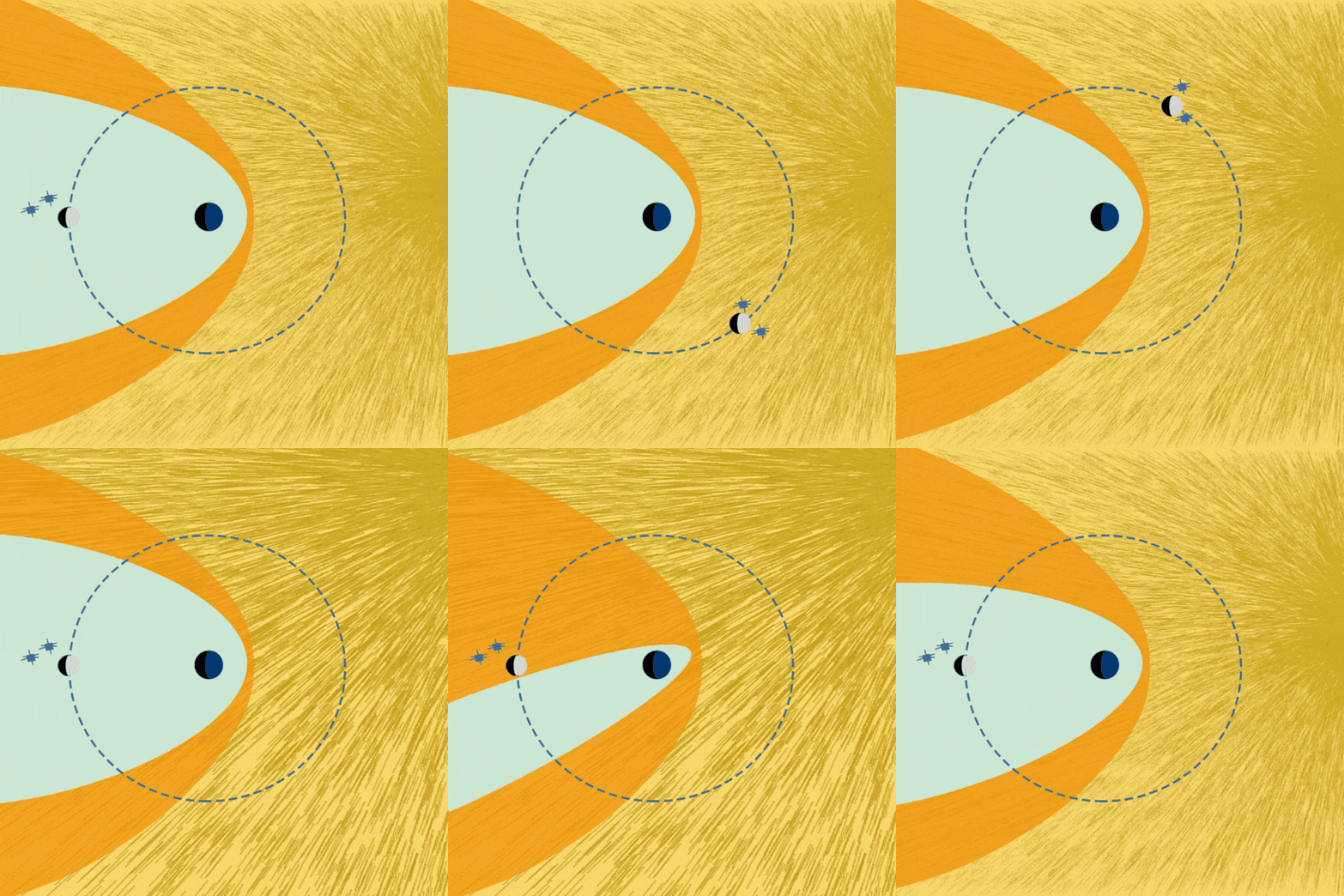
Scientists have previously shown that fairly far from Earth – at distances 800,000 miles (1.3 million kilometers) from the planet – the solar wind can cause the tail of the magnetosphere to flap around. The new research found this also happens at just one-third that distance, where the Moon orbits. At times of high solar activity, the Sun can release extra bursts of material in the solar wind – shock waves that ripple across the solar system. When these shock waves reach Earth, they have enough pressure to change the shape of the magnetosphere, which is already stretched into a windsock-like shape due to the pressure from solar wind particles. If the wind after the shock wave is strong enough, it can cause enough movement to expose the Moon to the solar wind, even when it’s directly behind Earth.
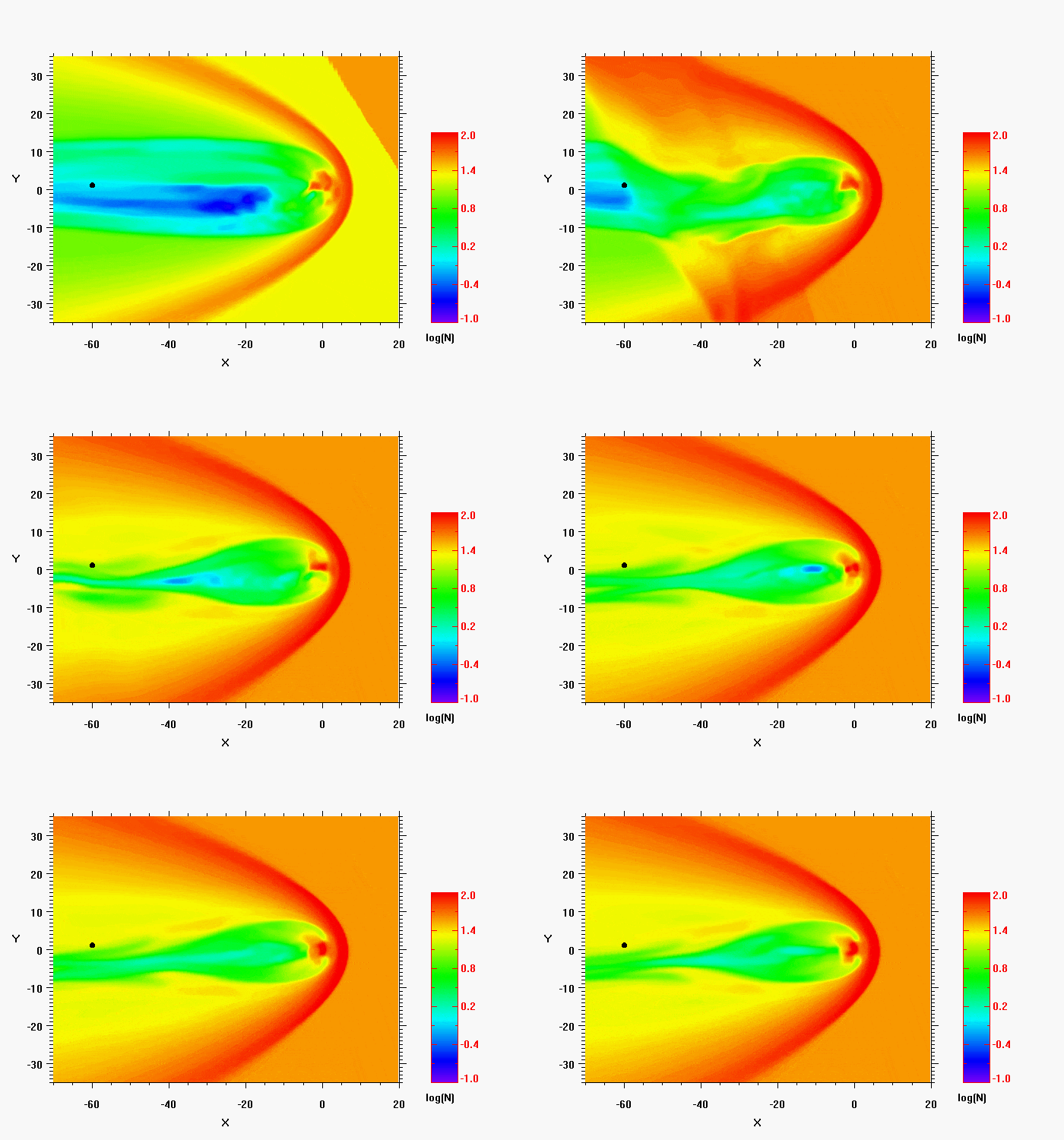
The new discovery used several of NASA’s spacecraft to watch the effects of one high-speed shock wave that barreled towards Earth in 2012, traveling at 1.7 million miles per hour. The shock was first measured by the Advanced Composition Explorer, Cluster and Wind missions, which are all situated between Earth and the Sun. An hour later the Moon changes to the magnetic environment were seen by THEMIS-ARTEMIS – short for Time History of Events and Macroscale Interactions – Acceleration, Reconnection, Turbulence, and Electrodynamics of the Moon’s Interaction with the Sun. THEMIS-ARTEMIS, a separate mission from the agency’s new Artemis program to explore the Moon, uses two satellites at the Moon to study the lunar space environment.
The data from the missions showed that the strong wind behind the shock wave pushed aside the magnetosphere’s long trailing tail, causing it to wave back and forth like a windsock. The side-to-side movement was so large that it repeatedly exposed the Moon to the solar wind over a half-hour period. This research also showed the lunar exposure could happen even without a shockwave – such as at times when the solar wind blows sideways – suggesting the exposure could occur even more commonly than previously thought.
As NASA’s Artemis program prepares to send new science and technology experiments ahead of a human return, it is essential to understand the area’s particle radiation environment, which can potentially damage electronics and humans during storm events. Data from THEMIS-ARTEMIS and other missions help scientists and engineers better understand the lunar environment and will help contextualize discoveries made on the Moon’s surface and protect lunar assets.
Reference: “Unusual Location of the Geotail Magnetopause Near Lunar Orbit: A Case Study” by W. S. Shang, B. B. Tang, Q. Q. Shi, A. M. Tian, X.‐Y. Zhou, Z. H. Yao, A. W. Degeling, I. J. Rae, S. Y. Fu, J. Y. Lu, Z. Y. Pu, A. N. Fazakerley, M. W. Dunlop, G. Facskó, J. Liu and M. Wang, 15 April 2020, Journal of Geophysical Research: Space Physics.
DOI: 10.1029/2019JA027401
Never miss a breakthrough: Join the SciTechDaily newsletter.
Follow us on Google and Google News.