
Close Menu
    Facebook X (Twitter) Instagram
    SciTechDaily
    • Biology
    • Chemistry
    • Earth
    • Health
    • Physics
    • Science
    • Space
    • Technology
    Facebook X (Twitter) Pinterest YouTube RSS
    SciTechDaily
    Home»Space»Astronomy & Astrophysics 101: Magnetosphere
    Space

    Astronomy & Astrophysics 101: Magnetosphere

    By NASAJanuary 4, 2025No Comments3 Mins Read
    Facebook Twitter Pinterest Telegram LinkedIn WhatsApp Email Reddit
    Share
    Facebook Twitter LinkedIn Pinterest Telegram Email Reddit
    Earth Magnetosphere Giant Magnetic Bubble
    Earth is surrounded by a giant magnetic bubble called the magnetosphere, which is is part of a dynamic, interconnected system that responds to solar, planetary, and interstellar conditions. Credit: NASA

    What Is a Magnetosphere?

    A magnetosphere is the region surrounding a planet that is dominated by its magnetic field. While other planets in our solar system also have magnetospheres, Earth’s stands out as the strongest among the rocky planets. This vast, comet-shaped magnetic bubble has been essential to Earth’s habitability, providing protection that has allowed life to develop and thrive. The magnetosphere shields the planet from harmful solar and cosmic radiation and prevents the solar wind — a continuous stream of charged particles from the sun — from eroding our atmosphere.

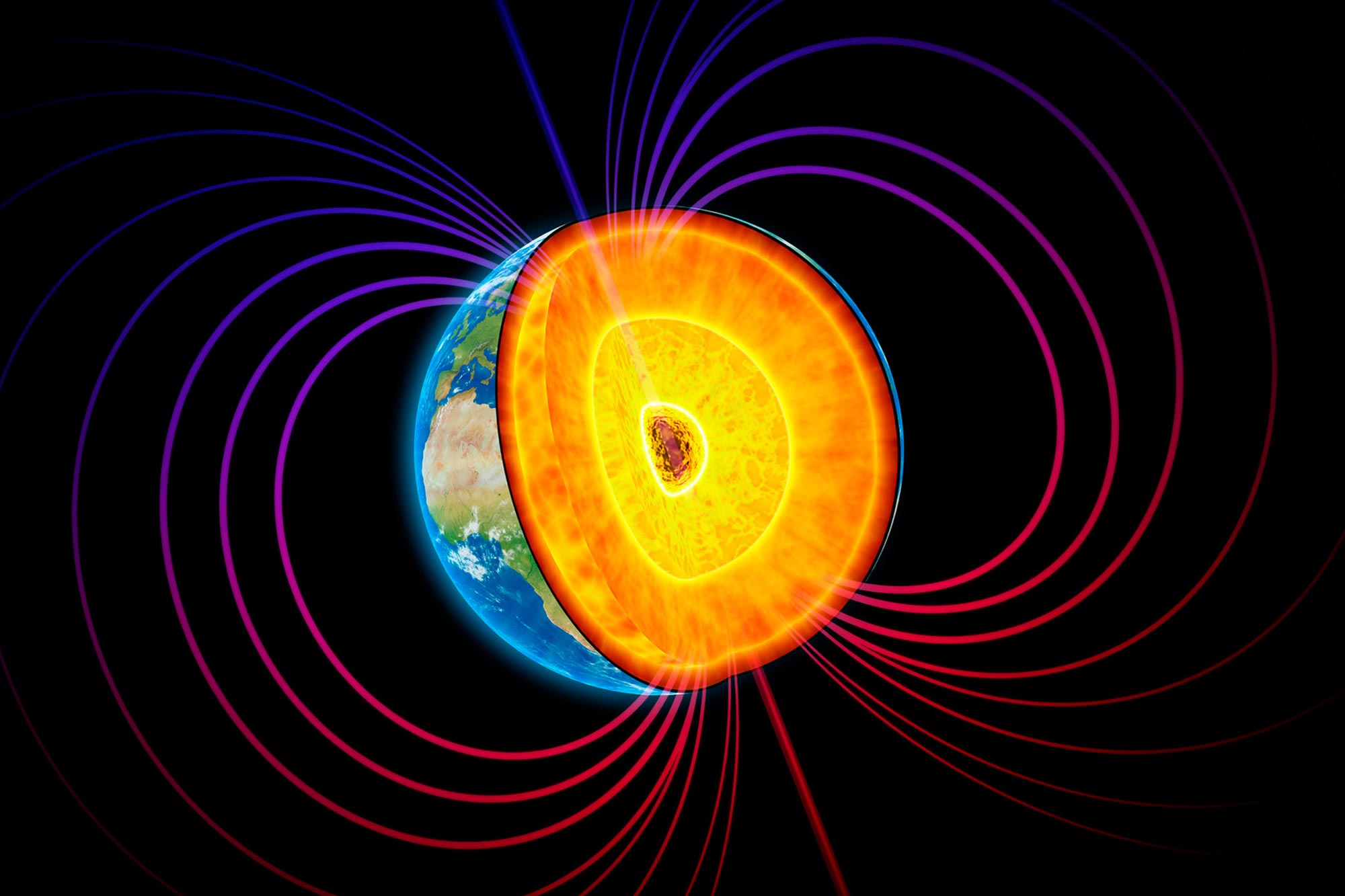
    Earth’s magnetosphere is part of a dynamic and interconnected system influenced by solar, planetary, and interstellar forces. It is powered by the movement of electrically charged, molten iron deep within Earth’s outer core. The constant bombardment of solar wind compresses the magnetosphere on the sun-facing side, known as the dayside, which extends six to ten times Earth’s radius. On the opposite side, the nightside magnetosphere stretches outward into a vast magnetotail that fluctuates in length, reaching hundreds of Earth radii and extending well beyond the moon’s orbit.
    Earths Core Magnetosphere Crop
    Earth’s magnetic field is generated by the movement of molten iron in its outer core. This liquid iron conducts electricity, and its motion creates electric currents, which in turn produce a magnetic field. This geodynamo effect forms the magnetosphere, shielding Earth from harmful cosmic and solar radiation.

    NASA heliophysics studies the magnetosphere to better understand its role in our space environment. Such research helps unravel the fundamental physics of space, which is dominated by complex electromagnetic interactions unlike what we experience day-to-day on Earth. By studying this space environment close to home, we can better understand the nature of space throughout the universe. Additionally, space weather within the magnetosphere — where many of our spacecraft reside — can sometimes have adverse effects on space technology as well as communications systems. Better understanding of the science of the magnetosphere helps improve our space weather models.

    NASA’s studies of the magnetosphere include research into: understanding the nature of the electromagnetic phenomena in near-Earth space; how near-Earth space responds to external and internal stimuli; how the coupled middle and upper atmosphere respond to external factors; and how the various regions of the magnetosphere and upper atmosphere interact with each other.

    Never miss a breakthrough: Join the SciTechDaily newsletter.
    Follow us on Google and Google News.

    Astronomy Astrophysics Magnetosphere NASA
    Share. Facebook Twitter Pinterest LinkedIn Email Reddit

    Related Articles

    20 Years of Science Discoveries From NASA’s Wind Spacecraft

    NuSTAR to Scan Supernovas and Help Improve Computer Simulations

    Hubble Captures Image of Compact Blue Dwarf Galaxy UGC 5497

    Study Challenges Prevailing Ideas About How Supermassive Black Holes Grow

    New Technique Leads to the Discovery of 5 New Pulsars

    Supernova Shock Wave Breaks Through a Cocoon of Gas

    The Bolshoi Simulation: Boxing the Universe

    NASA’s Kepler Mission Discovers 11 New Extrasolar Systems with 26 Exoplanets

    Hubble Observes Rare Blue Stars in Andromeda’s Core

    Leave A Reply Cancel Reply

    • Facebook
    • Twitter
    • Pinterest
    • YouTube

    Don't Miss a Discovery

    Subscribe for the Latest in Science & Tech!

    Trending News

    Breakthrough Bowel Cancer Trial Leaves Patients Cancer-Free for Nearly 3 Years

    Natural Compound Shows Powerful Potential Against Rheumatoid Arthritis

    100,000-Year-Old Neanderthal Fossils in Poland Reveal Unexpected Genetic Connections

    Simple “Gut Reset” May Prevent Weight Gain After Ozempic or Wegovy

    2.8 Days to Disaster: Scientists Warn Low Earth Orbit Could Suddenly Collapse

    Common Food Compound Shows Surprising Power Against Superbugs

    5 Simple Ways To Remember More and Forget Less

    The Atomic Gap That Could Cost the Semiconductor Industry Billions

    Follow SciTechDaily
    • Facebook
    • Twitter
    • YouTube
    • Pinterest
    • Newsletter
    • RSS
    SciTech News
    • Biology News
    • Chemistry News
    • Earth News
    • Health News
    • Physics News
    • Science News
    • Space News
    • Technology News
    Recent Posts
    • After 37 Years, the World’s Longest-Running Soil Warming Experiment Uncovers a Startling Climate Secret
    • NASA Satellite Captures First-Ever High-Res View of Massive Pacific Tsunami
    • ADHD Isn’t Just a Deficit: Study Reveals Powerful Hidden Strengths
    • Scientists Uncover “Astonishing” Hidden Property of Light
    • Scientists Discover Stem Cells That Could Regrow Teeth and Bone
    Copyright © 1998 - 2026 SciTechDaily. All Rights Reserved.
    • Science News
    • About
    • Contact
    • Editorial Board
    • Privacy Policy
    • Terms of Use

    Type above and press Enter to search. Press Esc to cancel.