
January 1 – October 7, 2021
A colder than usual winter atmosphere over the Southern Hemisphere led to a deep and larger-than-average ozone hole in 2021.
The 2021 Antarctic ozone hole reached its maximum area on October 7 and ranks as the 13th largest since 1979. Scientists from NASA and NOAA reported that this year’s ozone hole developed similarly to last year’s: A colder than usual Southern Hemisphere winter led to a deep and larger-than-average ozone hole that will likely persist into November or December.
“This is a large ozone hole because of the colder-than-average 2021 stratospheric conditions, and without a Montreal Protocol, it would have been much larger,” said Paul Newman, chief scientist for Earth sciences at NASA’s Goddard Space Flight Center.
How the Ozone Hole Forms Each Year
What we call the “ozone hole” is a thinning of the ozone layer in the stratosphere above Antarctica that develops every September. Chemically active forms of chlorine and bromine—derived from human-produced compounds—are released into the stratosphere during reactions on high-altitude polar clouds. The reactive chlorine and bromine then initiate ozone-destroying reactions as the Sun rises in the Antarctic at the end of winter.
The animation above shows the evolution of ozone over the South Pole between January 1 and October 7, 2021. Notice that moderate ozone losses (orange) are apparent by late August and become even more potent (red) and widespread through September. The ozone hole reached its maximum extent on October 7, 2021, as calculated by the NASA Ozone Watch team.
NASA and NOAA monitor the ozone hole via complementary instrumental methods. NASA’s Aura satellite, the NASA-NOAA Suomi NPP satellite, and NOAA’s JPSS NOAA-20 satellite all measure ozone from space. Aura’s Microwave Limb Sounder also estimates levels of ozone-destroying chlorine.
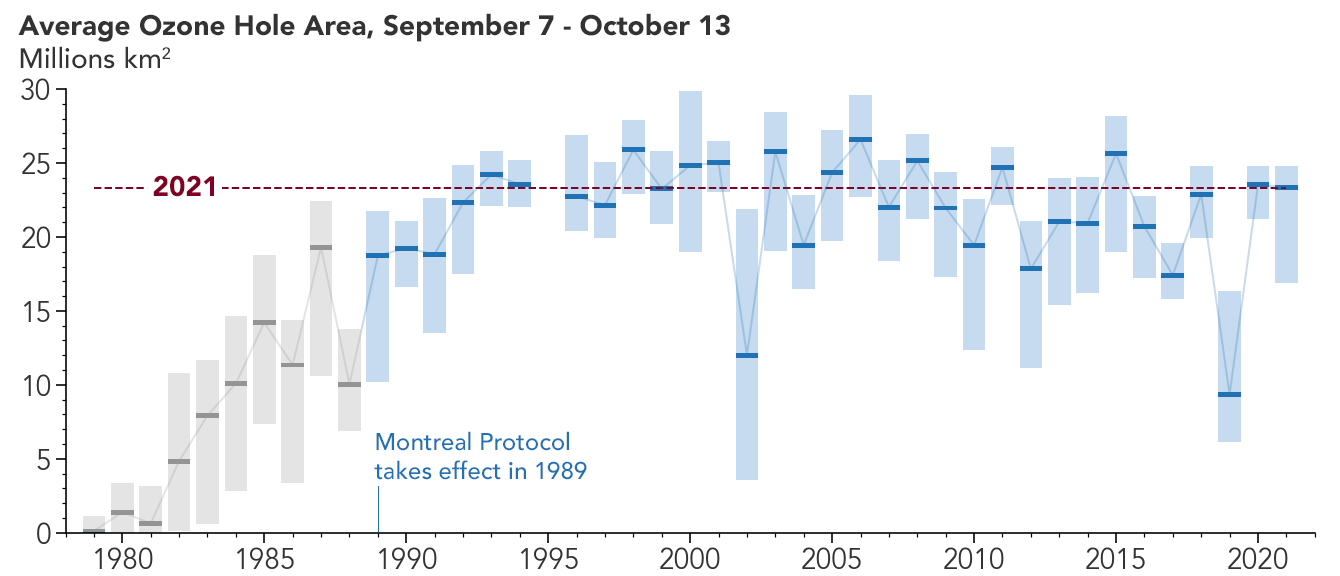
This year, NASA satellite observations determined the ozone hole reached a maximum of 24.8 million square kilometers (9.6 million square miles)—roughly the size of North America—before beginning to shrink in mid-October. Colder-than-average temperatures and strong winds in the stratosphere circling Antarctica contributed to its size.
In addition to the ozone hole’s area, scientists also track the average amount of depletion—how little ozone is left inside the hole. NOAA scientists at the South Pole Station record the layer’s thickness by releasing weather balloons carrying ozonesondes and by making ground-based measurements with a Dobson spectrophotometer.
On October 7, 2021, scientists recorded a total-column ozone concentration of 102 Dobson units, the 8th-lowest level since 1986. Prior to the emergence of the ozone hole in the 1970s, average ozone above the South Pole in September and October ranged from 250 to 350 Dobson units.
While the 2021 Antarctic ozone hole is larger than average, it is substantially smaller than those in the late 1990s and early 2000s. The chart above shows the average size of the ozone hole (solid blue and gray lines), as well as the range of its size (light blue and gray shaded bar) for each year since 1979.
Signs of Recovery Thanks to the Montreal Protocol
The ozone hole is recovering due to the Montreal Protocol and subsequent amendments banning the release of harmful ozone-depleting chemicals called chlorofluorocarbons, or CFCs. Newman and colleagues estimated that if atmospheric chlorine levels from CFCs were as high today as they were in the early 2000s, this year’s ozone hole would have been larger by about four million square kilometers (1.5 million square miles) under the same weather conditions.
NASA Earth Observatory images and video by Joshua Stevens, using data courtesy of Paul Newman and Eric Nash/NASA/Ozone Watch, and GEOS-5 data from the Global Modeling and Assimilation Office at NASA GSFC. Story by Sofie Bates/NASA’s Earth Science News Team, adapted for NASA Earth Observatory by Kathryn Hansen.
Never miss a breakthrough: Join the SciTechDaily newsletter.
Follow us on Google and Google News.
4 Comments
“While the 2021 Antarctic ozone hole is larger than average, it is SUBSTANTIALLY smaller than those in the late 1990s and early 2000s.”
I don’t see it! I think that “slightly smaller” would be a better description.
“… without a Montreal Protocol, it would have been much larger,” That sounds like whistling in the dark! How does one prove such a claim?
It looks to me like weather plays a more important role than CFCs. There have been two anomalously low events in 2002 and 2019. Otherwise, there has only been a slight decline in the trend, which could be attributed to temperatures, as the anomalous lows were.
This author is obviously shilling for the CCP. Unregulated aerosol’s use by Chinese industries has undone decades of western bans. Keep trying shill, no one here believes you.
At the risk of sounding shrill, I would like to see the plot of ozone hole size and stratospheric temperatures. It would also be nice to see freon releases, and/or chlorine. Otherwise, I suspect it is just selective plotting to push a story.
It takes lots of radiation to create ozone. The ozone layer is more likely absorbing the UV light and building from it. Is the hole bigger because the stratoshere cooled or vice versa. It seems to me that it grows and shrinks based on cme activity.