
NASA scientists propose a new seven-level scale to contextualize the search for extraterrestrial life.
How do we understand the significance of new scientific results related to the search for life? When would we be able to say, “yes, extraterrestrial life has been found?”
NASA scientists are encouraging the scientific community to establish a new framework that provides context for findings related to the search for life. Writing in the journal Nature, they propose creating a scale for evaluating and combining different lines of evidence that would ultimately lead to answering the ultimate question: Are we alone in the universe?
In the new article published in Nature, led by Jim Green, the agency’s chief scientist, a NASA group offers a sample scale to use as a starting point for discussions among anyone who would use it, such as scientists and communicators. They envision a scale informed by decades of experience in astrobiology, a field that probes the origins of life on Earth and possibilities of life elsewhere.
“Having a scale like this will help us understand where we are in terms of the search for life in particular locations, and in terms of the capabilities of missions and technologies that help us in that quest,” Green said.
The Seven-Level Life Detection Scale
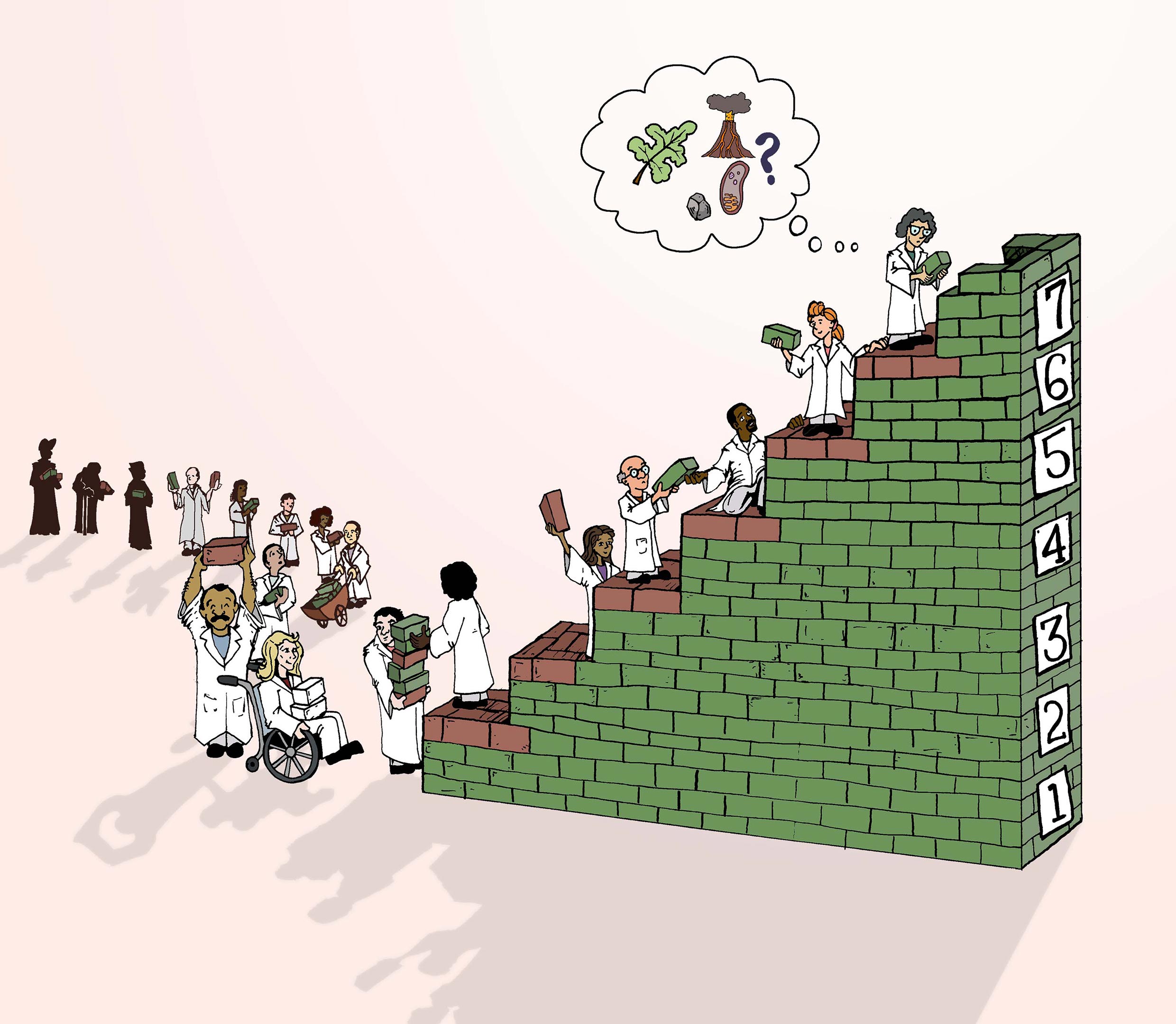
The scale contains seven levels, reflective of the winding, complicated staircase of steps that would lead to scientists declaring they’ve found life beyond Earth. As an analogy, Green and colleagues point to the Technology Readiness Level scale, a system used inside NASA to rate how ready a spacecraft or technology is to fly. Along this spectrum, cutting-edge technologies such as the Mars helicopter Ingenuity begin as ideas and develop into rigorously tested components of history-making space missions.
The authors hope that in the future, scientists will note in published studies how their new astrobiology results fit into such a scale. Journalists could also refer to this kind of framework to set expectations for the public in stories about new scientific results, so that small steps don’t appear to be giant leaps.
“Until now, we have set the public up to think there are only two options: it’s life or it’s not life,” said Mary Voytek, head of NASA’s Astrobiology Program at NASA Headquarters in Washington and study co-author. “We need a better way to share the excitement of our discoveries, and demonstrate how each discovery builds on the next, so that we can bring the public and other scientists along on the journey.”
It’s exciting each time a rover or orbiter finds proof that water once flowed on Mars. Each new finding shows us that Mars’ past climate was similar to Earth’s, and the red planet could have once supported life. But that doesn’t necessarily mean any sort of life ever lived there, or that anything lives there now. Discoveries of rocky planets orbiting stars beyond our Sun, especially those that could harbor liquid water on their surfaces, are similarly tantalizing, but not proof by themselves of life beyond Earth. So how do we understand these observations in context?
Science as an Iterative Process
All of science is a process of asking questions, coming up with hypotheses, developing new methods to look for clues, and ruling out all alternative explanations. Any individual detection may not be completely explained by a biological process, and must be confirmed through follow-up measurements and independent investigations. Sometimes, there are problems with the instruments themselves. Other times, experiments don’t turn up anything at all, but still deliver valuable information about what doesn’t work or where not to look.
Astrobiology is no different. The field pursues some of the most profound questions that anyone could ask, regarding our origins and place in the universe. As scientists learn more and more about what kinds of signals are associated with life in diverse environments on Earth, they can create and improve upon technologies needed to find similar signs elsewhere.
While the exact details of the scale will evolve as scientists, communicators, and others weigh in, the Nature article offers a starting point for discussion.
At the first step of the scale, “level 1,” scientists would report hints of a signature of life, such as a biologically relevant molecule. An example would be a future measurement of some molecule on Mars potentially related to life. Moving up to “level 2,” scientists would ensure that the detection was not influenced by the instruments having been contaminated on Earth. At “level 3” they would show how this biological signal is found in an analog environment, such as an ancient lakebed on Earth similar to the Perseverance rover’s landing site, Jezero Crater.
To add evidence to the middle of the scale, scientists would supplement those initial detections with information about whether the environment could support life, and rule out non-biological sources. For Mars in particular, samples returned from Mars could help make this kind of progress. Perseverance will soon be collecting and storing samples with the goal of a future mission returning them one day. Since different teams on Earth would have the opportunity to independently verify hints of life in Mars samples with a variety of instruments, the combination of their evidence could achieve “level 6,” the second highest step on the scale. But in this example, to reach level 7, the standard by which scientists would be most sure they had detected life on Mars, an additional mission to a different part of Mars may be required.
“Achieving the highest levels of confidence requires the active participation of the broader scientific community,” the authors write.
Exoplanets and the Next Frontier
This scale would apply to discoveries from beyond the solar system, too. Exoplanets, planets outside our solar system, are believed to outnumber the 300 billion stars in the Milky Way. But small, rocky planets are harder to study from afar than gas giants. Future missions and technologies would be necessary to analyze the atmospheres of Earth-size planets with Earth-like temperatures receiving adequate amounts of starlight for life as we know it. The James Webb Space Telescope, launching later this year, is the next big advance in this area. But it will likely take an even more sensitive telescope to detect the combination of molecules that would indicate life.
Detecting oxygen in the atmosphere of an exoplanet, a planet outside our solar system, would be a significant step in the process of searching for life. We associate oxygen with life because it is made by plants and we breathe it, but there are also geological processes that generate oxygen, so it is not proof by itself of life. To move upward on the scale, a mission team could demonstrate that the oxygen signal was not being contaminated by light reflected from Earth and study the chemistry of the planet’s atmosphere to rule out the geological explanation. Additional evidence of an environment that supports life, such as an ocean, would bolster the case that this hypothetical planet is inhabited.
Scientists who study exoplanets are eager to find both oxygen and methane, a combination of gases in Earth’s atmosphere indicative of life. Because these gases would lead to reactions that cancel each other out unless there are biological sources of both present, finding both would be a key “level 4” milestone.
To reach level 5, astronomers would need a second, independent detection of some hint of life, such as global images of the planet with colors suggestive of forests or algae. Scientists would need additional telescopes or longer-term observations to be sure they had found life on an exoplanet.
Study authors emphasize that the scale should not be seen as a race to the top. The scale emphasizes the importance of the groundwork that many NASA missions lay without directly detecting possible biological signals, such as in characterizing environments on other planetary bodies.
Upcoming missions such as Europa Clipper, an orbiter headed for Jupiter’s icy moon Europa later this decade, and Dragonfly, an octocopter that will explore Saturn’s moon Titan, will provide vital information about the environments in which some form of life may one day be found.
“With each measurement, we learn more about both biological and nonbiological planetary processes,” Voytek said. “The search for life beyond Earth requires broad participation from the scientific community and many kinds of observations and experiments. Together, we can be stronger in our efforts to look for hints that we are not alone.”
Reference: “Call for a framework for reporting evidence for life beyond Earth” by James Green, Tori Hoehler, Marc Neveu, Shawn Domagal-Goldman, Daniella Scalice and Mary Voytek, 27 October 2021, Nature.
DOI: 10.1038/s41586-021-03804-9
Never miss a breakthrough: Join the SciTechDaily newsletter.
Follow us on Google and Google News.
2 Comments
When NASA launch the James Webb telescope, It will search for biosignatures on exoplanets. Maybe it may lead to the discovery of extraterrestrial life.
Live on Ceres; You can see it. First screw up the Britness of your tablet or computer, than search the photo made by dawn. Pia 22480 look upside the dank rim a small piece left from the middle, you seetwo bildings illuminated windows.
Have a good look Nico. Vuyk