
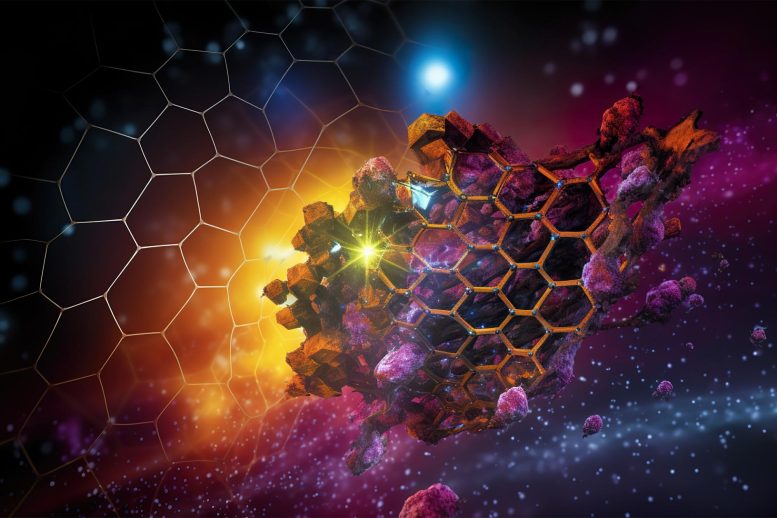
This molecule, never before seen in space, is believed to be a cornerstone of interstellar organic chemistry.
Carbon compounds form the foundations of all known life, and as such are of particular interest to scientists working to understand both how life developed on Earth, and how it could potentially develop elsewhere in our universe. As such, the study of interstellar organic (carbon-containing) chemistry is an area of keen fascination to many astronomers.
An international team of astronomers has used NASA’s James Webb Space Telescope to detect a carbon compound known as methyl cation for the first time. This molecule is important because it aids the formation of more complex carbon-based molecules. It was found in a young star system with a protoplanetary disk, 1,350 light-years away in the Orion Nebula.
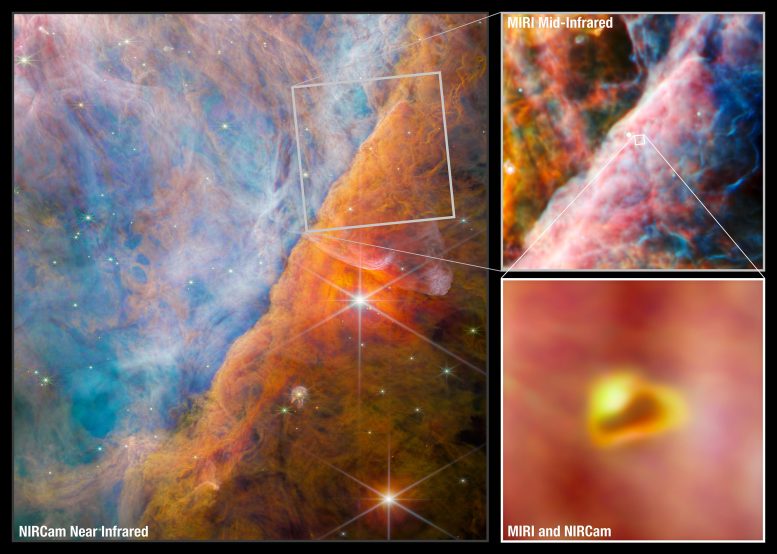
The largest image, on the left, is from Webb’s NIRCam (Near-Infrared Camera) instrument. At upper right, the telescope is focused on a smaller area using Webb’s MIRI (Mid-Infrared Instrument). At the very center of the MIRI area is a young star system with a protoplanetary disk named d203-506. The pullout at the bottom right displays a combined NIRCam and MIRI image of this young system.
Credit: ESA/Webb, NASA, CSA, M. Zamani (ESA/Webb), PDRs4ALL ERS Team
Webb Space Telescope Makes First Detection of Crucial Carbon Molecule
A team of international scientists has used NASA’s James Webb Space Telescope to detect a new carbon compound in space for the first time. Known as methyl cation (pronounced cat-eye-on) (CH3+), the molecule is important because it aids the formation of more complex carbon-based molecules. Methyl cation was detected in a young star system, with a protoplanetary disk, known as d203-506, which is located about 1,350 light-years away in the Orion Nebula.
Carbon compounds form the foundations of all known life, and as such are particularly interesting to scientists working to understand both how life developed on Earth, and how it could potentially develop elsewhere in our universe. The study of interstellar organic (carbon-containing) chemistry, which Webb is opening in new ways, is an area of keen fascination to many astronomers.
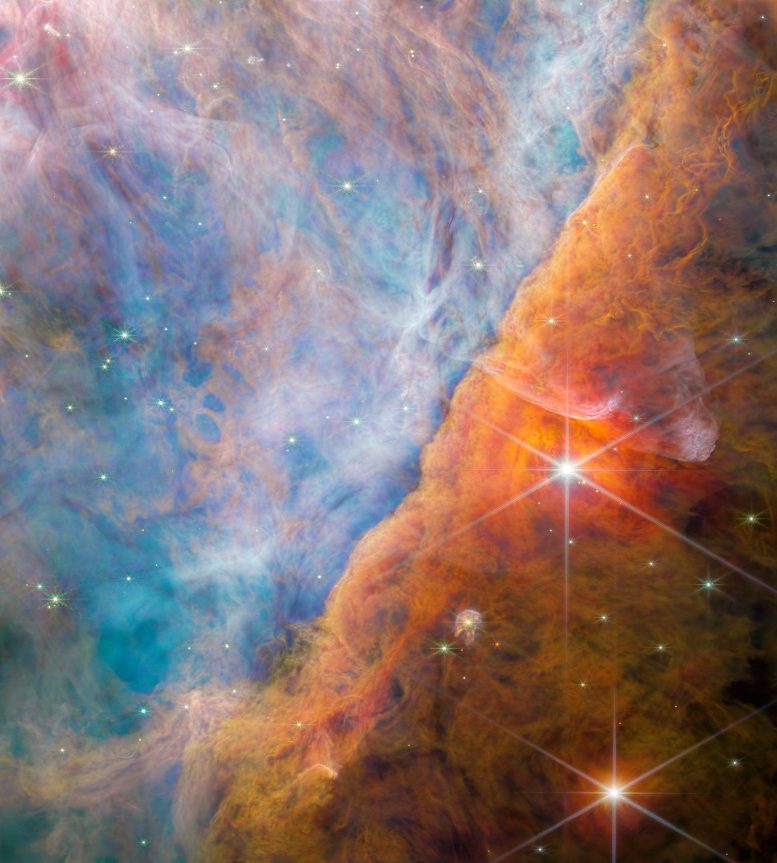
Within this image lies a young star system known as d203-506, which has a protoplanetary disk. Astronomers used Webb to detect a carbon molecule known as methyl cation in that disk for the first time. That molecule is important because it aids the formation of more complex carbon-based molecules.
Credit: ESA/Webb, NASA, CSA, M. Zamani (ESA/Webb), PDRs4ALL ERS Team
CH3+ is theorized to be particularly important because it reacts readily with a wide range of other molecules. As a result, it acts like a “train station” where a molecule can remain for a time before going in one of many different directions to react with other molecules. Due to this property, scientists suspect that CH3+ forms a cornerstone of interstellar organic chemistry.
The unique capabilities of Webb made it the ideal observatory to search for this crucial molecule. Webb’s exquisite spatial and spectral resolution, as well as its sensitivity, all contributed to the team’s success. In particular, Webb’s detection of a series of key emission lines from CH3+ cemented the discovery.
“This detection not only validates the incredible sensitivity of Webb but also confirms the postulated central importance of CH3+ in interstellar chemistry,” said Marie-Aline Martin-Drumel of the University of Paris-Saclay in France, a member of the science team.
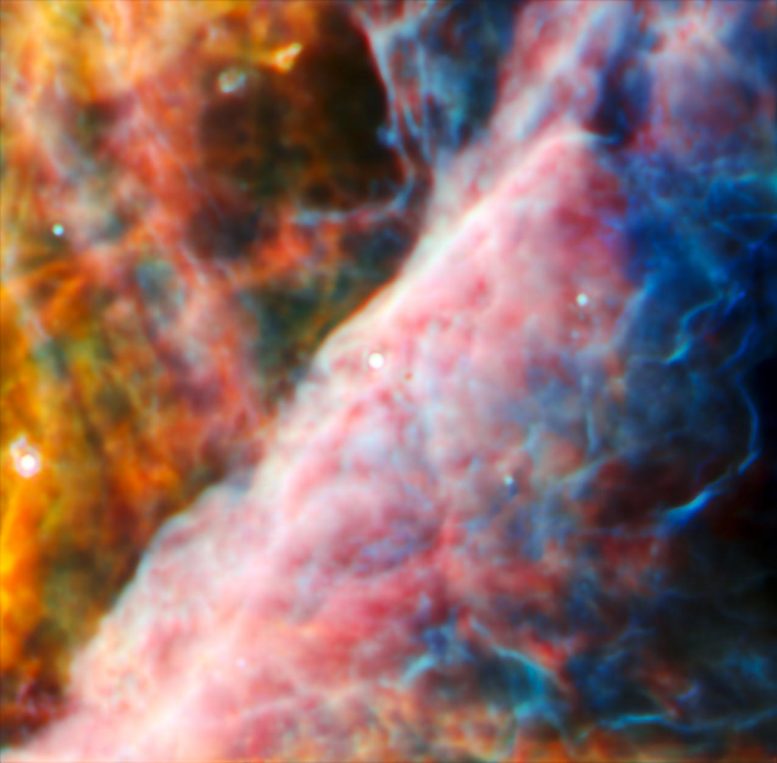
While the star in d203-506 is a small red dwarf, the system is bombarded by strong ultraviolet (UV) light from nearby hot, young, massive stars. Scientists believe that most planet-forming disks go through a period of such intense UV radiation, since stars tend to form in groups that often include massive, UV-producing stars.
Typically, UV radiation is expected to destroy complex organic molecules, in which case the discovery of CH3+ might seem to be a surprise. However, the team predicts that UV radiation might actually provide the necessary source of energy for CH3+ to form in the first place. Once formed, it then promotes additional chemical reactions to build more complex carbon molecules.
Broadly, the team notes that the molecules they see in d203-506 are quite different from typical protoplanetary disks. In particular, they could not detect any signs of water.
“This clearly shows that ultraviolet radiation can completely change the chemistry of a protoplanetary disk. It might actually play a critical role in the early chemical stages of the origins of life,” elaborated Olivier Berné of the French National Centre for Scientific Research in Toulouse, lead author of the study.
These findings, which are from the PDRs4ALL Early Release Science program, have been published in the journal Nature.
Reference: “Formation of the Methyl Cation by Photochemistry in a Protoplanetary Disk” by Olivier Berné, Marie-Aline Martin-Drumel, Ilane Schroetter, Javier R. Goicoechea, Ugo Jacovella, Brenger Gans, Emmanuel Dartois, Laurent Coudert, Edwin Bergin, Felipe Alarcon, Jan Cami, Evelyne Roueff, John H. Black, Oskar Asvany, Emilie Habart, Els Peeters, Amelie Canin, Boris Trahin, Christine Joblin, Stephan Schlemmer, Sven Thorwirth, Jose Cernicharo, Maryvonne Gerin, Alexander Tielens, Marion Zannese, Alain Abergel, Jeronimo Bernard-Salas, Christiaan Boersma, Emeric Bron, Ryan Chown, Sara Cuadrado, Daniel Dicken, Meriem Elyajouri, Asunción Fuente, Karl D. Gordon, Lina Issa, Olga Kannavou, Baria Khan, Ozan Lacinbala, David Languignon, Romane Le Gal, Alexandros Maragkoudakis, Raphael Meshaka, Yoko Okada, Takashi Onaka, Sofia Pasquini, Marc W. Pound, Massimo Robberto, Markus Röllig, Bethany Schefter, Thiébaut Schirmer, Ameek Sidhu, Benoit Tabone, Dries Van De Putte, Sílvia Vicente and Mark G. Wolfire, 26 June 2023, Nature.
DOI: 10.1038/s41586-023-06307-x
The James Webb Space Telescope is the world’s premier space science observatory. Webb will solve mysteries in our solar system, look beyond to distant worlds around other stars, and probe the mysterious structures and origins of our universe and our place in it. Webb is an international program led by NASA with its partners, ESA (European Space Agency), and CSA (Canadian Space Agency).
Never miss a breakthrough: Join the SciTechDaily newsletter.
Follow us on Google and Google News.
2 Comments
Ultraviolet rays stimulate carbon molecules of space in forming organic compounds of space by the polarisation behaviour of light rays say photon waves oscillate between circularly polarised clockwise anticlockwise between linearity and antiphases in between presence of electrified and absence going on variations in spinning directions and is going to be a very important study in space chemistry.
You Are Smartninb