
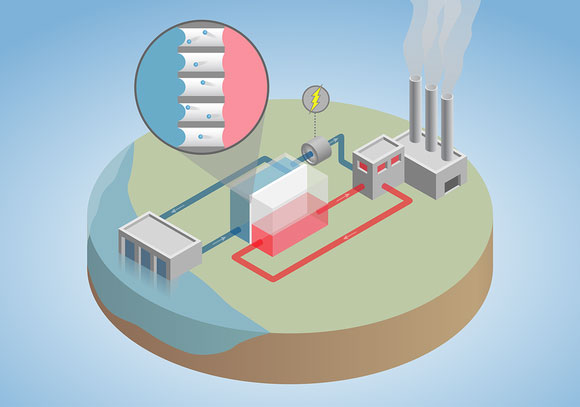
Yale University engineers have developed a new technology that makes energy from the low-temperature wasted heat produced by industrial sources and power plants.
It is estimated that recoverable waste heat in the U.S. alone could power tens of millions of homes. Although existing technologies can reuse high-temperature heat or convert it to electricity, it is difficult to efficiently extract energy from low-temperature heat waste due to the small temperature difference between the plant’s heat discharge and the surrounding environment. Additionally, conventional systems are designed to target a specific temperature difference, so they’re less effective when there are fluctuations in the output of waste heat.
Researchers at Yale’s Department of Chemical and Environmental Engineering have developed a new technology that overcomes these challenges. The key is a “nanobubble membrane” that traps tiny air bubbles within its pores when immersed in water. Heating one side of the membrane causes water to evaporate, travel across the air gap, and condense on the opposite side of the membrane. This temperature-driven flow of water across the membrane is then directed to a turbine to generate electricity.
To prove the concept, the team built a small-scale system and demonstrated that the nanobubble membranes could produce pressurized flows of water and generate power even with heat fluctuations and temperature differences as small as 20 degrees Celsius (68 degrees Fahrenheit) — making it feasible for use with the wasted heat from industrial sources. The findings were published online June 27 in the journal Nature Energy.
The researchers used nanostructured membranes with a surface chemistry that helps trap the air bubbles, keeping bubbles contained within pores even when large pressures are generated. These membranes, approximately as thick as two sheets of paper, were made from highly hydrophobic (water-repelling) polymer nanofibers.
“It was critical to identify robust air-trapping membranes that facilitate pressure generation,” said Menachem Elimelech, corresponding author on the paper and the Roberto C. Goizueta Professor of Chemical and Environmental Engineering at Yale. “Without the right membrane, water would displace the air in the pores, and the process would not be feasible.”
The demonstration of the prototype convinced the researchers of the value of the technology.
“We found that the efficiency of this system can exceed that of comparable technologies,” said Anthony Straub, first author on the study and a doctoral student in chemical and environmental engineering. “The process also only uses water, so it is cost-effective and environmentally friendly.”
The researchers plan to continue work on the technology, developing improved membranes that can better trap air bubbles. They also are investigating how large-scale future systems will perform.
In addition to Elimelech and Straub, the research team included Ngai Yin Yip, a former doctoral student at Yale and current assistant professor at Columbia University; Shihong Lin, a former Yale postdoc and current assistant professor at Vanderbilt University; and Jongho Lee, a postdoc in chemical and environmental engineering at Yale.
Reference: “Harvesting low-grade heat energy using thermo-osmotic vapour transport through nanoporous membranes” by Anthony P. Straub, Ngai Yin Yip, Shihong Lin, Jongho Lee and Menachem Elimelech, 27 June 2016, Nature Energy.
DOI: 10.1038/nenergy.2016.90
Never miss a breakthrough: Join the SciTechDaily newsletter.
Follow us on Google and Google News.
1 Comment
Another assault on the coal industry. It’s a conspiracy, I tell you. 😀
Add this to the new discoveries in ‘mining’ uranium from sea water and the future looks . . . interesting.