
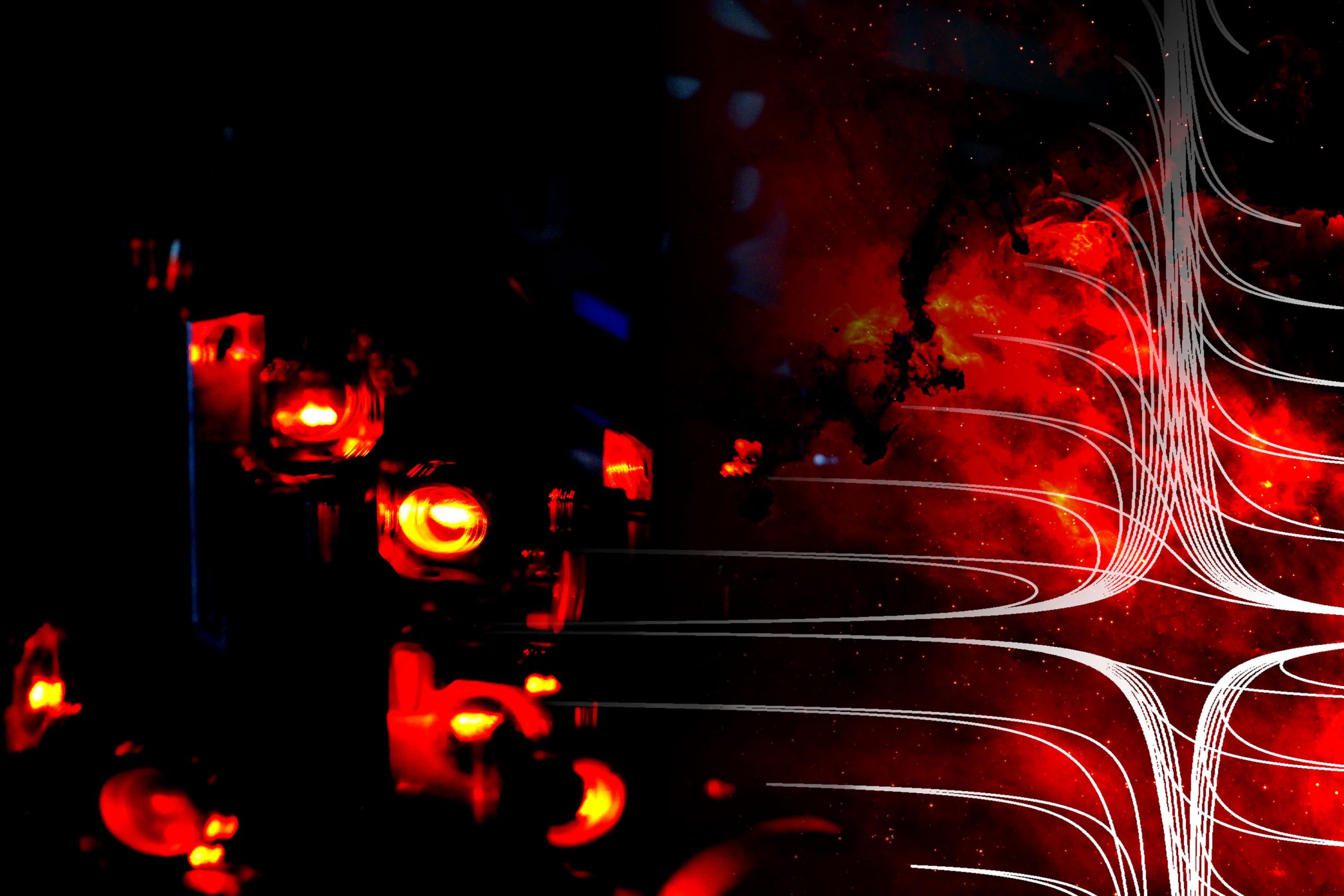
Photon-Photon Polaritons: Intriguing Particles That Emerge When Two Photons Couple
Researchers exploring the interactions between light particles, photons, and matter find that optical microresonators host quasiparticles made by two photons.
Scientists at the University of Bath have found a way to bind together two photons of different colors, paving the way for important advancements in quantum-electrodynamics – the field of science that describes how light and matter interact. In time, the team’s findings are likely to impact developments in optical and quantum communication, and precision measurements of frequency, time, and distances.
Apple and Wave: They Both Have a Mass
An apple falling from a tree has velocity and mass, which together give it momentum. ‘Apple energy’ derived from motion depends on the fruit’s momentum and mass.
Most people find the concept of momentum and energy (and therefore mass) an easy one to grasp when it’s associated with solid objects. But the idea that non-material objects, such as light waves (everything from sunlight to laser radiation), also have a mass is surprising to many. Among physicists, however, it’s a well-known fact. This apparently paradoxical idea that waves have a mass marks the place where quantum physics and the physical world come together.
The wave-particle duality, proposed by French physicist Louis de Broglie in 1924, is a powerful concept that describes how every particle or quantum entity can be described as either a particle or a wave. Many so-called quasiparticles have been discovered that combine either two different types of matter particles, or light waves bound to a particle of matter. A list of exotic quasiparticles includes phonons, plasmons, magnons, and polaritons.
The team of physicists at Bath has now reported a way to create quasiparticles that bind together two differently colored particles of light. They have named these formations photon-photon polaritons.
Detecting Photon-Photon Polaritons
The opportunity to discover, and manipulate, photon-photons is possible thanks to the relatively new development of high-quality microresonators. For light, microresonators act as miniature racetracks, with photons zipping around the internal structure in loops. The signature left by photon-photons in the light exiting the microresonator can be linked to the Autler–Townes effect, a peculiar phenomenon in quantum theory that describes strong photon-atom interactions. To achieve this effect in microresonators, a laser is tuned to the specific resonance frequency where a photon is expected to be absorbed, yet no resonance absorption happens. Instead, the photon-photon interaction makes up two new resonance frequencies away from the old one.
A significant feature that has emerged from the Bath research is that the microresonator provided a whole set of split resonances, where each photon-photon pair displayed its own momentum and energy, allowing the researchers to apply the quasiparticle concept and calculate mass. According to the researchers’ predictions, photon-photons are 1,000+ times lighter than electrons.
Professor Dmitry Skryabin, the physicist who led the research, said: “We now have a situation where microresonators – which are millimeter-scale objects – behave like giant atoms. The artificial atoms concept is rapidly gaining ground in the quantum-electrodynamics of microwaves in superconducting circuits, while here we are looking at the similar opportunity in the optical range of frequencies.
“The small mass of photon-photons could lead to further developments of many important analogies between light and fluids, where other families of quasiparticles have already being used.”
PhD student Vlad Pankratov, who participated in the project, said: “After a year of running models and collecting data, these are incredibly exciting findings for us. The potential applications of our results are in the terabit and quantum optical communication schemes, and in the area of precision measurements.”
Reference: “Photon-photon polaritons in χ(2) microresonators” by D. V. Skryabin, V. V. Pankratov, A. Villois and D. N. Puzyrev, 17 February 2021, Physical Review Research.
DOI: 10.1103/PhysRevResearch.3.L012017
This work was supported by the European Union Marie Skłodowska-Curie Actions (812818, MICROCOMB).
Never miss a breakthrough: Join the SciTechDaily newsletter.
Follow us on Google and Google News.