

As humanity continues its exploration of the universe, the low-gravity environment of space presents unusual challenges for scientists and engineers.
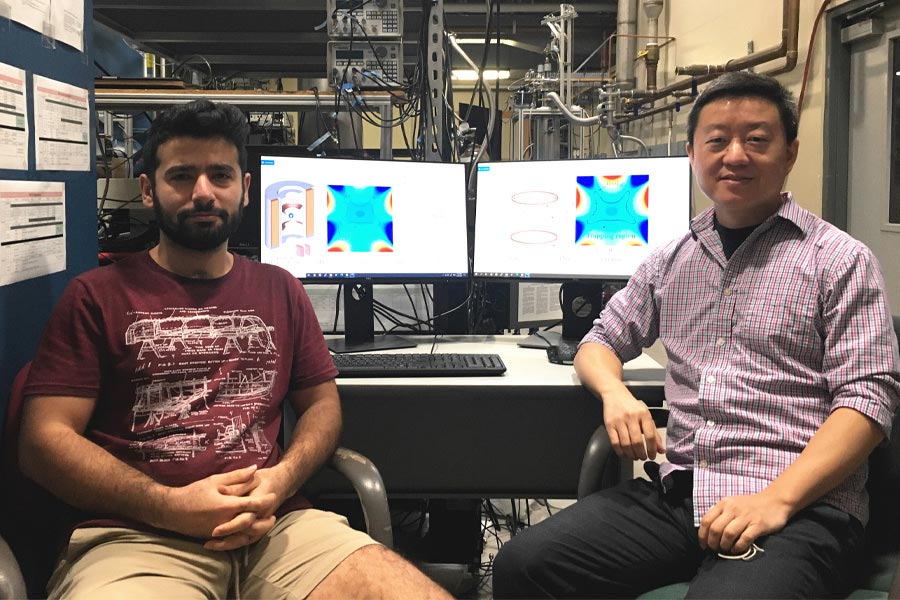
Researchers at the FAMU-FSU College of Engineering and the Florida State University-headquartered National High Magnetic Field Laboratory have developed a new tool to help meet that challenge — a novel design for a low-gravity simulator that promises to break new ground for future space research and habitation.
Their new design for a magnetic levitation-based low-gravity simulator can create an area of low gravity with a volume about 1,000 times larger than existing simulators of the same type. The work was published in the journal npj Microgravity.
“Low gravity has a profound effect on the behaviors of biological systems and also affects many physical processes from the dynamics and heat transfer of fluids to the growth and self-organization of materials,” said Wei Guo, associate professor in mechanical engineering and lead scientist on the study. “However, spaceflight experiments are often limited by the high cost and the small payload size and mass. Therefore, developing ground-based low-gravity simulators is important.”
Existing simulators, such as drop towers and parabolic aircraft, use free fall to generate near-zero gravity. But these facilities typically have short low-gravity durations, i.e., several seconds to a few minutes, which makes them unsuitable for experiments that require long observation times. On the other hand, magnetic levitation-based simulators (MLS) can offer unique advantages, including low cost, easy accessibility, adjustable gravity, and practically unlimited operation time.
But a conventional MLS can only create a small volume of low gravity. When a typical simulator mimics an environment that is about 1 percent of Earth’s gravity, the functional volume is only a few micro-liters, too small for practical space research and applications.
Superconducting Magnet and Maxwell Coil Solution
In order to increase the functional volume of an MLS, the researchers needed a magnet that would allow a uniform levitation force to be generated that would balance the gravitational force in a large volume. They found that they could achieve this by integrating a superconducting magnet with a gradient Maxwell coil — a coil configuration that was first proposed in the 1800s by physicist James Clark Maxwell.
“Our analysis shows that an unprecedented functional volume of over 4,000 micro-liters can be achieved in a compact coil with a diameter of only eight centimeters,” said doctoral student Hamid Sanavandi, a co-author of the paper. “When the current in the MLS is reduced to emulate the gravity on Mars, the functional volume can exceed 20,000 micro-liters, or about 20 cubic centimeters.”
The researchers also showed how the MLS can be made using existing high-temperature superconducting materials, which allows it to operate with minimal energy consumption.
This work could prove especially useful in the preparation for future space missions aimed at long-term habitation of the moon and Mars.
A Game-Changer for Biological and Medical Research
“The fact that our MLS design offers a functional volume about three orders of magnitude larger than that for conventional solenoid MLSs makes it a potential game-changer in the low-gravity research field,” Guo said. “When this MLS design is used to emulate reduced gravities in extraterrestrial environments, such as on the moon or the Mars, the resulted functional volume is large enough to accommodate even small plants, making this an exciting tool for medical and biology research.”
Reference: “Low-Gravity Simulator Design Offers New Avenues for Space Research and Mission Training” by Hamid Sanavandi and Wei Guo, 29 October 2021, npj Microgravity.
DOI: 10.1038/s41526-021-00174-4
This research was supported by the National Science Foundation under Grant No. CBET-1801780. The work was conducted at the National High Magnetic Field Laboratory at Florida State University, which is supported by National Science Foundation Cooperative Agreement No. DMR-1644779 and the State of Florida.
Never miss a breakthrough: Join the SciTechDaily newsletter.
Follow us on Google and Google News.