
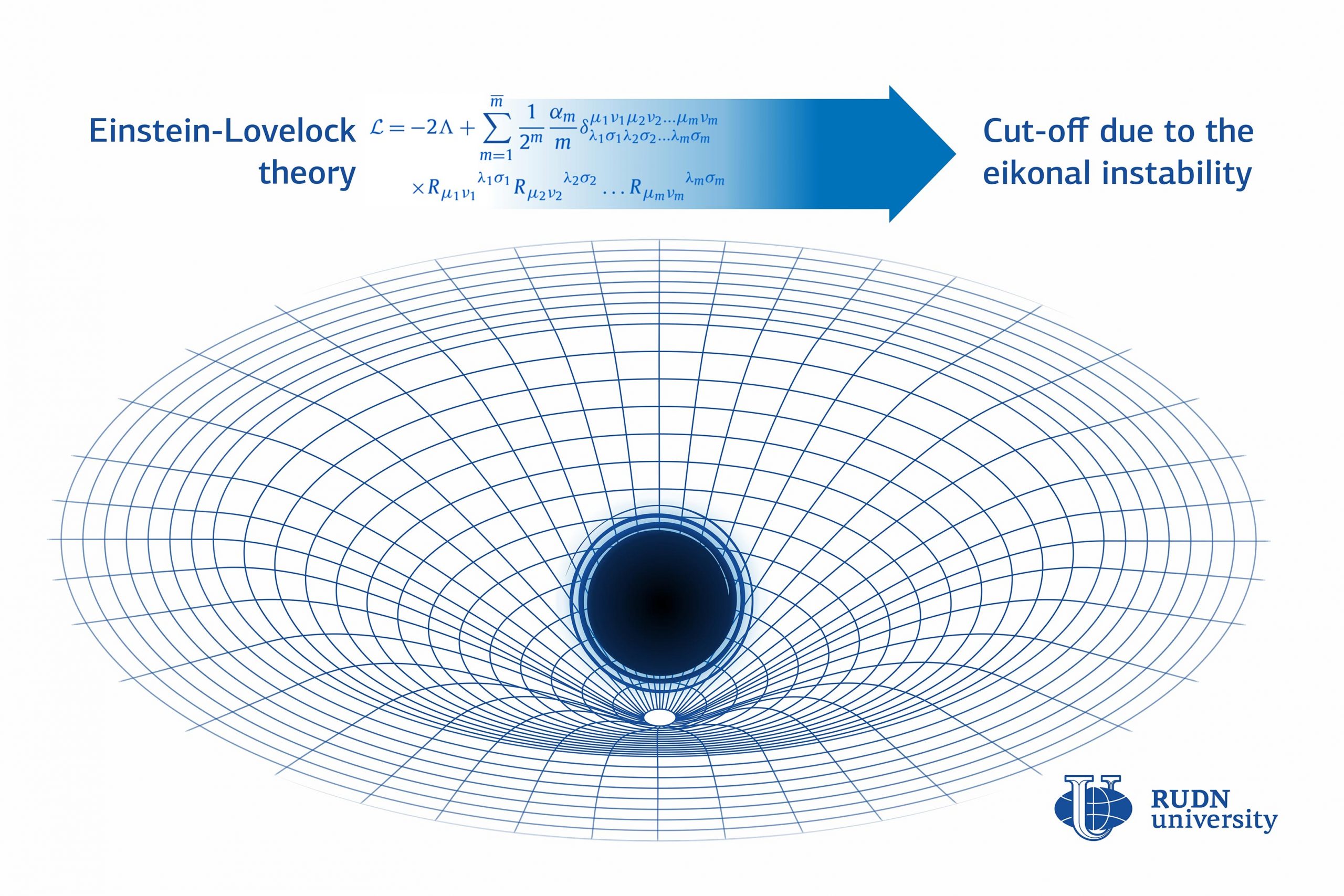
Allowing for quantum corrections, the Einstein-Lovelock theory describes black holes with an equation that contains an infinite number of terms. However, according to a RUDN University physicist, the geometry of a black hole in this theory can be presented in a compact form, and a limited number of terms can suffice to describe the observed values. This could help scientists study black holes in theories with quantum corrections to Einstein’s equations. The work was published in the Physics Letters B journal.
Einstein’s general theory of relativity predicted the existence of black holes — supermassive objects in the Universe that attract everything, including light. Black holes are described by many mathematical models, one of which is the Einstein-Lovelock theory that imposes quantum corrections to elaborate on the general theory of relativity. In it, a black hole is described by a sum of an infinite number of terms. However, a physicist from RUDN University confirmed that a limited number of terms can suffice to describe the effects observed in the vicinity of a black hole. Other components of the equation have a negligibly small contribution that can be ignored. This would considerably simplify calculations and help researchers study black holes in theories with quantum corrections.
According to Einstein’s theory, heavy objects warp space-time — a 4D construction that has three spatial and one temporal dimension. In 1971, Lovelock generalized this theory to include any number of dimensions. The Einstein-Lovelock equation is an infinite sum: the first two terms in it are Einstein’s representation, and each subsequent one details the space-time curvature.
Each term in the Einstein-Lovelock equation is multiplied by the so-called coupling constant. According to the physicist from RUDN University, if one sticks to the positive values of coupling constants, high curvature corrections can be ‘cut off’. This is due to the fact that each coupling constant has a critical value: after it is reached, a black hole becomes unstable, i.e. unable to exist in reality. Such a representation is still possible from the point of view of mathematics but has no physical sense. The more terms, the lower is the critical value for coupling constants. Therefore the stability of a black hole (i.e. the possibility of its physical existence) can be used as a criterion to remove redundant terms.
“With every new Lovelock’s term, the critical value of coupling constants becomes lower. This is an important observation: it confirms that in order to find the biggest possible correction to black hole geometry caused by a newly added Lovelock’s term, all other terms can be considered negligibly small,” said Roman Konoplya, a researcher at the Academic Research Institute for Gravitation and Cosmology, RUDN University.
According to the scientist and his team, the main observable values (such as the radius of a black hole shadow) remain virtually unchanged when the Lovelock corrections of higher than the fourth order in curvature are included. These findings can be useful not only for studying processes in the black holes but also for confirming theoretical predictions associated with possible generalizations of Einstein’s theory.
Reference: “4D Einstein-Lovelock black holes: Hierarchy of orders in curvature” by R. A. Konoplya and A. Zhidenko, 7 July 2020, Physics Letters B.
DOI: 10.1016/j.physletb.2020.135607
Never miss a breakthrough: Join the SciTechDaily newsletter.
Follow us on Google and Google News.
10 Comments
… this all looks like a story about Isaac Newton and his late gravity theory, there was a lot of attempts to save the sick puppy, but Albert Einstein came along and he kicked the old sick puppy.
Now, it is a time to kick his sick puppy…
? The paper results strengthen Einstein’s theory. C.f. how last week the black hole observations increased the precision against alternatives with a factor 500 [ https://scitechdaily.com/einsteins-theory-of-general-relativity-tested-using-black-hole-shadow/ ].
This is a very successful theory, and its former competition has mostly already vanished because they don’t agree with observations. C.f. how the multimessenger binary neutron star merger mostly killed them already 2017, and now it became a factor 500 harder to remain in the competition. The paper here show some of the reason why, Einstein’s theory is the simplest classical theory consistent with observations that is at the same time robust against modifications.
What utter nonsense.
Since Lovelock theory is the natural extension of general relativity to higher dimensions [ https://en.wikipedia.org/wiki/Lovelock_theory_of_gravity ], it seems to be a convenient testing ground for alternatives to it as well as for characterizing how robust it is by itself.
Pity summary:
General relativity remains a winner. From the paper, on additive corrections: “Therefore, for this case, we can safely ignore the fifth and higher Lovelock orders as it is unlikely that the deviation from the Einstein theory for the geodesics’ parameters could be observed with accuracy of ∼ 0.2% in the near future.”
Ridiculous!
Mostly ridiculous trolling comments, yes.
… entanglement doesn’t exist, and we don’t fall down because the space time is curved, etc…
Yeah, very successful one though! Just one thing, when is next step?
Even though, Albert has changed the Newton it doesn’t mean that Newtons physic are not significant, but this doesn’t mean that it is the end of the road, just less rough corners, that need to be unseen by regular eyes.
Complexity is the best cloak of invisibility for common people, but not for them all….
… And one more, a very short one.
Let’s say that one would need to figure out the threads of kneatting and how to perform the kneatting of the space time. One would need to know about many more thing too.
It’s a pity that main stream physicists are no longer interested in rational debates, but simply reject all proofs showing relativity is wrong and there is no such thing called spacetime in nature. As Einstein’s relativity has already been disproved for more than four years both experimentally and theoretically, they are still wasting tax-payers money to mislead the public.
The most reliable and well-known experimental evidence for the absolute time is that the atomic clocks on the GPS satellites, after corrections, are synchronized to show the same absolute time relative to all reference frames (the ground frame, the satellite frames, etc), while special relativity claims that time is relative and thus clocks can never be synchronized relative to more than one inertial reference frame no matter how you correct them.
Einstein made a fatal mistake in his special relativity. He postulates that the speed of light should be the same relative to all inertial reference frames, which forces the change of the definition of space and time. But he never verified that the newly defined time was still the time measured with physical clocks. Please be aware that our physical time i.e. clock time won’t change with the change of the definition of the space and time. Actually, the newly defined relativistic time is indeed not the time measured with physical clocks any longer. It is just a mathematical variable without physical meaning, which can be easily verified as follows:
We know a clock records the effect of time such as the angle of the arm or the number of cycles, etc, and then uses it to calculate time, rather than recording time directly. That is, physical time T has a relationship with the relativistic time t in Einstein’s special relativity: T = tf/k where f is the relativistic frequency of the clock and k is a calibration constant. Now We would like to use the behavior of our physical time in Lorentz Transformation to demonstrate that the relativistic time t defined by Lorentz Transformation is no longer our physical time T.
If you have a clock (clock 1) with you and watch my clock (clock 2) in motion and both clocks are set to be synchronized to show the same physical time T relative to your inertial reference frame at relativistic time t, you will see your clock time: T1 = tf1/k1 = T and my clock time: T2 = tf2/k2 = T, where t is the relativistic time of your reference frame, f1 and f2 are the relativistic frequencies of clock 1 and clock 2 respectively, k1 and k2 are calibration constants of the clocks. The two events (Clock1, T1=T, x1=0, y1=0, z1=0, t1=t) and (Clock2, T2=T, x2=vt, y2=0, z2=0, t2=t) are simultaneous measured with both relativistic time t and clock time T in your reference frame. When these two clocks are observed by me in the moving inertial reference frame, according to special relativity, we can use Lorentz Transformation to get the events in my frame (x’, y’, z’, t’): (clock1, T1′, x1’=-vt1′, y1’=0, z1’=0, t1’=t/γ) and (clock2, T2′, x2’=0, y2’=0, z2’=0, t2’=γt), where T1′ = t1’f1’/k1 = (t/γ)(γf1)/k1 = tf1/k1 = T1 = T and T2′ = t2’f2’/k2 = (γt)(f2/γ)/k2 = tf2/k2 = T2 = T, where γ = 1/sqrt(1-v^2/c^2). That is, no matter observed from which inertial reference frame, the events are still simultaneous measured with physical time: T1 = T2 = T1′ = t2′ = T, i.e., the two clocks are always synchronized measured with physical time T, but not synchronized measured with relativistic time t’: t1′ != t2′ though t1 = t2 = t. Therefore, our physical time and the relativistic time behave differently in Lorentz Transformation and thus they are not the same thing. The change of the reference frame only makes changes of the relativistic time from t to t’ and the relativistic frequency from f to f’, which cancel each other in the formula: T = tf/k to make the physical time T unchanged i.e. our physical time is still absolute in special relativity. Thus, relativistic time is just an artificial mathematical variable without physical meaning. Based on the artificial relativistic time, special relativity is wrong, so is general relativity. For more details, please check:
https://www.researchgate.net/publication/297527784_Challenge_to_the_Special_Theory_of_Relativity
… at small distances space-time doesn’t behave like a analysis we know, and then you try to explain it with it…
… Strange, at least to say…
…strengthens, …