
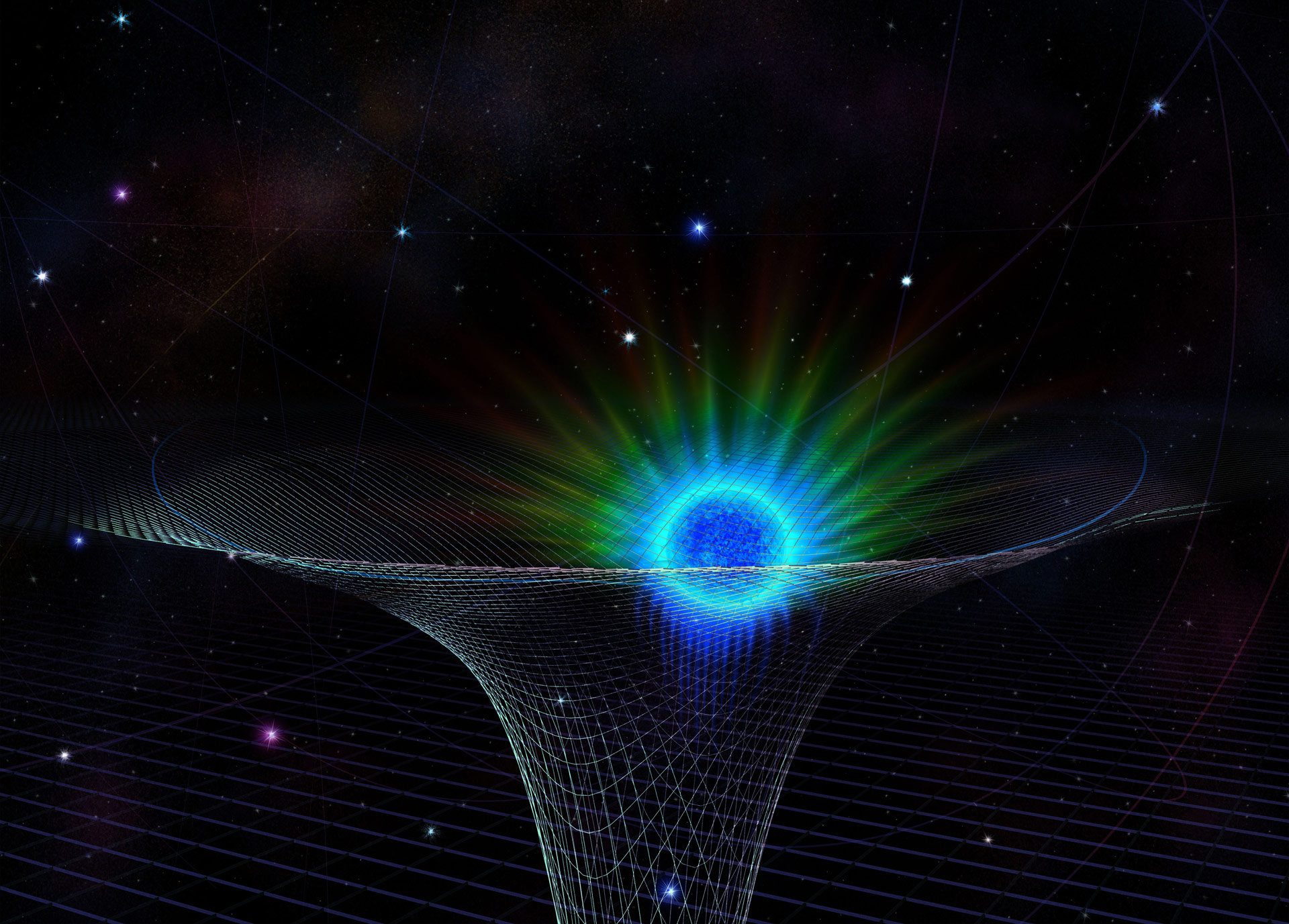
More than 100 years after Albert Einstein published his iconic general theory of relativity, it is beginning to fray at the edges, said Andrea Ghez, UCLA professor of physics and astronomy. Now, in the most comprehensive test of general relativity near the monstrous black hole at the center of our galaxy, Ghez and her research team report on July 25 in the journal Science that Einstein’s theory holds up.
“Einstein’s right, at least for now,” said Ghez, a co-lead author of the research. “We can absolutely rule out Newton’s law of gravity. Our observations are consistent with Einstein’s general theory of relativity. However, his theory is definitely showing vulnerability. It cannot fully explain gravity inside a black hole, and at some point we will need to move beyond Einstein’s theory to a more comprehensive theory of gravity that explains what a black hole is.”
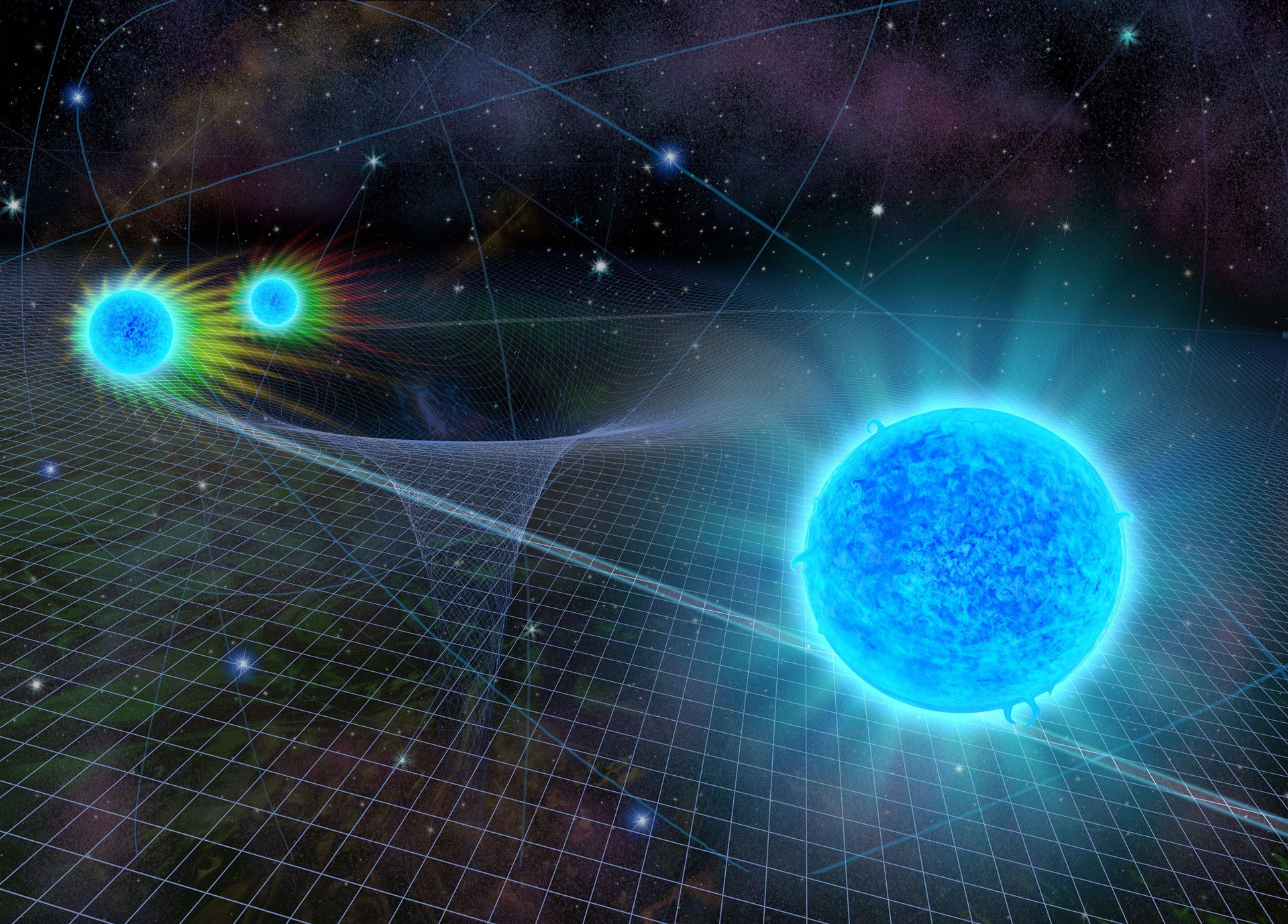
Einstein’s 1915 general theory of relativity holds that what we perceive as the force of gravity arises from the curvature of space and time. The scientist proposed that objects such as the sun and the Earth change this geometry. Einstein’s theory is the best description of how gravity works, said Ghez, whose UCLA-led team of astronomers has made direct measurements of the phenomenon near a supermassive black hole — research Ghez describes as “extreme astrophysics.”
Andrea Ghez: Feeling gravity’s pull. Video by Julie Winokur
The laws of physics, including gravity, should be valid everywhere in the universe, said Ghez, who added that her research team is one of only two groups in the world to watch a star known as S0-2 make a complete orbit in three dimensions around the supermassive black hole at the center of the Milky Way. The full orbit takes 16 years, and the black hole’s mass is about 4 million times that of the sun.
The researchers say their work is the most detailed study ever conducted into the supermassive black hole and Einstein’s general theory of relativity.
The key data in the research were spectra that Ghez’s team analyzed last April, May and September as her “favorite star” made its closest approach to the enormous black hole. Spectra, which Ghez described as the “rainbow of light” from stars, shows the intensity of light and offers important information about the star from which the light travels. Spectra also show the composition of the star. These data were combined with measurements Ghez and her team have made over the last 24 years.
Spectra — collected at the W.M. Keck Observatory in Hawaii using a spectrograph built at UCLA by a team led by colleague James Larkin — provide the third dimension, revealing the star’s motion at a level of precision not previously attained. (Images of the star the researchers took at the Keck Observatory provide the two other dimensions.) Larkin’s instrument takes light from a star and disperses it, similar to the way raindrops disperse light from the sun to create a rainbow, Ghez said.
“What’s so special about S0-2 is we have its complete orbit in three dimensions,” said Ghez, who holds the Lauren B. Leichtman and Arthur E. Levine Chair in Astrophysics. “That’s what gives us the entry ticket into the tests of general relativity. We asked how gravity behaves near a supermassive black hole and whether Einstein’s theory is telling us the full story. Seeing stars go through their complete orbit provides the first opportunity to test fundamental physics using the motions of these stars.”
Animation by Zina Deretsky/National Science Foundation
Ghez’s research team was able to see the co-mingling of space and time near the supermassive black hole. “In Newton’s version of gravity, space and time are separate, and do not co-mingle; under Einstein, they get completely co-mingled near a black hole,” she said.
“Making a measurement of such fundamental importance has required years of patient observing, enabled by state-of-the-art technology,” said Richard Green, director of the National Science Foundation’s division of astronomical sciences. For more than two decades, the division has supported Ghez, along with several of the technical elements critical to the research team’s discovery. “Through their rigorous efforts, Ghez and her collaborators have produced a high-significance validation of Einstein’s idea about strong gravity.”
Keck Observatory Director Hilton Lewis called Ghez “one of our most passionate and tenacious Keck users.” “Her latest groundbreaking research,” he said, “is the culmination of unwavering commitment over the past two decades to unlock the mysteries of the supermassive black hole at the center of our Milky Way galaxy.”
The researchers studied photons — particles of light — as they traveled from S0-2 to Earth. S0-2 moves around the black hole at blistering speeds of more than 16 million miles per hour at its closest approach. Einstein had reported that in this region close to the black hole, photons have to do extra work. Their wavelength as they leave the star depends not only on how fast the star is moving, but also on how much energy the photons expend to escape the black hole’s powerful gravitational field. Near a black hole, gravity is much stronger than on Earth.
Ghez was given the opportunity to present partial data last summer, but chose not to so that her team could thoroughly analyze the data first. “We’re learning how gravity works. It’s one of four fundamental forces and the one we have tested the least,” she said. “There are many regions where we just haven’t asked, how does gravity work here? It’s easy to be overconfident and there are many ways to misinterpret the data, many ways that small errors can accumulate into significant mistakes, which is why we did not rush our analysis.”
Ghez, a 2008 recipient of the MacArthur “Genius” Fellowship, studies more than 3,000 stars that orbit the supermassive black hole. Hundreds of them are young, she said, in a region where astronomers did not expect to see them.
It takes 26,000 years for the photons from S0-2 to reach Earth. “We’re so excited, and have been preparing for years to make these measurements,” said Ghez, who directs the UCLA Galactic Center Group. “For us, it’s visceral, it’s now — but it actually happened 26,000 years ago!”
This is the first of many tests of general relativity Ghez’s research team will conduct on stars near the supermassive black hole. Among the stars that most interest her is S0-102, which has the shortest orbit, taking 11 1/2 years to complete a full orbit around the black hole. Most of the stars Ghez studies have orbits much longer than a human lifespan.
Ghez’s team took measurements about every four nights during crucial periods in 2018 using the Keck Observatory — which sits atop Hawaii’s dormant Mauna Kea volcano and houses one of the world’s largest and premier optical and infrared telescopes. Measurements are also taken with an optical-infrared telescope at Gemini Observatory and Subaru Telescope, also in Hawaii. She and her team have used these telescopes both on-site in Hawaii and remotely from an observation room in UCLA’s department of physics and astronomy.
Black holes have such high density that nothing can escape their gravitational pull, not even light. (They cannot be seen directly, but their influence on nearby stars is visible and provides a signature. Once something crosses the “event horizon” of a black hole, it will not be able to escape. However, the star S0-2 is still rather far from the event horizon, even at its closest approach, so its photons do not get pulled in.)
Ghez’s co-authors include Tuan Do, lead author of the Science paper, a UCLA research scientist and deputy director of the UCLA Galactic Center Group; Aurelien Hees, a former UCLA postdoctoral scholar, now a researcher at the Paris Observatory; Mark Morris, UCLA professor of physics and astronomy; Eric Becklin, UCLA professor emeritus of physics and astronomy; Smadar Naoz, UCLA assistant professor of physics and astronomy; Jessica Lu, a former UCLA graduate student who is now a UC Berkeley assistant professor of astronomy; UCLA graduate student Devin Chu; Greg Martinez, UCLA project scientist; Shoko Sakai, a UCLA research scientist; Shogo Nishiyama, associate professor with Japan’s Miyagi University of Education; and Rainer Schoedel, a researcher with Spain’s Instituto de Astrofısica de Andalucıa.
The National Science Foundation has funded Ghez’s research for the last 25 years. More recently, her research has also been supported by the W.M. Keck Foundation, the Gordon and Betty Moore Foundation and the Heising-Simons Foundation; as well as Lauren Leichtman and Arthur Levine, and Howard and Astrid Preston.
In 1998, Ghez answered one of astronomy’s most important questions, helping to show that a supermassive black hole resides at the center of our Milky Way galaxy. The question had been a subject of much debate among astronomers for more than a quarter of a century.
A powerful technology that Ghez helped to pioneer, called adaptive optics, corrects the distorting effects of the Earth’s atmosphere in real-time. With adaptive optics at Keck Observatory, Ghez and her colleagues have revealed many surprises about the environments surrounding supermassive black holes. For example, they discovered young stars where none was expected to be seen and a lack of old stars where many were anticipated. It’s unclear whether S0-2 is young or just masquerading as a young star, Ghez said.
In 2000, she and colleagues reported that for the first time, astronomers had seen stars accelerate around the supermassive black hole. In 2003, Ghez reported that the case for the Milky Way’s black hole had been strengthened substantially and that all of the proposed alternatives could be excluded.
In 2005, Ghez and her colleagues took the first clear picture of the center of the Milky Way, including the area surrounding the black hole, at Keck Observatory. And in 2017, Ghez’s research team reported that S0-2 does not have a companion star, solving another mystery.
Reference: “Relativistic redshift of the star S0-2 orbiting the Galactic center supermassive black hole” by Tuan Do, Aurelien Hees, Andrea Ghez, Gregory D. Martinez, Devin S. Chu, Siyao Jia, Shoko Sakai, Jessica R. Lu, Abhimat K. Gautam, Kelly Kosmo O’Neil, Eric E. Becklin, Mark R. Morris, Keith Matthews, Shogo Nishiyama, Randy Campbell, Samantha Chappell, Zhuo Chen, Anna Ciurlo, Arezu Dehghanfar, Eulalia Gallego-Cano, Wolfgang E. Kerzendorf, James E. Lyke, Smadar Naoz, Hiromi Saida, Rainer Schödel, Masaaki Takahashi, Yohsuke Takamori, Gunther Witzel and Peter Wizinowich, 25 July 2019, Science.
DOI: 10.1126/science.aav8137
Never miss a breakthrough: Join the SciTechDaily newsletter.
Follow us on Google and Google News.
24 Comments
Headline: Einstein’s General Relativity Theory Beginning to Fray at the Edges
Last line of the first paragraph: Ghez and her research team report July 25 in the journal Science that Einstein’s theory holds up
Talk about “click bait”.
Not a good idea to kick at the support poles your house is resting on before you’ve built the new one.
Very captivating title … But does it state anywhere how general relativity is “fraying” … Or has Fake News infiltrated “science”???(if we can call this article related to “science” at all)
First and last time visiting this site due to the horrendously fake headline
Who came up with the title? Terrible
I’m with you.
Theories are supposed to fray at the edges. Those how science progresses.
Absolutely dishonest article & misleading title. It doesn’t delve into how & to what extent Einstein’s general theory fails to explain gravity inside the event horizon. Please interview the research team for specifics and report them accurately. This is tabloid gossip for science in its current form.
The headline is not clickbait. It’s what Ghez herself said, which is unfortunate language she probably regrets now, in spite of her qualifying remarks. GR is exceptionally robust up until we pass into a BH void about which the theory was never intended to talk. It has been understood for many decades that relativity was incompatible with BH interiors, and incompatible with Quantum domains for that matter btw. There is no ‘beginning’ about it. GR stays in its lane, it’s rock solid; it passes every test.
Addendum. The article isn’t clickbaiting Ghez words.
Reuters, directly quoting Ghez words:
‘ “Newton had the best description of gravity for a long time but it started to fray around the edges. And Einstein provided a more complete theory. Today we are seeing Einstein’s theories starting to fray around the edges,” said Ghez, who led the study published in the journal Science. ‘
What does it mean that a black hole spins? Is there spinning inside the event horizon? If so how do we know that? And if a black hole is spinning, are the stars that revolve around it moving in the same direction, along the same plane?
Tabloid “science” at its worst. Scratch another site off the list of reputable sources.
@ralph, the headline is a quote of Andrea Ghez. It’s not a mischaracterization. She goes on to explain why in the second paragraph.
The key to unifying gravity with the other three fundamental forces is mayonnaise. The key to reconciling quantum mechanics with the gravity of Einstein’s relativity will be found by studying mayonnaise. It either comes out in globs or clings to the jar.
This is written on about a third grade level. Horrible.
SRT and RT are NOT fraying. Solid as Penrose diagrams telling us what a singularity can be or not. Physics and particle physics will tell us if its 4d, 5d or more and degreness of singularityness behind an ever better definition of event horizon.
Scientista is myopic and thats why we cannot rely on females doing science unless under male guidance.
Article is misleading click bait.
What ever the remains of the theory is doesn’t matter it will always change as age catches up
Horsesh@t! No fraying at all of GR has been evidenced. Just the opposite. GR has been ovewhelmingly supported in extraordinary circumstances. This is not just click bait, it’s ignorant and frankly stupid!
… don’t meddle with Albert’s theory it too perfect!…
Yeah, perfect windmill!…
it is … correction…
Einstein gave us a working model of gravity, with math good enough to make pretty accurate predictions.. It’s not a detailed explanation of reality.. Gravity appears to be a pulling force and explaining it that way seems impossible because it is impossible.. Einstein sidestepped the issue by saying space has a geometrical structure that can be curved by mass, and so no pulling force is necessary.. Objects are just following the curve.. The evidence for this geometry of space is circumstancial at best.. While a pull force seems hard to explain, a push force is easily understood.. Gravity as an imbalance of push forces will ultimately be the answer..
… So! 3 body, and beyond systems, any help. Newtons head hurt for days, but Albert’s didn’t…
… Now, there is a reason to ask why is that…
Something like, why American presidents don’t have contacts with aliens any more?
Some will say that that aliens seek a intelligent contact. … So, after Ronald Regan, …
I hope it does fray at the edges, and I hope that some of the members of our species continue to be able to (and WANT to be able to) recognize this. Although, this theory does continue to receive strong support, let’s not dogmatize ourselves to the point of forgetting what science is all about. It’s ironic, considering how Einstein’s early work was negatively criticized “back in its fringe days” by classical physicists who fell for the trap of generational dogma. Let’s remind ourselves of that and at least keep an open mind to all possibilities, even with established theories that continue to offer support and explanation for all that we can see and detect. Assuming we continue to discover and detect new things in this universe, then one day we will find something that GR won’t explain perfectly, hopefully, or else science sort of loses any purpose.
First of all, a theory is just a theory,mainly it’s man’s attempt to explain how or why something is as it is!!! In other words man’s fragile ego can’t stand the idea it cant explain ALL , EVERYTHING IN THE UNIVERSE!!!