
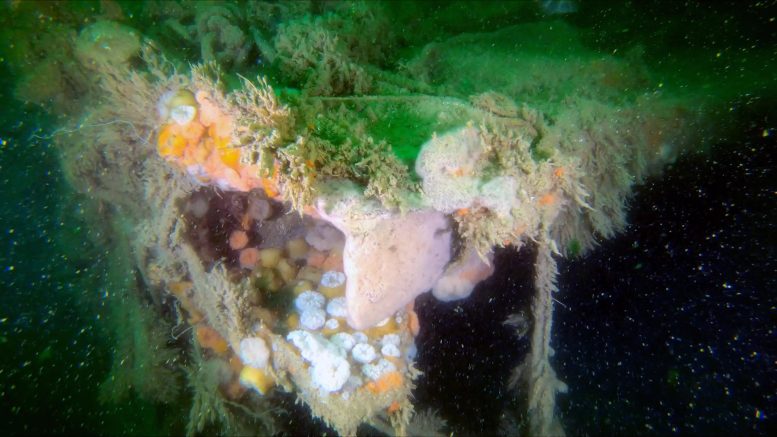
Scientists have discovered that an 80-year-old historic shipwreck from World War II is still influencing the microbiology and geochemistry of the ocean floor where it rests.
In the scientific journal Frontiers in Marine Science, they show how the wreck is leaking hazardous pollutants, including explosives and heavy metals, into the ocean floor sediment of the North Sea, influencing the marine microbiology around it.
The seabed of the North Sea is covered in thousands of ship and aircraft wrecks, warfare agents, and millions of tons of conventional munition such as shells and bombs. Wrecks contain hazardous substances (such as petroleum and explosives) that may harm the marine environment. Yet, there is a lack of information about the location of the wrecks, and the effect they might have on the environment.
“The general public is often quite interested in shipwrecks because of their historical value, but the potential environmental impact of these wrecks is often overlooked,” said PhD candidate Josefien Van Landuyt, of Ghent University.
For instance, it is estimated that World War I and II shipwrecks around the world collectively contain between 2.5 and 20.4 million tons of petroleum products.
“Although we don’t see these old shipwrecks, and many of us don’t know where they are, they can still be polluting our marine ecosystem.” Josefien Van Landuyt
“While wrecks can function as artificial reefs and have tremendous human story-telling value, we should not forget that they can be dangerous, human-made objects which were unintentionally introduced into a natural environment,” Van Landuyt continued. “Today, new shipwrecks are removed for this exact reason.”
Van Landuyt and her colleagues investigated how the World War II shipwreck V-1302 John Mahn in the Belgian part of the North Sea is impacting the microbiome and geochemistry in its surrounding seabed. It was part of the North Sea Wrecks project.
“We wanted to see if old shipwrecks in our part of the sea (Belgium) were still shaping the local microbial communities and if they were still affecting the surrounding sediment. This microbial analysis is unique within the project,” explained Van Landuyt.
Dangerous Chemicals and Corroding Microbes
A German fishing trawler, V-1302 John Mahn, was requisitioned during World War II to use as a patrol boat. During ‘the Channel Dash’ in 1942, it was attacked by the British Royal Air Force in front of the Belgian coast, where it quickly sank to the bottom of the sea.
To analyze the bio- and geochemistry around the shipwreck, the researchers took steel hull and sediment samples from and around it, at an increasing distance from it and in different directions.
They found varying degrees of concentrations of toxic pollutants depending on the distance from the shipwreck. Most notably, they found heavy metals (such as nickel and copper), polycyclic aromatic hydrocarbons (PAHs; chemicals that occur naturally in coal, crude oil, and gasoline), arsenic, and explosive compounds.
The highest metal concentrations were found in the sample closest to the ship’s coal bunker. The freshly deposited sediment in the wake of the wreck had a high metal content. The highest PAH concentrations were closest to the ship.
“Although we don’t see these old shipwrecks, and many of us don’t know where they are, they can still be polluting our marine ecosystem,” explained Van Landuyt.
“In fact, their advancing age might increase the environmental risk due to corrosion, which is opening up previously enclosed spaces. As such, their environmental impact is still evolving.”
They also found that the ship influenced the microbiome around it. Known PAH-degrading microbes like Rhodobacteraceae and Chromatiaceae were found in samples with the highest pollutant content. Moreover, sulfate-reducing bacteria (such as Desulfobulbia) were present in the hull samples, likely leading to the corrosion of the steel hull.
Forgotten Polluters
Van Landuyt explained that this study is only the tip of the iceberg: “People often forget that below the sea surface, we, humans, have already made quite an impact on the local animals, microbes, and plants living there and are still making an impact, leaching chemicals, fossil fuels, heavy metals from — sometimes century old — wrecks we don’t even remember are there.”
“We only investigated one ship, at one depth, in one location. To get a better overview of the total impact of shipwrecks on our North Sea, a large number of shipwrecks in various locations would have to be sampled,” Van Landuyt concluded.
Reference: “80 years later: Marine sediments still influenced by an old war ship” by Josefien Van Landuyt, Kankana Kundu, Sven Van Haelst, Marijke Neyts, Koen Parmentier, Maarten De Rijcke and Nico Boon, 18 October 2022, Frontiers in Marine Science.
DOI: 10.3389/fmars.2022.1017136
Never miss a breakthrough: Join the SciTechDaily newsletter.
Follow us on Google and Google News.
12 Comments
Way to cherry pick this wreck. Why didn’t you just go study the U.S.S. Arizona. Same thing but warm shallow water. Your describing every wreck everywhere. It’s not a risk! It’s a localized biome and your wring your hands trying to get another grant. Well, you just wasted the first one. How about next time you try something beneficial to your fellow down trodden humans.
3675 ships were sunk during the days of the Atlantic convoys, let alone the occasional U-boat. That’s a fair trail of polluting stuff scattered and dispersing across the Atlantic. Then there were the convoys to the Mediterranean and Murmansk some of which saw half their ships sunk. No doubt this scattered trail of sunken ships carrying war materials and fuel oil will provide an interesting scatter of geochemistry and resulting changes in local biology. That would make a handy application for research grant.
The ocean is huge and these effects are tiny. There are areas that spew hydrocarbons constantly and naturally, throughout the waters.
Isn’t it amazing how resilient nature is, and organisms have naturally selected to adapt and overcome despite manmade influences
I believe the ocean is quite a large place. But the article was written to show how man has forced the environment that we live in to try and adapt. The things that we do as mankind are and will affect future mankind. Only very recently has man actually given a hoot about what is going on in our world that might affect our well-being. I feel certain that if that person were to go and inspect a shipwreck like the Arizona as one person said on this comment section you would find similar actions being taken by nature. But I also feel certain that that same person that commented would not dare to take a glass of water from right around that shipwreck and then drink it and expect no problems. It is the big picture that was supposed to be shown. We as mankind have polluted almost all Waters in this world. And think about this the radioactive waste from our nuclear power plants and the other things that’s not going away it just gets buried in concrete in tune and buried underground to make it if the radioactivity does come out which it may well because of world war 3 that might be around the corner. The big picture is that we need to do better then we do now if we end up thinking we’re going to live on this planet for a much longer period of time. Our overall environmental impact in only a few hundred years of industrialization is significantly destructive. You are unable to really swim in any river waters without being engulfed in pollution that is resonant and remains behind as industries have changed over a few hundred years. The pollution still emanates into the waters and slowly emanates into mankind and other animals. We really do need to pay attention more our 100 Year lifespan is nothing over billions.
We really need to understand how badly we have and are still polluting air, water, space, sky, and earth to an unbelievable level and degree. The effects would be on drinking water, agricultural commodities, sea food, health etc etc. Already the European world is crying for gas and wheat! Imagine what would be the condition of West by climate change effects and pollution effects on its agriculture, etc. Those who laugh now can’t laugh when there is a hurricane, flood, etc Hence all Wstern rich countries must come to its senses and urgently act together with the test of the world. War by any country should be stopped immediately as every country can be safe only if other countries are safe irrespective of any political system. The rulers must basically understand this.
Delete western when it comes to blaming rich counties. Countries such as PR China, India, Vietnam, Thailand and Pakistan can no longer claim to be “developing”. Any country that can build nuclear reactors and high-speed railways with “bullet” trains is developed. At the height of western power, there were plenty of poor and indeed starving people in those western countries; and there still are such.
Nothing new the Arizona has been leaking oil since 1941
I love hearing comments from people who fail to understand that many of these compounds accumulate in the environment over time with concentrations magnifying up the food chain threatening ALL life. The ocean will dilute the toxic effects is old Republican thinking. Proven time and again to be at best naive, at worst apocryphal.
Liberal; a mental illness, a distortion of reality, a conflict between emotion and reason and a constant search for something to be a victim of
There are no winners in wars . Our only chance of survival is to clean up our environment & atmosphere a d keep it clean .
“Liberal; a mental illness, a distortion of reality, a conflict between emotion and reason and a constant search for something to be a victim of”
Much like being conservative to the point of ignoring obvious environmental hazards if it means living in a bubble of ignorance and idiocy just to keep their thoughts from getting tol uncomfortable.
Caring only for the convenience of the human kind, needs of one species against many, failing to realize that the environment affects the human kind as well.