
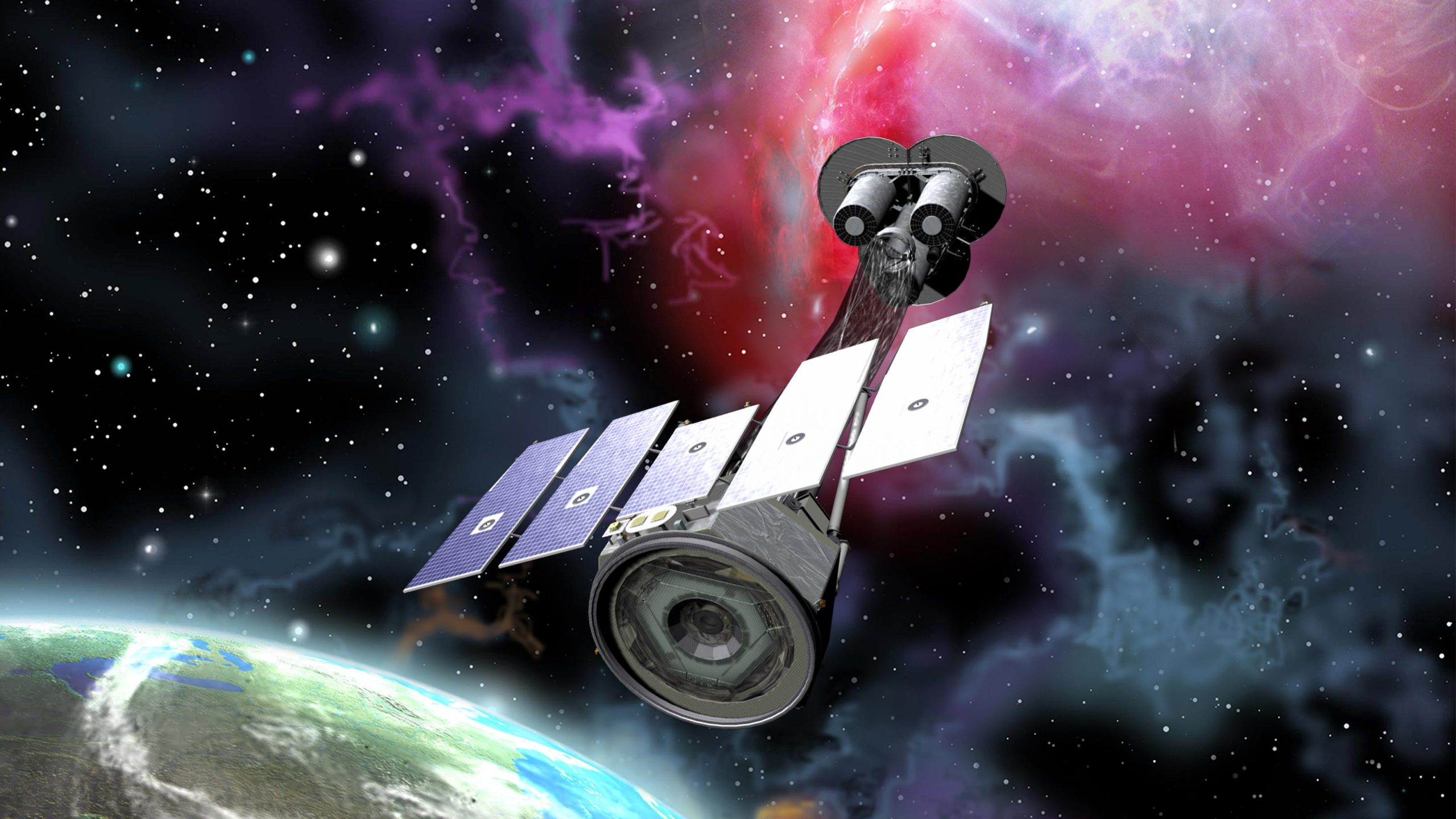
NASA’s Imaging X-ray Polarimetry Explorer (IXPE), launched in collaboration with the Italian Space Agency, is now operational in space, focused on studying X-ray polarization from celestial objects like black holes and supernovae.
NASA’s newest X-ray eyes are open and ready for discovery!
Having spent just over a month in space, the Imaging X-ray Polarimetry Explorer (IXPE) is working and already zeroing in on some of the hottest, most energetic objects in the universe.
A joint effort between NASA and the Italian Space Agency, IXPE is the first space observatory dedicated to studying the polarization of X-rays coming from objects like exploded stars and black holes. Polarization describes how the X-ray light is oriented as it travels through space.
“The start of IXPE’s science observations marks a new chapter for X-ray astronomy,” said Martin Weisskopf, the mission’s principal investigator at NASA’s Marshall Space Flight Center in Huntsville, Alabama. “One thing is certain: we can expect the unexpected.”

IXPE launched December 9 on a Falcon 9 rocket into orbit 370 miles (600 kilometers) above Earth’s equator. The observatory’s boom, which provides the distance needed to focus X-rays onto its detectors, was deployed successfully on December 15. The IXPE team spent the next three weeks checking out the observatory’s maneuvering and pointing abilities and aligning the telescopes.
Over the course of these tests, the team pointed IXPE at two bright calibration targets: 1ES 1959+650, a black-hole-powered galaxy core with jets shooting into space; and SMC X-1, a spinning dead star, or pulsar. The brightness of these two sources made it easy for the IXPE team to see where X-rays are falling on IXPE’s polarization-sensitive detectors and make small adjustments to the telescopes’ alignment.
What’s Next for IXPE?
On January 11, IXPE began observing its first official scientific target – Cassiopeia A, or Cas A – the remains of a massive star that blew itself apart in a supernova around 350 years ago in our own Milky Way galaxy. Supernovae are filled with magnetic energy and accelerate particles to near light-speed, making them laboratories for studying extreme physics in space.
IXPE will provide details about Cas A’s magnetic field structure that can’t be observed in other ways. By studying the X-ray polarization, scientists can work out the detailed structure of its magnetic field and the sites where these particles pick up speed.
IXPE’s observations of Cas A will last about three weeks.
“Measuring X-ray polarization is not easy,” said Weisskopf. “You have to collect a lot of light, and the unpolarized light acts like background noise. It can take a while to detect a polarized signal.”
More About the IXPE Mission
IXPE transmits scientific data several times a day to a ground station operated by the Italian Space Agency in Malindi, Kenya. The data flows from the Malindi station to IXPE’s Mission Operations Center at the University of Colorado Boulder’s Laboratory for Atmospheric and Space Physics (LASP) and then to IXPE’s Science Operations Center at NASA Marshall for processing and analysis. IXPE’s scientific data will be publicly available from the High Energy Astrophysics Science Research Center at the NASA’s Goddard Space Flight Center in Greenbelt, Maryland.
The Marshall science operations team also coordinates with mission operations team at LASP to schedule science observations. The mission plans to observe more than 30 planned targets during its first year. The mission will study distant supermassive black holes with energetic particle jets that light up their host galaxies. IXPE will also probe the twisted space-time around stellar-mass black holes and measure their spin. Other planned targets include different types of neutron stars, such as pulsars and magnetars. The science team has also reserved about a month to observe other interesting objects that may appear in the sky or brighten unexpectedly.
IXPE is a collaboration between NASA and the Italian Space Agency with partners and science collaborators in 12 countries. Ball Aerospace, headquartered in Broomfield, Colorado, manages spacecraft operations.
Never miss a breakthrough: Join the SciTechDaily newsletter.
Follow us on Google and Google News.
1 Comment
Why don’t they ever post an actual photograph. Just show a real picture of space and not a CGI. I don’t need the illusion of the satellite or spacecraft flying through space, just show where it’s heading.