
Close Menu
    Facebook X (Twitter) Instagram
    SciTechDaily
    • Biology
    • Chemistry
    • Earth
    • Health
    • Physics
    • Science
    • Space
    • Technology
    Facebook X (Twitter) Pinterest YouTube RSS
    SciTechDaily
    Home»Space»Hubble Image of the Week – Evolution in Slow Motion
    Space

    Hubble Image of the Week – Evolution in Slow Motion

    By SciTechDailySeptember 14, 20151 Comment2 Mins Read
    Facebook Twitter Pinterest Telegram LinkedIn WhatsApp Email Reddit
    Share
    Facebook Twitter LinkedIn Pinterest Telegram Email Reddit
    Hubble Image of the Week - Evolution in Slow Motion
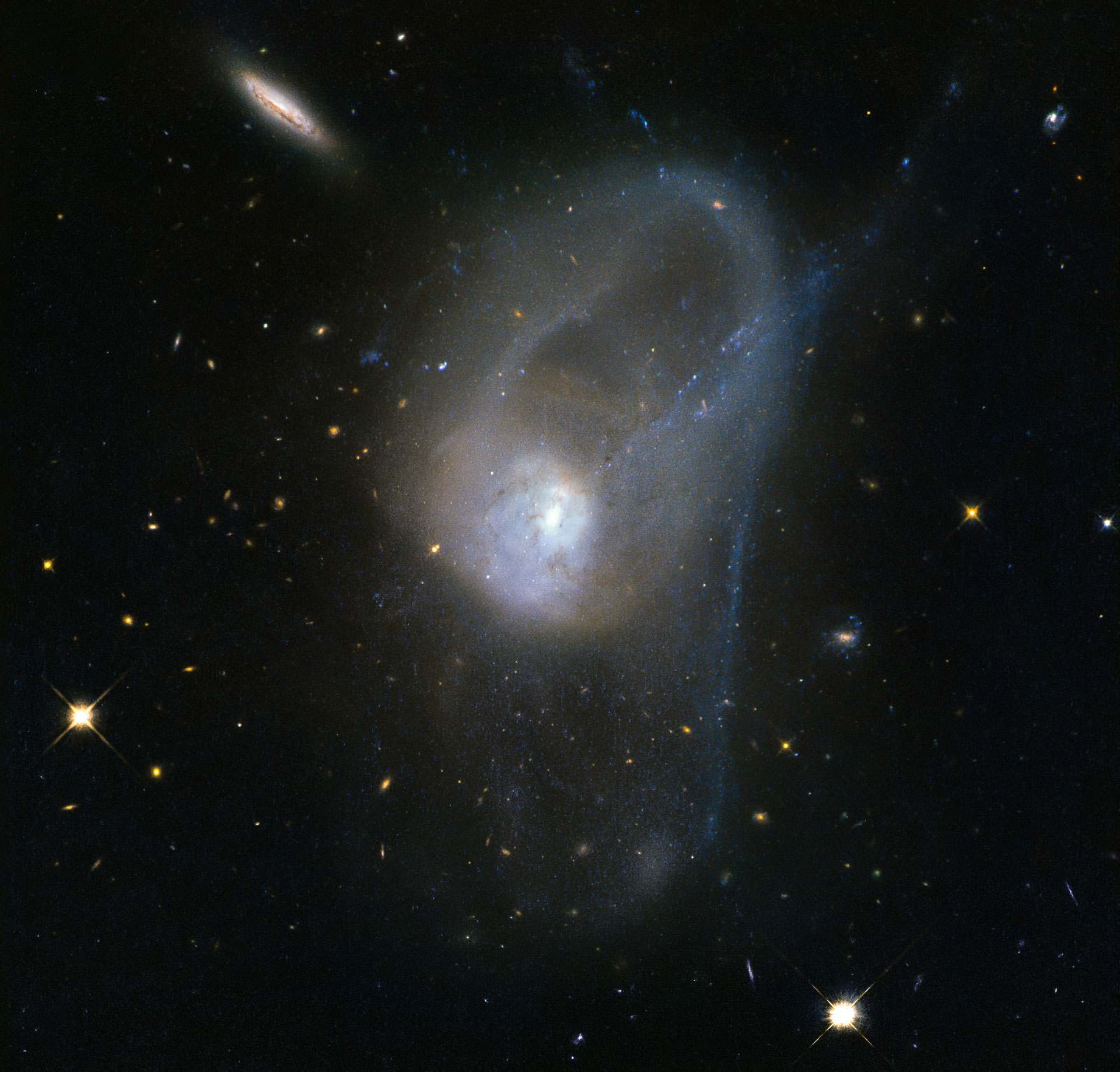
    NGC 3921 — found in the constellation of Ursa Major (The Great Bear) — is an interacting pair of disc galaxies in the late stages of its merger. Credit: ESA/Hubble & NASA, Acknowledgement: Judy Schmidt

    This newly released Hubble image shows a pair of interacting galaxies known as NGC 3921.

    It is known today that merging galaxies play a large role in the evolution of galaxies and the formation of elliptical galaxies in particular. However, there are only a few merging systems close enough to be observed in depth. The pair of interacting galaxies picture seen here — known as NGC 3921 — is one of these systems.

    NGC 3921 — found in the constellation of Ursa Major (The Great Bear) — is an interacting pair of disc galaxies in the late stages of its merger. Observations show that both of the galaxies involved were about the same mass and collided about 700 million years ago. You can see clearly in this image the disturbed morphology, tails, and loops characteristic of a post-merger.

    The clash of galaxies caused a rush of star formation and previous Hubble observations showed over 1000 bright, young star clusters bursting to life at the heart of the galaxy pair.


    Never miss a breakthrough: Join the SciTechDaily newsletter.
    Follow us on Google and Google News.

    Astronomy Cosmology Galaxy Evolution Hubble Space Telescope NASA
    Share. Facebook Twitter Pinterest LinkedIn Email Reddit

    Related Articles

    Hubble Image of the Week: Quadruple Star System DI Cha

    Hubble Reveals Some of the Earliest Known Galaxies

    Newly Released Hubble Image of Spiral Galaxy Messier 96

    How Milky Way-Like Galaxies Have Evolved Over Time

    Uniform Heavy Element Distribution Points to Early Cosmic ‘Seeding’

    Study Suggest Spiral Galaxies Are Larger Than Previously Thought

    One of the Most Efficient Star Making Galaxies Ever Observed

    Asteroid Belts and Their Potential Significance for Life

    Hubble Helps Solve the Mystery of Why Ultra-Faint Dwarf Galaxies Contain Few Stars

    1 Comment

    1. tarzan on September 14, 2015 12:17 pm

      You are still laboring under the myth of the ‘merger’ for reasons that
      are incomprehensible. For starters, the cosmos is expanding and there are more systems and not fewer. Where would the ‘Big Bang’ be if no systems formed afterward?
      Next, you are avoiding the objective possibility that this system is a fission in progress. Like so many others, there is ample evidence that the objects in the system share many ‘DNA’ traits like chemistry and morphology. What are the odds that two RANDOM objects would share so many traits?
      Like fictional ‘merger’ images, there is an evolution of ALL systems that can be more practically explained through fission. In a recent interview
      an astronomer correctly stated that the term “merger” is a “working
      hypothesis” and MUCH more thought needs to be applied to these galactic
      processes.

      Reply
    Leave A Reply Cancel Reply

    • Facebook
    • Twitter
    • Pinterest
    • YouTube

    Don't Miss a Discovery

    Subscribe for the Latest in Science & Tech!

    Trending News

    The Universe Is Expanding Too Fast and Scientists Can’t Explain Why

    “Like Liquid Metal”: Scientists Create Strange Shape-Shifting Material

    Early Warning Signals of Esophageal Cancer May Be Hiding in Plain Sight

    Common Blood Pressure Drug Shows Surprising Power Against Deadly Antibiotic-Resistant Superbug

    Scientists Uncover Dangerous Connection Between Serotonin and Heart Valve Disease

    Scientists Discover a “Protector” Protein That Could Help Reverse Hair Loss

    Bone-Strengthening Discovery Could Reverse Osteoporosis

    Scientists Uncover Hidden Trigger Behind Stem Cell Aging

    Follow SciTechDaily
    • Facebook
    • Twitter
    • YouTube
    • Pinterest
    • Newsletter
    • RSS
    SciTech News
    • Biology News
    • Chemistry News
    • Earth News
    • Health News
    • Physics News
    • Science News
    • Space News
    • Technology News
    Recent Posts
    • Scientists Overcome Major Quantum Bottleneck, Potentially Transforming Teleportation and Computing
    • Quantum Physics’ Strangest Problem May Hold the Key to Time Itself
    • Scientists Create “Liquid Gears” That Spin Without Touching
    • The Simple Habit That Could Help Prevent Cancer
    • Forgotten Medicinal Plant Shows Promise in Fighting Dangerous Superbugs
    Copyright © 1998 - 2026 SciTechDaily. All Rights Reserved.
    • Science News
    • About
    • Contact
    • Editorial Board
    • Privacy Policy
    • Terms of Use

    Type above and press Enter to search. Press Esc to cancel.