
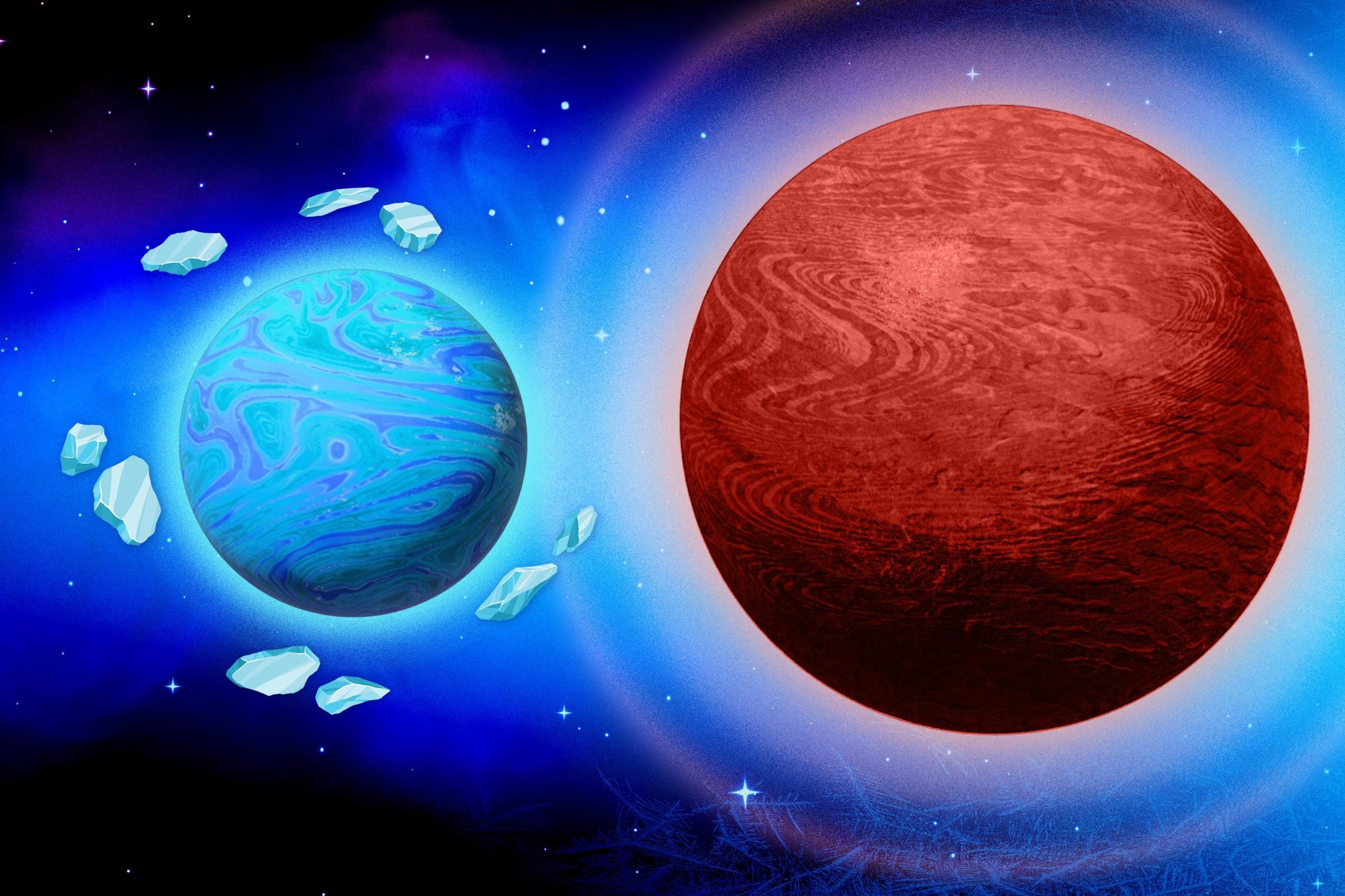
A bizarre pair of planets 190 light-years away is forcing astronomers to rethink how planetary systems form.
A strange and extremely rare pair of planets is orbiting a star about 190 light-years from Earth, and astronomers think they may finally understand how this cosmic odd couple came to exist. The system contains a hot Jupiter, a giant planet type that is usually found alone, along with a smaller mini-Neptune orbiting even closer to the star. Ever since the system was discovered in 2020, scientists have struggled to explain how both planets managed to survive together.
Now, researchers at MIT have used NASA’s James Webb Space Telescope (JWST) to study the atmosphere of the mini-Neptune and uncover new clues about the system’s origins.
JWST Studies a Rare Mini-Neptune
The new findings, published in Astrophysical Journal Letters, mark the first time astronomers have measured the atmosphere of a mini-Neptune located inside the orbit of a hot Jupiter.
The observations revealed that the smaller planet has a dense atmosphere filled with heavier molecules, including water vapor, carbon dioxide, sulfur dioxide, and traces of methane. According to the researchers, this type of atmosphere should not exist if the planet formed near its current location, close to its star.
Instead, the data suggest the mini-Neptune and its giant companion likely formed much farther away in the colder outer regions of their young planetary system.
There, both worlds could have accumulated thick atmospheres rich in ice and volatile compounds before gradually migrating inward over time. Scientists believe the planets moved closer to their star together while keeping their atmospheres intact.
The study also provides the strongest evidence yet that mini-Neptunes can form beyond a star’s “frost line,” the region far enough from a star for water to freeze into ice.
“This is the first time we’ve observed the atmosphere of a planet that is inside the orbit of a hot Jupiter,” says Saugata Barat, a postdoc in MIT’s Kavli Institute for Astrophysics and Space Research and the lead author of the study. “This measurement tells us this mini-Neptune indeed formed beyond the frost line, giving confirmation that this formation channel does exist.”
The international research team includes astronomers from MIT, the Harvard and Smithsonian Center for Astrophysics, the University of South Queensland, the University of Texas at Austin, and Lund University.
A Hot Jupiter With an Unusual Companion
Mini-Neptunes are smaller than Neptune and are mostly made of gas surrounding a rocky core. Although they are among the most common planets found in the Milky Way, our own solar system does not contain any examples.
Most mini-Neptunes discovered so far are considered fairly ordinary. But in 2020, Chelsea X. Huang, then a Torres Postdoctoral fellow at MIT (now on the faculty at University of South Queensland), identified one in a very unusual system. The mini-Neptune appeared to orbit its star alongside a hot Jupiter, something astronomers rarely see.
The discovery came from observations by NASA’s Transiting Exoplanet Survey Satellite (TESS). Scientists studying the star TOI-1130, located 190 light years away, found signs of two planets orbiting the star every four and eight days.
“This was a one-of-a-kind system,” says Huang. “Hot Jupiters are ‘lonely,’ meaning they don’t have companion planets inside their orbits. They are so massive, and their gravity is so strong, that whatever is inside their orbit just gets scattered away. But somehow, with this hot Jupiter, an inner companion has survived. And that raises questions about how such a system could form.”
Predicting the Perfect JWST Observation
The unusual system motivated scientists to examine the planets in greater detail using JWST, especially the inner mini-Neptune known as TOI-1130b.
But getting the timing right for the observations proved difficult. Most planets orbit their stars with clocklike precision, making their movements easy to predict. In this case, however, the mini-Neptune and hot Jupiter are locked in what astronomers call “mean motion resonance.” Their gravitational interactions slightly alter each other’s orbits, changing the timing of their movements around the star.
To solve this problem, researchers led by Judith Korth of Lund University combined earlier observations of the system and created a detailed model to predict when the planets would pass in front of the star from JWST’s point of view.
“It was a challenging prediction, and we had to be spot-on,” Barat says.
The effort paid off, allowing the team to capture detailed measurements of both planets.
Water Vapor and Heavy Molecules Reveal the Truth
“The beauty of JWST is that it does not observe just in one color, but at different colors, or wavelengths,” Barat explains. “And the specific wavelengths that a planet absorbs can tell you a lot about the composition of its atmosphere.”
The telescope detected clear signatures of water, carbon dioxide, sulfur dioxide, and smaller amounts of methane in the mini-Neptune’s atmosphere. These heavier molecules stand out because planets that form close to their stars are generally expected to have lighter atmospheres dominated by hydrogen and helium.
The findings suggest TOI-1130b could only have formed much farther from its star before migrating inward.
Scientists think the planet originally gathered water and other volatile compounds in the cold region beyond the frost line. In that environment, water freezes onto dust particles, creating icy pebbles that a growing planet can pull into its atmosphere. As the planet later moves closer to its star, the ice evaporates.
Barat says the atmospheric evidence strongly suggests both planets formed in the outer reaches of the system and slowly migrated inward together.
“This system represents one of the rarest architectures that astronomers have ever found,” Barat says. “The observations of TOI-1130b provide the first hint that such mini-Neptunes that form beyond the water/ice line are indeed present in nature.”
Reference: “JWST Unveils a High Mean Molecular Weight Atmosphere for Mini-Neptune TOI-1130 b: Evidence for Formation Beyond the Water Ice Line*” by Saugata Barat, Tyler Fairnington, Shelby Courreges, Chelsea Huang, Andrew Vanderburg, Caroline V. Morley, Judith Korth, Hannu Parviainen, Alexis Brandeker, George Zhou, Thomas M. Evans-Soma, Lizhou Sha, Douglas N. C. Lin, Duncan Wright, Ava Morrissey, Emma Nabbie, Karen A. Collins, Phil Evans, Tristan Guillot, Keith Horne, Don J. Radford, Richard P. Schwarz, Avi Shporer, Gregorg Srdoc and Olga Suarez, 5 May 2026, The Astrophysical Journal Letters.
DOI: 10.3847/2041-8213/ae5f8b
This work was supported, in part, by NASA.
Never miss a breakthrough: Join the SciTechDaily newsletter.
Follow us on Google and Google News.
1 Comment
thanks