
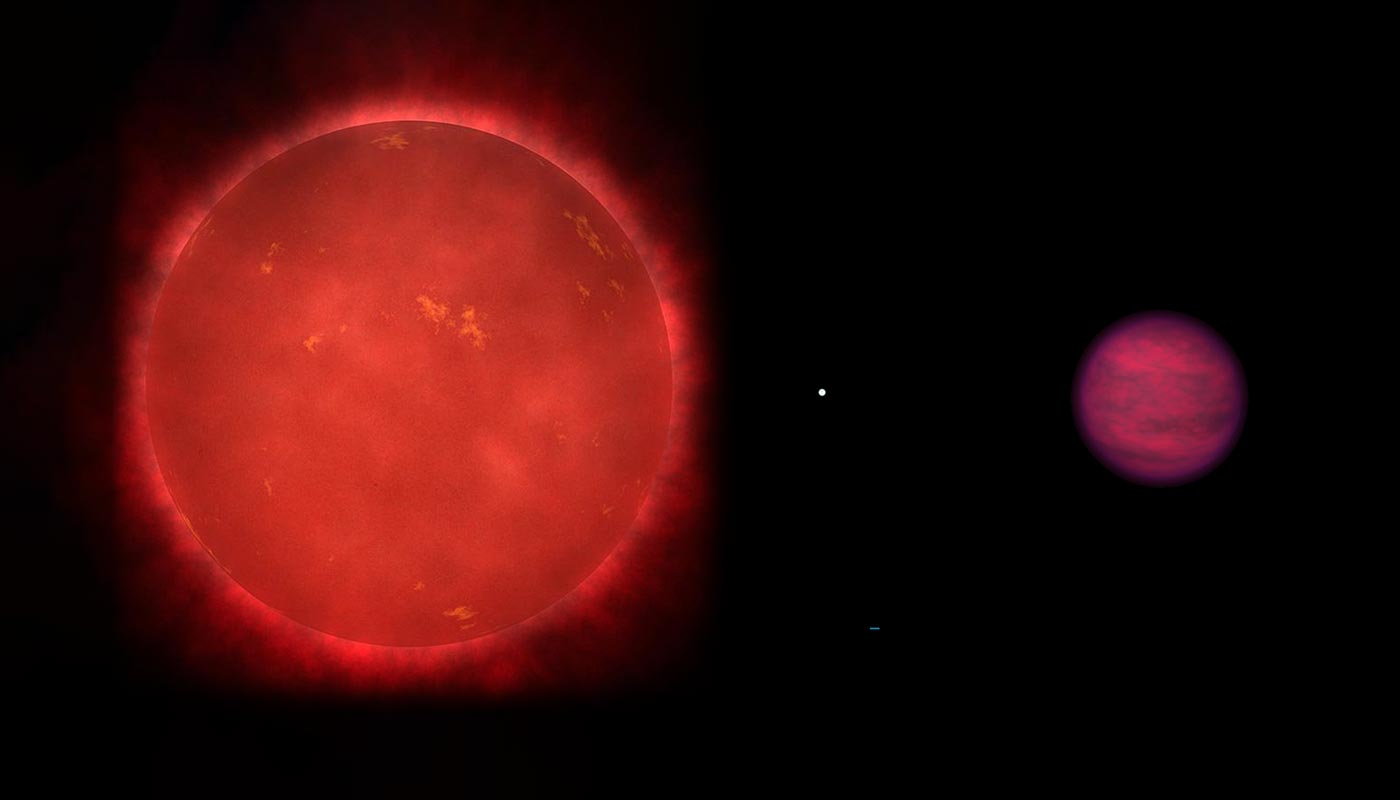
Phosphine has finally been spotted in the atmosphere of the brown dwarf Wolf 1130C, surprising astronomers who have struggled to find the gas elsewhere.
JWST’s detailed measurements revealed phosphine at exactly the levels theory predicted, breaking a streak of unexplained non-detections.
The Role of Phosphorus in Life and Beyond
Phosphorus is one of the six essential elements that support life on Earth. When it combines with hydrogen, it produces phosphine (PH3), a gas that is both explosive and highly toxic. Phosphine is present in the atmospheres of Jupiter and Saturn and has been viewed as a possible biosignature for anaerobic life because terrestrial planets have very few natural ways to generate it. On Earth, it is released through the breakdown of organic material in swampy environments.
A research group led by University of California, San Diego Professor of Astronomy and Astrophysics Adam Burgasser has now identified phosphine in the atmosphere of a cool and ancient brown dwarf called Wolf 1130C. Their findings were published in Science.
Phosphine’s Peculiar Disappearance
The team detected phosphine in Wolf 1130C’s atmosphere using data from the James Webb Space Telescope (JWST), which has the sensitivity needed to examine these faint objects in detail. What puzzles researchers is not the presence of phosphine on this brown dwarf, but its absence in other brown dwarfs and gas giant exoplanets where it has long been predicted to appear.
“Our astronomy program, called Arcana of the Ancients, focuses on old, metal-poor brown dwarfs as a means of testing our understanding of atmospheric chemistry,” said lead author Burgasser. “Understanding the problem with phosphine was one of our first goals.”
The Missing Phosphine Mystery
Phosphine forms naturally in hydrogen-rich atmospheres like those of Jupiter and Saturn. Because of this, scientists have expected to find it on gas giants around other stars and on brown dwarfs, which are larger than planets but smaller than true stars. These objects are sometimes referred to as “failed stars” because they cannot fuse hydrogen.
Despite these expectations, phosphine has been difficult to detect. Even earlier JWST observations did not show the gas, raising concerns about gaps in current models of phosphorus chemistry. “Prior to JWST, phosphine was expected to be abundant in exoplanet and brown dwarf atmospheres, following theoretical predictions based on the turbulent mixing we know exists in these sources,” explained co-author Sam Beiler, who recently graduated from the University of Toledo and is now postdoctoral scholar at Trinity College Dublin.
Beiler, who has previously investigated the missing phosphine problem, added, “Every observation we’ve obtained with JWST has challenged the theoretical predictions — that is, until we observed Wolf 1130C.”
A Curious System: Wolf 1130ABC
In the star system Wolf 1130ABC, located 54 light-years from the sun in the constellation Cygnus, the brown dwarf Wolf 1130C follows a wide orbit around a tight double star system, composed of a cool red star (Wolf 1130A) and a massive white dwarf (Wolf 1130B). Wolf 1130C has been a favorite source for brown dwarf astronomers due to its low abundance of “metals” – essentially any elements other than hydrogen and helium – compared to the sun.
Unlike other brown dwarfs, the team easily spotted phosphine in JWST’s infrared spectral data of Wolf 1130C. To fully understand the implications of their findings, they needed to quantify the abundance of this gas in Wolf 1130C’s atmosphere. This was done by Assistant Professor of Astronomy at San Francisco State University Eileen Gonzales, also a co-author on the study.
“To determine the abundances of molecules in Wolf 1130C, I used a modeling technique known as atmospheric retrievals,” explained Gonzales. “This technique uses the JWST data to back out how much of each molecular gas species should be in the atmosphere. It’s like reverse engineering a really delicious cookie when the chef wouldn’t give up the recipe.”
A Surprising Abundance
Gonzales’s models showed that abundant phosphine was the secret ingredient in Wolf 1130C. Specifically, she found that phosphine was present at the predicted theoretical abundances of about 100 parts per billion.
While the researchers are delighted by their discovery, it raises an issue: why is phosphine present in the atmosphere of this brown dwarf and not others?
One possibility is the low abundance of metals in Wolf 1130C’s atmosphere, which may change its underlying chemistry. “It may be that in normal conditions phosphorus is bound up in another molecule such as phosphorus trioxide,” explained Beiler. “In the metal-depleted atmosphere of Wolf 1130C, there isn’t enough oxygen to take up the phosphorus, allowing phosphine to form from the abundant hydrogen.”
The team hopes to explore this possibility with new JWST observations that will search for phosphine in the atmospheres of other metal-poor brown dwarfs.
Another possibility is that phosphorus was generated locally in the Wolf 1130ABC system, specifically by its white dwarf, Wolf 1130B.
White Dwarfs and Ancient Fireworks
“A white dwarf is the leftover husk of a star that has finished fusing its hydrogen,” explained Burgasser. “They are so dense that when they accrete material on their surface they can undergo runaway nuclear reactions, which we detect as novae.”
Astronomers have not observed any such eruptions in the Wolf 1130ABC system in the time it has been studied, but nova cycles often span thousands or even tens of thousands of years. Because this system has only been known for a little more than a century, earlier eruptions could easily have gone unnoticed. If they occurred, they might have scattered phosphorus throughout the system. Previous research has suggested that this type of event could be responsible for producing a substantial amount of the phosphorus found in the Milky Way.
A Window Into Cosmic Chemistry
Figuring out why Wolf 1130C displays such a distinct phosphine signature could reveal how phosphorus forms in the galaxy and how it behaves in different planetary environments. As Burgasser noted, “Understanding phosphine chemistry in the atmospheres of brown dwarfs where we don’t expect life is crucial if we hope to use this molecule in the search for life on terrestrial worlds beyond our solar system.”
Reference: “Observation of undepleted phosphine in the atmosphere of a low-temperature brown dwarf” by Adam J. Burgasser, Eileen C. Gonzales, Samuel A. Beiler, Channon Visscher, Ben Burningham, Gregory N. Mace, Jacqueline K. Faherty, Zenghua Zhang, Clara Sousa-Silva, Nicolas Lodieu, Stanimir A. Metchev, Aaron Meisner, Michael Cushing, Adam C. Schneider, Genaro Suarez, Chih-Chun Hsu, Roman Gerasimov, Christian Aganze and Christopher A. Theissen, 2 October 2025, Science.
DOI: 10.1126/science.adu0401
This study was funded in part by NASA/STScI (NAS 5-03127 and AR-2232) and the Heising-Simons Foundation.
Never miss a breakthrough: Join the SciTechDaily newsletter.
Follow us on Google and Google News.