
Close Menu
    Facebook X (Twitter) Instagram
    SciTechDaily
    • Biology
    • Chemistry
    • Earth
    • Health
    • Physics
    • Science
    • Space
    • Technology
    Facebook X (Twitter) Pinterest YouTube RSS
    SciTechDaily
    Home»Physics»Proposed Thorium Neutron-Based Clock Would be Accurate for Billions of Years
    Physics

    Proposed Thorium Neutron-Based Clock Would be Accurate for Billions of Years

    By SciTechDailyMarch 21, 2012No Comments2 Mins Read
    Facebook Twitter Pinterest Telegram LinkedIn WhatsApp Email Reddit
    Share
    Facebook Twitter LinkedIn Pinterest Telegram Email Reddit
    laser-tuned-thorium-nuclear-clock
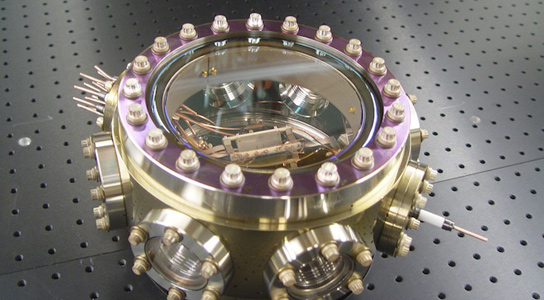
    An ultra-high vacuum chamber houses an ion trap where single thorium atoms are suspended and laser-cooled to near absolute zero temperature. Credit: Alexander Radnaev

    Scientists are proposing the building of a hyper-accurate nuclear clock that would lose only one-tenth of a second over 14 billion years, the current age of the universe. This design would be 100 times more accurate than atomic clocks available today and could be used in applications such as high-precision GPS satellites, and experiments that probe the fundamentals of physics and relativity.

    Normal atomic clocks measure time using the oscillations of a single atom. Time is calculated to 17 decimal places and such precision is needed for GPS measurements and synchronization in particle accelerator experiments. The findings will be published in an upcoming issue of the journal Physical Review Letters.
    ultraviolet-laser-tuning-clock

    Errant magnetism, electrical fields, and microscopic jostling make atomic clocks drift about four seconds over 14 billion years. The new clock would measure time on the oscillations of a neutron, which isn’t susceptible to vibrations or electromagnetic forces.

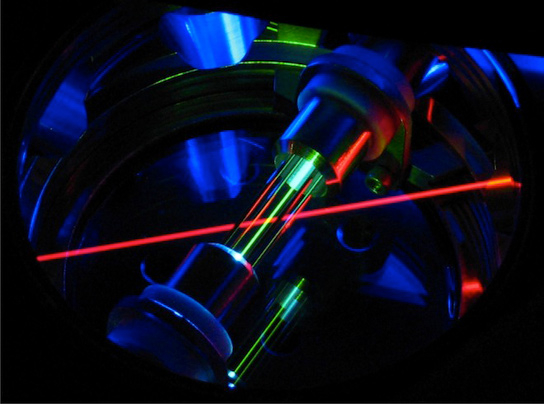
    Researchers would excite a single thorium atom’s nucleus with an ultraviolet laser, and then use the oscillations of the neutrons as a way to measure time. The whole clock would have to be cooled down to just about absolute zero.

    All the technical components are possible with today’s science, but physicists still need to know the exact frequency of the ultraviolet laser emissions so that they can excite the thorium nucleus the right way.

    Reference: “Single-Ion Nuclear Clock for Metrology at the 19th Decimal Place” by C. J. Campbell, A. G. Radnaev, A. Kuzmich, V. A. Dzuba, V. V. Flambaum and A. Derevianko, 22 March 2012, Physical Review Letters.
    DOI: 10.1103/PhysRevLett.108.120802

    Never miss a breakthrough: Join the SciTechDaily newsletter.
    Follow us on Google and Google News.

    Atomic Clock GPS Lasers Neutrons Nuclear Thorium Time
    Share. Facebook Twitter Pinterest LinkedIn Email Reddit

    Related Articles

    Physicists Are Using Time Itself to Crack the Dark Matter Puzzle

    Redefining the Second: The Breakthrough Optical Clocks Revolutionizing Timekeeping

    Discover How Nuclear Innovations Are Revolutionizing Timekeeping

    Deciphering Titanium-48: Unraveling a Century-Old Nuclear Enigma

    1000x More Precise: Breakthrough for Next Generation Atomic Clocks

    MIT Physicists Harness Quantum “Time Reversal” for Detecting Gravitational Waves and Dark Matter

    Atom Laser Creates Reflective Matter-Wave Patterns Similar to Light

    Nuclear Clock Accurate to 19 Decimal Places

    Nucleons in a Dense Nucleus Exceed 25 Percent of the Speed of Light

    Leave A Reply Cancel Reply

    • Facebook
    • Twitter
    • Pinterest
    • YouTube

    Don't Miss a Discovery

    Subscribe for the Latest in Science & Tech!

    Trending News

    AI Could Detect Early Signs of Alzheimer’s in Under a Minute – Far Before Traditional Tests

    What if Dark Matter Has Two Forms? Bold New Hypothesis Could Explain a Cosmic Mystery

    This Metal Melts in Your Hand – and Scientists Just Discovered Something Strange

    Beef vs. Chicken: Surprising Results From New Prediabetes Study

    Alzheimer’s Breakthrough: Scientists Discover Key Protein May Prevent Toxic Protein Clumps in the Brain

    Quantum Reality Gets Stranger: Physicists Put a Lump of Metal in Two Places at Once

    Scientists May Have Found the Key to Jupiter and Saturn’s Moon Mystery

    Scientists Uncover Brain Changes That Link Pain to Depression

    Follow SciTechDaily
    • Facebook
    • Twitter
    • YouTube
    • Pinterest
    • Newsletter
    • RSS
    SciTech News
    • Biology News
    • Chemistry News
    • Earth News
    • Health News
    • Physics News
    • Science News
    • Space News
    • Technology News
    Recent Posts
    • Scientists Discover Enzyme That Could Supercharge Ozempic-Like Weight Loss Drugs
    • Asthma and Depression Don’t Mix the Way Scientists Expected
    • Why Promising Cancer Drugs Failed: Scientists Uncover the Missing Piece
    • Popular Sweetener Linked to DNA Damage – “It’s Something You Should Not Be Eating”
    • Ancient “Rock” Microbes May Reveal How Complex Life Began
    Copyright © 1998 - 2026 SciTechDaily. All Rights Reserved.
    • Science News
    • About
    • Contact
    • Editorial Board
    • Privacy Policy
    • Terms of Use

    Type above and press Enter to search. Press Esc to cancel.