
Close Menu
    Facebook X (Twitter) Instagram
    SciTechDaily
    • Biology
    • Chemistry
    • Earth
    • Health
    • Physics
    • Science
    • Space
    • Technology
    Facebook X (Twitter) Pinterest YouTube RSS
    SciTechDaily
    Home»Space»Emerald-Cut Dwarf Galaxy Located 70 Million Light-Years Away
    Space

    Emerald-Cut Dwarf Galaxy Located 70 Million Light-Years Away

    By SciTechDailyMarch 21, 2012No Comments2 Mins Read
    Facebook Twitter Pinterest Telegram LinkedIn WhatsApp Email Reddit
    Share
    Facebook Twitter LinkedIn Pinterest Telegram Email Reddit
    LEDA-074886-rectangular-emerald-shape-galaxy
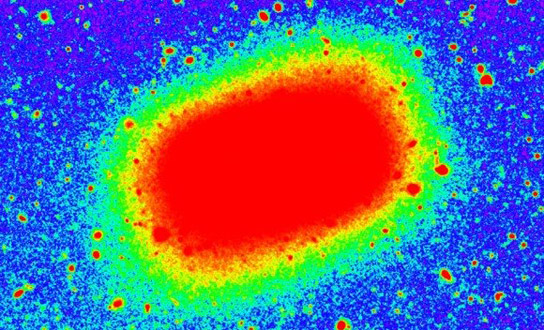
    LEDA 074886: a dwarf galaxy with a curious rectangular shape.

    This rare rectangular-shaped galaxy was located 70 million light-years away, 21 Mpc, in the Eridanus Group, in the constellation Eridanus. LEDA 074886 has been dubbed the emerald-cut galaxy, and was recently discovered by an international team of astronomers at the Swinburne University of Technology in Australia. The findings will be published in The Astrophysical Journal but a preprint is available on arXiv  [PDF].

    Redshift values of the Eridanus Group show that it’s composed of about 250 galaxies, 70% of which are spiral and irregular type galaxies while the remaining 30% are elliptical and lenticular types.
    LEDA-074886-rectangular-emerald-shape-galaxy-false-color
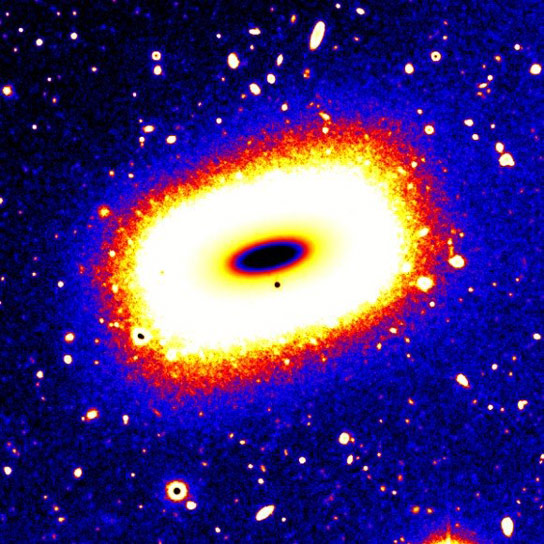
    False-color image of LEDA 074886 taken with Subaru Telescope’s Suprime-Cam. Contrast enhanced to show central disk structure. Credit: Graham et al.

    LEDA 074886 was detected using wide-field images taken by astrophysicist Lee Spitler and the Japanese Subaru Telescope. The unusual shape of this dwarf galaxy is possibly the result of a collision between two former satellite galaxies of NGC 1407, the brightest of all 250 galaxies within its local group.

    LEDA 074886 also features a stellar disk inside of it, which is aligned edgewise to Earth’s line of sight. The disk of stars rotates at speeds up to 33 km/second, though it hasn’t yet been possible to determine if it has a spiral structure because of the relative position of Earth.

    The Milky Way is heading for a collision with the Andromeda galaxy in about three billion years, and it’s possible that the resulting structure will be rectangular as well.

    Reference: “LEDA 074886: A Remarkable Rectangular-Looking Galaxy” by Alister W. Graham, Lee R. Spitler, Duncan A. Forbes, Thorsten Lisker, Ben Moore and Joachim Janz, 24 April 2012, The Astrophysical Journal.
    DOI: 10.1088/0004-637X/750/2/121

    Never miss a breakthrough: Join the SciTechDaily newsletter.
    Follow us on Google and Google News.

    Astronomy Astrophysics Galaxy
    Share. Facebook Twitter Pinterest LinkedIn Email Reddit

    Related Articles

    A Surprising Result – Making Better Measurements of the Composition of Galaxies

    Dark Mysteries of the Cosmos: Unraveling the Secrets of an Invisible Galaxy

    AI Discovers Secret Equation for “Weighing” Colossal Clusters of Galaxies

    Researchers Measure Size-Luminosity Relation of Galaxies Less Than a Billion Years After Big Bang

    Remarkable Similarities – New Analysis Reveals Links Between Galaxies Near and Far

    The Hunt for Cosmic Dawn: HERA Doubles Sensitivity to Unlock the Secrets of the Early Universe

    Astronomers Suggest More Galaxies Were Formed in the Early Universe Than Previously Thought

    The Most Extraordinary Example Yet – Tiny, Hidden Galaxy Provides a Portal Into the Distant Past

    The First Galaxies Unveiled: Non-Detection of Key Signal Reveals Key Information Regarding the Early Universe

    Leave A Reply Cancel Reply

    • Facebook
    • Twitter
    • Pinterest
    • YouTube

    Don't Miss a Discovery

    Subscribe for the Latest in Science & Tech!

    Trending News

    A Star Near the Milky Way’s Black Hole Is Losing Mass at an Astonishing Rate

    Scientists Solve a Vitamin B12 Mystery With an Unexpected Culprit

    Has the Autism Spectrum Become Too Broad? Leading Scientist Warns of Hidden Consequences

    Rewriting History: Researchers Uncover a Forgotten Amazon Civilization That May Have Housed 3 Million People

    New Research May Change How We Think About Weight Loss Drugs Like Ozempic

    Coffee Drinkers Show Surprising Differences in Fat, Muscle, and Hormones

    New Treatment Targets Gum Disease Without Killing Good Bacteria

    Scientists Discover a 245-Million-Year-Old Reptile With Its Organs Still Preserved

    Follow SciTechDaily
    • Facebook
    • Twitter
    • YouTube
    • Pinterest
    • Newsletter
    • RSS
    SciTech News
    • Biology News
    • Chemistry News
    • Earth News
    • Health News
    • Physics News
    • Science News
    • Space News
    • Technology News
    Recent Posts
    • Scientists Reveal How ADHD Could Fuel Creative Thinking
    • Scientists Find a Surprising Diabetes-Fighting Compound in Turmeric
    • Archaeologists Discover a 10,000-Year Human History Hidden in the Pyrenees
    • Scientists Discover a Surprising Link Between Human Genes and Language
    • Archaeologists Discover a Forgotten 3,000-Year-Old Egyptian Tomb – Now They’re Racing To Save It
    Copyright © 1998 - 2026 SciTechDaily. All Rights Reserved.
    • Science News
    • About
    • Contact
    • Editorial Board
    • Privacy Policy
    • Terms of Use

    Type above and press Enter to search. Press Esc to cancel.