
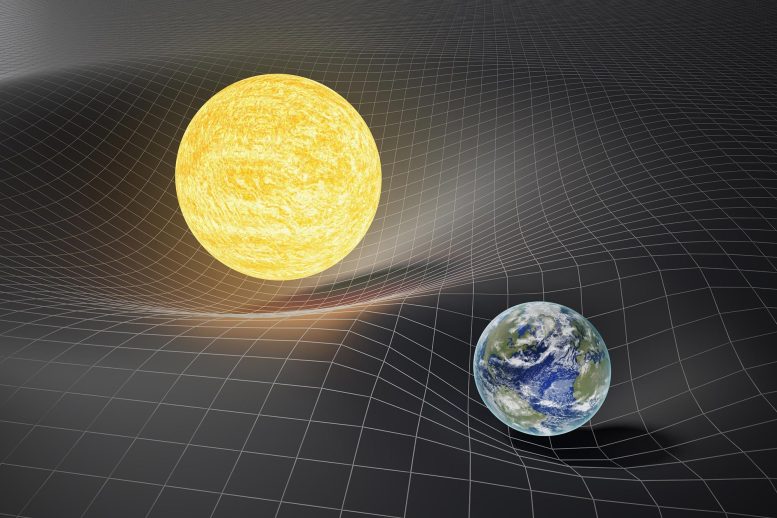
JILA physicists measured time dilation at the smallest scale ever using atomic clocks just a millimeter apart. Their results improve clock precision and may help link general relativity with quantum mechanics, offering new insights into curved space-time.
JILA physicists have measured Albert Einstein’s theory of general relativity, or more specifically, the effect called time dilation, at the smallest scale ever, showing that two tiny atomic clocks, separated by just a millimeter or the width of a sharp pencil tip, tick at different rates.
Breakthrough Offers New Insights Into Relativity and Quantum Mechanics
The experiments, described in the February 17, 2022, issue of the journal Nature, suggest how to make atomic clocks 50 times more precise than today’s best designs and offer a route to perhaps revealing how relativity and gravity interact with quantum mechanics, a major quandary in physics.
JILA is jointly operated by the National Institute of Standards and Technology (NIST) and the University of Colorado Boulder.
“The most important and exciting result is that we can potentially connect quantum physics with gravity, for example, probing complex physics when particles are distributed at different locations in the curved space-time,” NIST/JILA Fellow Jun Ye said. “For timekeeping, it also shows that there is no roadblock to making clocks 50 times more precise than today — which is fantastic news.”
Einstein’s 1915 theory of general relativity explains large-scale effects such as the gravitational effect on time and has important practical applications such as correcting GPS satellite measurements. Although the theory is more than a century old, physicists remain fascinated by it. NIST scientists have used atomic clocks as sensors to measure relativity more and more precisely, which may help finally explain how its effects interact with quantum mechanics, the rulebook for the subatomic world.
According to general relativity, atomic clocks at different elevations in a gravitational field tick at different rates. The frequency of the atoms’ radiation is reduced — shifted toward the red end of the electromagnetic spectrum — when observed in stronger gravity, closer to Earth. That is, a clock ticks more slowly at lower elevations. This effect has been demonstrated repeatedly; for example, NIST physicists measured it in 2010 by comparing two independent atomic clocks, one positioned 33 centimeters (about 1 foot) above the other.
Precision Measurements of Strontium Atoms in an Optical Lattice
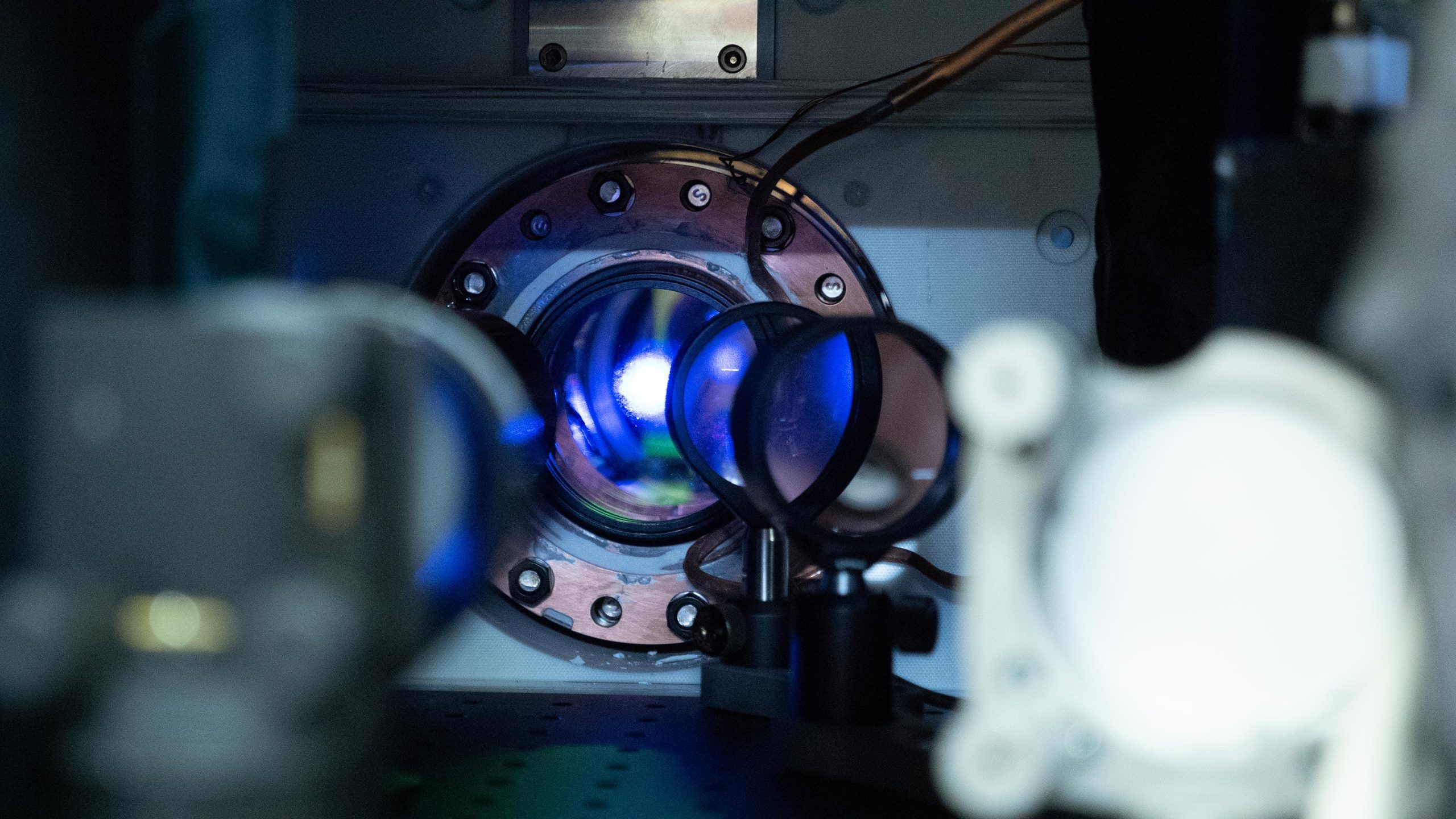
The JILA researchers have now measured frequency shifts between the top and bottom of a single sample of about 100,000 ultracold strontium atoms loaded into an optical lattice, a lab setup similar to the group’s earlier atomic clocks. In this new case the lattice, which can be visualized as a stack of pancakes created by laser beams, has unusually large, flat, thin cakes, and they are formed by less intense light than normally used. This design reduces the distortions in the lattice ordinarily caused by the scattering of light and atoms, homogenizes the sample, and extends the atoms’ matter waves, whose shapes indicate the probability of finding the atoms in certain locations. The atoms’ energy states are so well controlled that they all ticked between two energy levels in exact unison for 37 seconds, a record for what is called quantum coherence.
Crucial to the new results were the Ye group’s imaging innovation, which provided a microscopic map of frequency distributions across the sample, and their method of comparing two regions of an atom cloud rather than the traditional approach of using two separate clocks.
Implications for the Study of Quantum Mechanics and Gravity
The measured redshift across the atom cloud was tiny, in the realm of 0.0000000000000000001, consistent with predictions. (While much too small for humans to perceive directly, the differences add up to major effects on the universe as well as technology such as GPS.) The research team resolved this difference quickly for this type of experiment, in about 30 minutes of averaging data. After 90 hours of data, their measurement precision was 50 times better than in any previous clock comparison.
“This a completely new ballgame, a new regime where quantum mechanics in curved space-time can be explored,” Ye said. “If we could measure the redshift 10 times even better than this, we will be able to see the atoms’ whole matter waves across the curvature of space-time. Being able to measure the time difference on such a minute scale could enable us to discover, for example, that gravity disrupts quantum coherence, which could be at the bottom of why our macroscale world is classical.”
Better clocks have many possible applications beyond timekeeping and navigation. Ye suggests atomic clocks can serve as both microscopes to see minuscule links between quantum mechanics and gravity and as telescopes to observe the deepest corners of the universe. He is using clocks to look for mysterious dark matter, believed to constitute most matter in the universe. Atomic clocks are also poised to improve models and understanding of the shape of the Earth through the application of a measurement science called relativistic geodesy.
Reference: “Resolving the gravitational redshift in a millimetre-scale atomic sample” by Tobias Bothwell, Colin J. Kennedy, Alexander Aeppli, Dhruv Kedar, John M. Robinson, Eric Oelker, Alexander Staron & Jun Ye, 16 February 2022, Nature.
DOI: 10.1038/s41586-021-04349-7
Funding was provided by the Defense Advanced Research Projects Agency, National Science Foundation, Department of Energy Quantum System Accelerator, NIST and Air Force Office for Scientific Research.
Never miss a breakthrough: Join the SciTechDaily newsletter.
Follow us on Google and Google News.
3 Comments
Ok great. How long until we get our first functioning warp drive? I have a meeting scheduled in Alpha Centauri in 2025, and I’ll never get there at this rate.
Excellent! The article does not say that gravity slows time. Because, it doesn’t. Gravity IS time passing differently her and there. Bill Unruh says so in his description of the “lesson” of General Relativity;
A more accurate way of summarizing the lessons of General Relativity is that gravity does not cause time to run differently in different places (e.g., faster far from the earth than near it). Gravity is the unequable flow of time from place to place. It is not that there are two separate phenomena, namely gravity and time and that the one, gravity, affects the other. Rather the theory states that the phenomena we usually ascribe to gravity are actually caused by time’s flowing unequably from place to place. (W. G. Unruh, arxiv.org/abs/gr-qc/9312027v2)
From there, GR and QM have Time in common…
… yeah, but if I could have test I would look for some Time Dilation in a strong magnetic field meeting another magnetic field that are of opposite orientation… That is what I would do too. By the way, how does AA gravity explains wobble of the Earth and some other things, … yeah, the imperfection, but is that all that is there to it…