
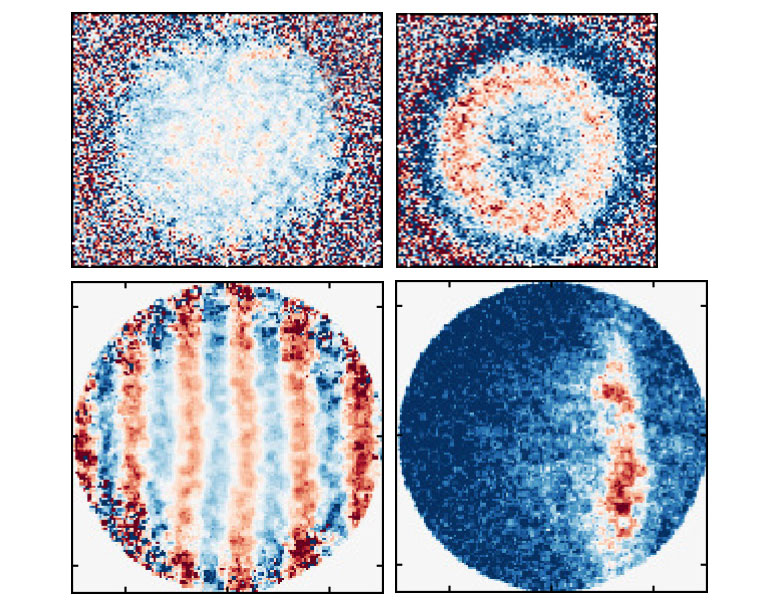
JILA scientists have invented a new imaging technique that produces rapid, precise measurements of quantum behavior in an atomic clock in the form of near-instant visual art. The technique combines spectroscopy, which extracts information from interactions between light and matter, with high-resolution microscopy.
As described in Physical Review Letters, the JILA method makes spatial maps of energy shifts among the atoms in a three-dimensional strontium lattice atomic clock, providing information about each atom’s location and energy level, or quantum state.
The technique rapidly measures physical effects that are important to atomic clocks, thus improving the clock’s precision, and it can add new atomic-level detail to studies of phenomena such as magnetism and superconductivity. In the future, the method may allow scientists to finally see new physics such as the connection between quantum physics and gravity.
JILA is operated jointly by the National Institute of Standards and Technology (NIST) and the University of Colorado Boulder.
“This technique allows us to write a piece of beautiful ‘music’ with laser light and atoms, and then map that into a structure and freeze it like a stone so we can look at individual atoms listening to the different tones of the laser, read out directly as an image,” JILA/NIST Fellow Jun Ye said.
The atoms are in a so-called quantum degenerate gas, in which large numbers of atoms interact with each other. This “quantum many-body” phenomenon is extending measurement precision to new extremes.
To prepare atoms for a beauty shot, researchers use a laser pulse to drive about 10,000 strontium atoms from their low-energy ground state to a high-energy, excited state. Then, a blue laser positioned underneath the lattice is shined upward vertically through the atoms, and a camera takes a picture of the shadow the atoms cast, which is a function of how much light they absorb. Ground-state atoms absorb more light.
The resulting images are false-color representations of atoms in the ground state (blue) and excited state (red). The white region represents atoms in a fine mixture of about 50 percent red and 50 percent blue, creating a dappled effect. This occurs because these atoms were initially prepared in a quantum state of superposition, or both ground and excited states simultaneously, and the imaging measurement prompts a collapse into one of the two states, which creates “noise” in the image.
As a demonstration, the JILA team created a series of images to map small frequency shifts, or fractions of atoms in the excited state, across different regions of the lattice. The ability to make simultaneous comparisons improves precision and speed in measurements of a group of atoms. The researchers reported achieving a record precision in measuring frequency of 2.5 x 10⁻¹⁹ (error of just 0.25 parts per billion billion) in 6 hours. Imaging spectroscopy is expected to greatly improve the precision of the JILA atomic clock, and other atomic clocks generally.
Imaging spectroscopy provides information about the local environment of the atoms, similar to the incredible resolution offered by scanning tunneling microscopy. So far, the method has been used to produce two-dimensional images, but it could make 3-D images based on layer-by-layer measurements as is done in tomography, which combines multiple cross-sections of solid objects, Ye said.
A sort of artificial crystal, the lattice of atoms could also be used as a magnetic or gravitational sensor to test the interplay between different fields of physics. Ye is most excited about the future possibility of using the atoms in the clock as a gravity sensor, to see how quantum mechanics, which operates on very small spatial scales, interacts with general relativity, the theory of gravity, a macroscopic force.
“As the clock gets better in the next 20 years, this little crystal could not only map out how gravity affects frequency, but we could also start to see the interplay of gravity and quantum mechanics,” Ye said. “This is a physical effect that no experimental probe has ever measured. This imaging technique could become a very important tool.”
The research is supported by NIST, the Defense Advanced Research Projects Agency, the Air Force Office of Scientific Research and the National Science Foundation.
Publication: “Imaging Optical Frequencies with 100μ Hz Precision and 1.1 μm Resolution” by G.E. Marti, R.B. Hutson, A. Goban, S.L. Campbell, N. Poli and J. Ye, 5 March 2018, Physical Review Letters.
DOI: 10.1103/PhysRevLett.120.103201
Never miss a breakthrough: Join the SciTechDaily newsletter.
Follow us on Google and Google News.