
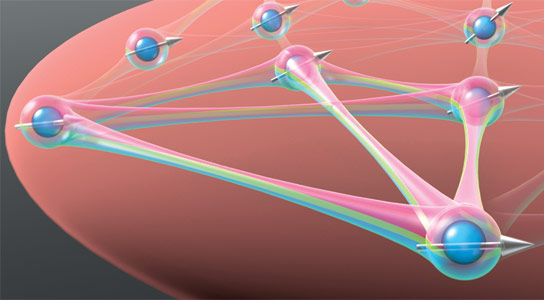
For the first time, a team of scientists at JILA have used an atomic clock as a quantum simulator, mimicking the behavior of a different, more complex quantum system.
Atomic clocks now join a growing list of physical systems that can be used for modeling and perhaps eventually explaining the quantum mechanical behavior of exotic materials such as high-temperature superconductors, which conduct electricity without resistance. All but the smallest, most trivial quantum systems are too complicated to simulate on classical computers, hence the interest in quantum simulators. Sharing some of the features of experimental quantum computers—a hot research topic—quantum simulators are “special purpose” devices designed to provide insight into specific challenging problems.
JILA is operated jointly by the National Institute of Standards and Technology (NIST) and the University of Colorado Boulder.
As described in the August 9 issue of Science, the JILA experiment was performed with an atomic clock made of about 2,000 neutral strontium atoms trapped in intersecting laser beams. The researchers were surprised to discover that, under certain conditions, the clock atoms interact like atoms in magnetic materials.
“This was completely unexpected,” JILA/NIST Fellow Jun Ye says. “We were not looking for this at all, we were just naively trying to understand the particle interactions as part of our effort to further improve the clock. We were pleasantly surprised to find we can now use a clock as a powerful quantum apparatus to study magnetic spin interactions.”
The strontium clock atoms are arranged like a stack of 100 pancakes, each containing about 20 atoms. Normally the atoms react individually to red laser pulses, switching between two energy levels. But researchers discovered the atoms also can interact with each other, first in pairs and eventually all together. Until now researchers have been trying to eliminate these interactions, which are undesirable in atomic clocks but they can turn into a powerful feature for a quantum simulator.
Strontium atoms have two energy levels used for clock purposes, each with a particular configuration of electrons. In the JILA simulation, all the atoms start out at the same energy level with the same electron configuration, also called a spin-down state. A quick pulse from a very stable red laser places all the atoms in a “superposition” of spins pointing both up and down at the same time. The possibility of superposition is one of the most notable features of the quantum world. When the laser is turned off, the atoms start to interact. One second later another pulse from the same laser hits the atoms to prepare them for collective spin measurement, and then a different laser measures, based on any detected fluorescence, the final spin states of all the atoms.
In the world of classical physics, such measurements would have definite results, without any “noise,” or uncertainty. However, in the quantum world, a spin measurement usually has a random amount of noise. In the JILA experiment, correlations appear over time between the noise patterns of some of the atoms’ spins. Ye says these correlations suggest the atoms become entangled, another unusual quantum feature that links the properties of separated particles. JILA researchers have not yet performed the definitive test proving entanglement, however.
JILA theorist Ana Maria Rey helped to explain what Ye’s experimental team observed. For small numbers of particles, about 30 atoms, Rey calculated that the clock atom interactions obey mathematical formulas similar to those describing the behavior of electrons in magnetic materials. But if more atoms are included, classical calculations would not keep up with the experimental results. In the future, the JILA team hopes to perform more complicated simulations while continuing to develop a theory explaining the findings.
The atomic clock joins a growing list of quantum simulators demonstrated recently at NIST and elsewhere.
The JILA research is supported by NIST, the Defense Advanced Research Projects Agency, Air Force Office of Scientific Research, National Science Foundation, and Army Research Office.
Reference: “A Quantum Many-Body Spin System in an Optical Lattice Clock” by M. J. Martin, M. Bishof, M. D. Swallows, X. Zhang, C. Benko, J. von-Stecher, A. V. Gorshkov, A. M. Rey and Jun Ye, 9 August 2013, Science.
DOI: 10.1126/science.1236929
Never miss a breakthrough: Join the SciTechDaily newsletter.
Follow us on Google and Google News.