
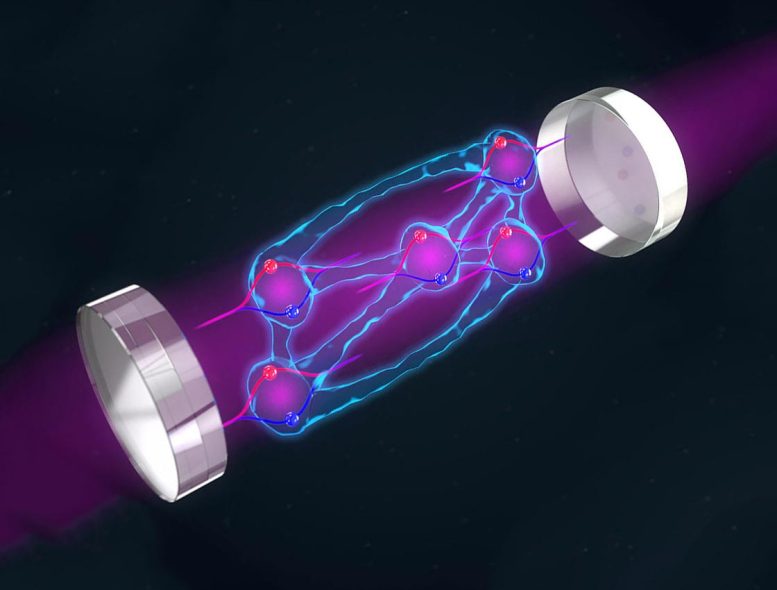
A team of researchers at JILA has for the first time successfully combined two of the “spookiest” features of quantum mechanics to make a better quantum sensor: entanglement between atoms and delocalization of atoms. JILA is a physical science research institute operated by the National Institute of Standards and Technology (NIST) and the University of Colorado Boulder.
For the first time, scientists have successfully combined two of the “spookiest” features of quantum mechanics to make a better quantum sensor: entanglement between atoms and delocalization of atoms. The achievement was accomplished by JILA and NIST Fellow James K. Thompson’s team of researchers.
Einstein originally referred to entanglement as creating spooky action at a distance—the strange effect of quantum mechanics where what happens to one atom somehow influences another atom located somewhere else. Entanglement is at the heart of the envisioned quantum computers, quantum simulators, and quantum sensors of the future. A second rather spooky aspect of quantum mechanics is delocalization, the fact that a single atom can be in more than one place at the same time.
“By learning to harness and control all of the spookiness we already know about, maybe we can discover new spooky things about the universe that we haven’t even thought of yet!” James K. Thompson
As described in their paper that was published in the journal Nature on October 19, the Thompson group has combined the spookiness of both entanglement and delocalization to realize a matter-wave interferometer that can sense accelerations with a precision that surpasses the standard quantum limit (a limit on the accuracy of an experimental measurement at a quantum level) for the first time. By doubling down on the spookiness, future quantum sensors will be able to provide more precise navigation, explore for needed natural resources, more precisely determine fundamental constants such as the fine structure and gravitational constants, look more precisely for dark matter, or maybe even one day detect gravitational waves.
Generating Entanglement
To entangle two objects, one must typically bring them very, very close to each other so they can interact. The Thompson group has learned how to entangle thousands to millions of atoms even when they are millimeters or more apart. They do this by using light bouncing between mirrors, called an optical cavity, to allow information to jump between the atoms and knit them into an entangled state. Using this unique light-based approach, they have created and observed some of the most highly entangled states ever generated in any system be it atomic, photonic, or solid-state.
Using this technique, the group designed two distinct experimental approaches, both of which they utilized in their recent work. In the first approach, called a quantum nondemolition measurement, they make a premeasurement of the quantum noise associated with their atoms and simply subtract the quantum noise from their final measurement. In a second approach, light injected into the cavity causes the atoms to undergo one-axis twisting, a process in which the quantum noise of each atom becomes correlated with the quantum noise of all the other atoms so that they can conspire together to become quieter.
“The atoms are kind of like kids shushing each other to be quiet so they can hear about the party the teacher has promised them, but here it’s the entanglement that does the shushing,” says Thompson.
Matter-Wave Interferometer
One of the most precise and accurate quantum sensors today is the matter-wave interferometer. The idea is that one uses pulses of light to cause atoms to simultaneously move and not move by having both absorbed and not absorbed laser light. This causes the atoms over time to simultaneously be in two different places at once.
As graduate student Chengyi Luo explained, “We shine laser beams on the atoms so we actually split each atom’s quantum wave packet in two, in other words, the particle actually exists in two separate spaces at the same time.”
Later pulses of laser light then reverse the process bringing the quantum wave packets back together so that any changes in the environment such as accelerations or rotations can be sensed by a measurable amount of interference happening to the two parts of the atomic wave packet, much like is done with light fields in normal interferometers, but here with de’Broglie waves, or waves made of matter.
The team of JILA graduate students figured out how to make all of this work inside an optical cavity with highly reflective mirrors. They could measure how far the atoms fell along the vertically oriented cavity due to gravity in a quantum version of Galileo’s gravity experiment dropping items from the Leaning Tower of Pisa, but with all the benefits of precision and accuracy that comes along from quantum mechanics.
Doubling the Spookiness
By learning how to operate a matter-wave interferometer inside of an optical cavity, the team of graduate students led by Chengyi Luo and Graham Greve was then able to take advantage of the light-matter interactions to create entanglement between the different atoms to make a quieter and more precise measurement of the acceleration due to gravity. This is the first time that anyone has been able to observe a matter-wave interferometer with a precision that surpasses the standard quantum limit on precision set by the quantum noise of unentangled atoms.
Thanks to the enhanced precision, researchers like Luo and Thompson see many future benefits for utilizing entanglement as a resource in quantum sensors. Thompson says, “I think that one day we will be able to introduce entanglement into matter-wave interferometers for detecting gravitational waves in space, or for dark matter searches—things that probe fundamental physics, as well as devices that can be used for everyday applications such as navigation or geodesy.”
With this momentous experimental advance, Thompson and his team hope that others will use this new entangled interferometer approach to lead to other advances in the field of physics. With optimism, Thompson says, “By learning to harness and control all of the spookiness we already know about, maybe we can discover new spooky things about the universe that we haven’t even thought of yet!”
Reference: “Entanglement-enhanced matter-wave interferometry in a high-finesse cavity” by Graham P. Greve, Chengyi Luo, Baochen Wu and James K. Thompson, 19 October 2022, Nature.
DOI: 10.1038/s41586-022-05197-9
Never miss a breakthrough: Join the SciTechDaily newsletter.
Follow us on Google and Google News.
6 Comments
Spookyness is unique for photon or matter-wave,this is Principle of Entanglement.So,nothing new can occure from matter wave entanglment,except metaphysics perception ratio as Laws of entanglement state.Entanglement is equal but differ only by metaphysical ratio for three possible types based on use of photon,electron and matter wave.
Fish cannot live without water. Trees cannot live without soil and atmosphere. Microscopic particles and celestial bodies cannot live without dark matter and dark energy gravitational fields. Dark matter and dark energy gravitational fields cannot live without the topological vortex field.
To study fish, we must study water. To study trees, we must study soil and atmosphere.
Dark matter and dark energy of topological vortex fields are everywhere, the interaction and balance between them cover all long-distance and short-range contributions. The key is how to utilize them to generate entanglement.
“Back to the future”, script,
originally use to be called aether, all encompassing etc.
Deviation driven realities are to be uncovered, by cancelling the entanglement with the word’s materialistic burden.It may as time’s direction will allow it
And as long as earth is quiter..
Quantum entanglement should be felt or sense by entangling self with their farthest counterpart
This experiment will solve all the thoughts of spooky action at distance
All experiments separating observer from the system are telling story of half truth
The observer cannot be separated from the system that consists of topological vortex gravitational fields.