
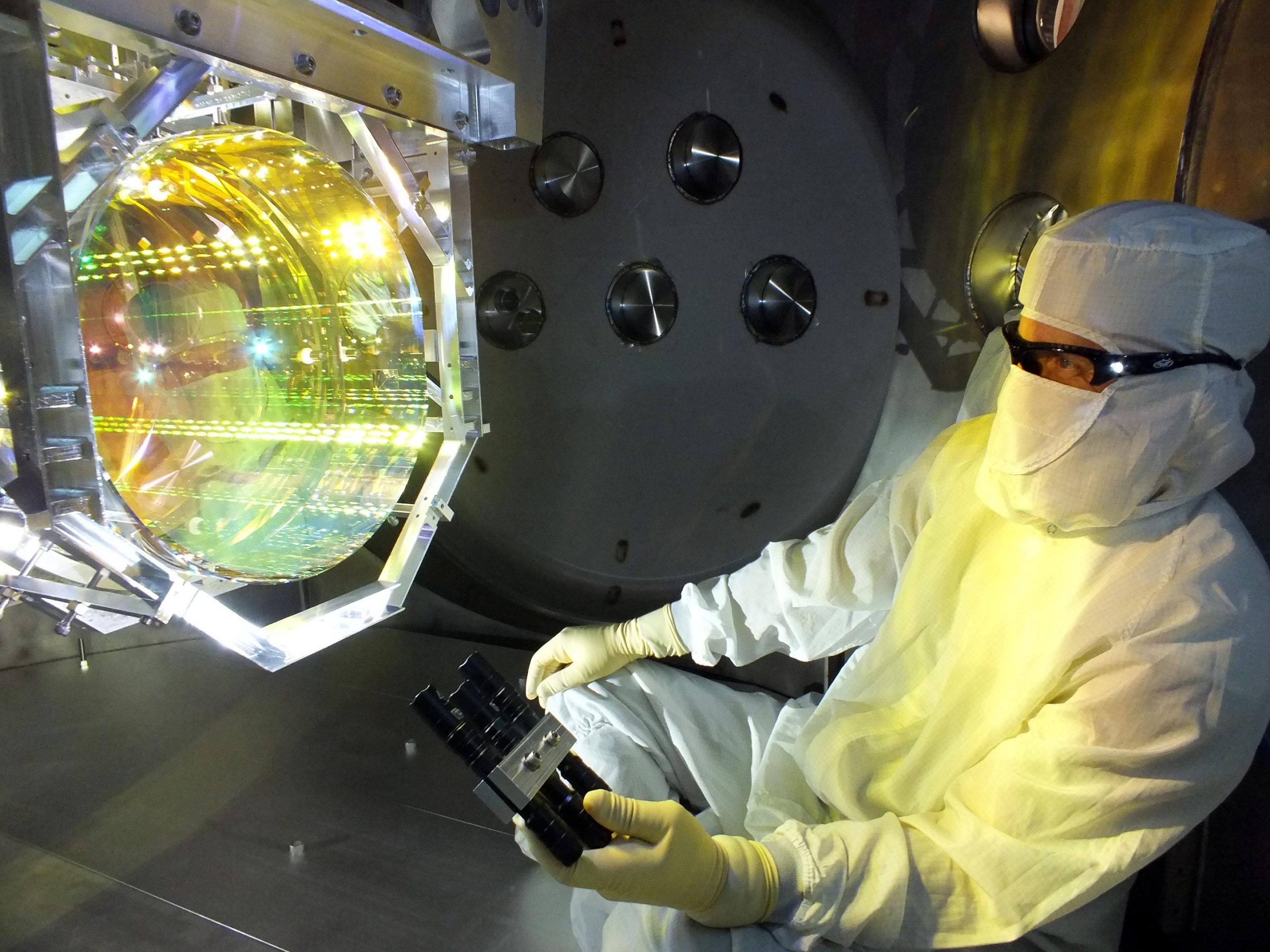
Study shows LIGO’s 40-kilogram (88 pounds) mirrors can move in response to tiny quantum effects, revealing the “spooky popcorn of the universe.”
The universe, as seen through the lens of quantum mechanics, is a noisy, crackling space where particles blink constantly in and out of existence, creating a background of quantum noise whose effects are normally far too subtle to detect in everyday objects.
Now for the first time, a team led by researchers at MIT LIGO Laboratory has measured the effects of quantum fluctuations on objects at the human scale. In a paper published on July 1, 2020, in Nature, the researchers report observing that quantum fluctuations, tiny as they may be, can nonetheless “kick” an object as large as the 40-kilogram mirrors of the U.S. National Science Foundation’s Laser Interferometer Gravitational-wave Observatory (LIGO), causing them to move by a tiny degree, which the team was able to measure.
It turns out the quantum noise in LIGO’s detectors is enough to move the large mirrors by 10-20 meters — a displacement that was predicted by quantum mechanics for an object of this size, but that had never before been measured.
“A hydrogen atom is 10-10 meters, so this displacement of the mirrors is to a hydrogen atom what a hydrogen atom is to us — and we measured that,” says Lee McCuller, a research scientist at MIT’s Kavli Institute for Astrophysics and Space Research.
The researchers used a special instrument that they designed, called a quantum squeezer, to “manipulate the detector’s quantum noise and reduce its kicks to the mirrors, in a way that could ultimately improve LIGO’s sensitivity in detecting gravitational waves,” explains Haocun Yu, a physics graduate student at MIT.
“What’s special about this experiment is we’ve seen quantum effects on something as large as a human,” says Nergis Mavalvala, the Marble Professor and associate head of the physics department at MIT. “We too, every nanosecond of our existence, are being kicked around, buffeted by these quantum fluctuations. It’s just that the jitter of our existence, our thermal energy, is too large for these quantum vacuum fluctuations to affect our motion measurably. With LIGO’s mirrors, we’ve done all this work to isolate them from thermally driven motion and other forces, so that they are now still enough to be kicked around by quantum fluctuations and this spooky popcorn of the universe.”
Yu, Mavalvala, and McCuller are co-authors of the new paper, along with graduate student Maggie Tse and Principal Research Scientist Lisa Barsotti at MIT, along with other members of the LIGO Scientific Collaboration.
A quantum kick
LIGO is designed to detect gravitational waves arriving at the Earth from cataclysmic sources millions to billions of light years away. It comprises twin detectors, one in Hanford, Washington, and the other in Livingston, Louisiana. Each detector is an L-shaped interferometer made up of two 4-kilometer-long (2.5-mile-long) tunnels, at the end of which hangs a 40-kilogram (88 pounds) mirror.
To detect a gravitational wave, a laser located at the input of the LIGO interferometer sends a beam of light down each tunnel of the detector, where it reflects off the mirror at the far end, to arrive back at its starting point. In the absence of a gravitational wave, the lasers should return at the same exact time. If a gravitational wave passes through, it would briefly disturb the position of the mirrors, and therefore the arrival times of the lasers.
Much has been done to shield the interferometers from external noise, so that the detectors have a better chance of picking out the exceedingly subtle disturbances created by an incoming gravitational wave.
Mavalvala and her colleagues wondered whether LIGO might also be sensitive enough that the instrument might even feel subtler effects, such as quantum fluctuations within the interferometer itself, and specifically, quantum noise generated among the photons in LIGO’s laser.
“This quantum fluctuation in the laser light can cause a radiation pressure that can actually kick an object,” McCuller adds. “The object in our case is a 40-kilogram mirror, which is a billion times heavier than the nanoscale objects that other groups have measured this quantum effect in.”
Noise squeezer
To see whether they could measure the motion of LIGO’s massive mirrors in response to tiny quantum fluctuations, the team used an instrument they recently built as an add-on to the interferometers, which they call a quantum squeezer. With the squeezer, scientists can tune the properties of the quantum noise within LIGO’s interferometer.
The team first measured the total noise within LIGO’s interferometers, including the background quantum noise, as well as “classical” noise, or disturbances generated from normal, everyday vibrations. They then turned the squeezer on and set it to a specific state that altered the properties of quantum noise specifically. They were able to then subtract the classical noise during data analysis, to isolate the purely quantum noise in the interferometer. As the detector constantly monitors the displacement of the mirrors to any incoming noise, the researchers were able to observe that the quantum noise alone was enough to displace the mirrors, by 10-20 meters.
Mavalvala notes that the measurement lines up exactly with what quantum mechanics predicts. “But still it’s remarkable to see it be confirmed in something so big,” she says.
Going a step further, the team wondered whether they could manipulate the quantum squeezer to reduce the quantum noise within the interferometer. The squeezer is designed such that when it is set to a particular state, it “squeezes” certain properties of the quantum noise, in this case, phase, and amplitude. Phase fluctuations can be thought of as arising from the quantum uncertainty in the light’s travel time, while amplitude fluctuations impart quantum kicks to the mirror surface.
“We think of the quantum noise as distributed along different axes, and we try to reduce the noise in some specific aspect,” Yu says.
When the squeezer is set to a certain state, it can for example squeeze, or narrow the uncertainty in phase, while simultaneously distending, or increasing the uncertainty in amplitude. Squeezing the quantum noise at different angles would produce different ratios of phase and amplitude noise within LIGO’s detectors.
The group wondered whether changing the angle of this squeezing would create quantum correlations between LIGO’s lasers and its mirrors, in a way that they could also measure. Testing their idea, the team set the squeezer to 12 different angles and found that, indeed, they could measure correlations between the various distributions of quantum noise in the laser and the motion of the mirrors.
Through these quantum correlations, the team was able to squeeze the quantum noise, and the resulting mirror displacement, down to 70 percent of its normal level. This measurement, incidentally, is below what’s called the standard quantum limit, which, in quantum mechanics, states that a given number of photons, or, in LIGO’s case, a certain level of laser power, is expected to generate a certain minimum of quantum fluctuations that would generate a specific “kick” to any object in their path.
By using squeezed light to reduce the quantum noise in the LIGO measurement, the team has made a measurement more precise than the standard quantum limit, reducing that noise in a way that will ultimately help LIGO to detect fainter, more distant sources of gravitational waves.
Reference: “Quantum correlations between light and the kilogram-mass mirrors of LIGO” by Haocun Yu, L. McCuller, M. Tse, N. Kijbunchoo, L. Barsotti, N. Mavalvala and members of the LIGO Scientific Collaboration, 1 July 2020, Nature.
DOI: 10.1038/s41586-020-2420-8
This research was funded, in part, by the National Science Foundation.
Never miss a breakthrough: Join the SciTechDaily newsletter.
Follow us on Google and Google News.
2 Comments
Two words “Quantum Speakers”
I now, non-seriously, choose to believe that’s what visual snow is. The brain not filtering out all this quantum noise.
https://rarediseases.info.nih.gov/diseases/12062/visual-snow-syndrome