
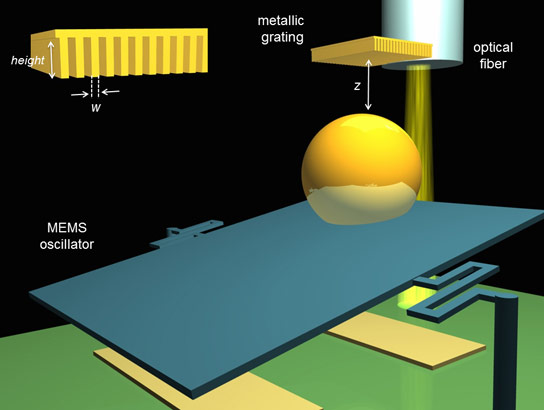
By replacing a flat surface with a surface that contained engineered nanoscale structures, researchers found that the Casimir attraction between two surfaces decreased much more quickly than theoretically predicted.
You might think that a pair of parallel plates hanging motionless in a vacuum just a fraction of a micrometer away from each other would be like strangers passing in the night—so close but destined never to meet. Thanks to quantum mechanics, you would be wrong.
Scientists working to engineer nanoscale machines know this only too well as they have to grapple with quantum forces and all the weirdness that comes with them. These quantum forces, most notably the Casimir effect, can play havoc if you need to keep closely spaced surfaces from coming together.
Controlling these effects may also be necessary for making small mechanical parts that never stick to each other, for building certain types of quantum computers, and for studying gravity at the microscale.
Now, a large collaborative research group involving scientists from a number of federal labs, including the National Institute of Standards and Technology (NIST), and major universities, has observed that these sticky effects can be increased or lessened by patterning one of the surfaces with nanoscale structures. The discovery, described in Nature Communications, opens a new path for tuning these effects.
But as often happens with quantum phenomena, the work raises new questions even as it answers others.
One of the insights of quantum mechanics is that no space, not even outer space, is ever truly empty. It’s full of energy in the form of quantum fluctuations, including fluctuating electromagnetic fields that seemingly come from nowhere and disappear just as fast.
Some of this energy, however, just isn’t able to “fit” in the submicrometer space between a pair of electromechanical contacts. More energy on the outside than on the inside results in a kind of “pressure” called the Casimir force, which can be powerful enough to push the contacts together and stick.
Prevailing theory does a good job describing the Casimir force between featureless, flat surfaces and even between most smoothly curved surfaces. However, according to NIST researcher and co-author of the paper, Vladimir Aksyuk, the existing theory fails to predict the interactions they observed in their experiment.
“In our experiment, we measured the Casimir attraction between a gold-coated sphere and flat gold surfaces patterned with rows of periodic, flat-topped ridges, each less than 100 nanometers across, separated by somewhat wider gaps with deep sheer-walled sides,” says Aksyuk. “We wanted to see how a nanostructured metallic surface would affect the Casimir interaction, which had never been attempted with a metal surface before. Naturally, we expected that there would be reduced attraction between our grooved surface and the sphere, regardless of the distance between them, because the top of the grooved surface presents less total surface area and less material. However, we knew the Casimir force’s dependence on the surface shape is not that simple.”
Indeed, what they found was more complicated.
According to Aksyuk, when they increased the separation between the surface of the sphere and the grooved surface, the researchers found that the Casimir attraction decreased much more quickly than expected. When they moved the sphere farther away, the force fell by a factor of two below the theoretically predicted value. When they moved the sphere surface close to the ridge tops, the attraction per unit of ridge top surface area increased.
“Theory can account for the stronger attraction, but not for the too-rapid weakening of the force with increased separation,” says Aksyuk. “So this is new territory, and the physics community is going to need to come up with a new model to describe it.”
This work was performed in collaboration with scientists from Los Alamos National Laboratory; the University of Maryland, College Park; Argonne National Laboratory; and Indiana University – Purdue University, Indianapolis.
Reference: “Strong Casimir force reduction through metallic surface nanostructuring” by Francesco Intravaia, Stephan Koev, Il Woong Jung, A. Alec Talin, Paul S. Davids, Ricardo S. Decca, Vladimir A. Aksyuk, Diego A. R. Dalvit and Daniel López, 27 September 2013, Nature Communications.
DOI: 10.1038/ncomms3515
arXiv:1202.6356
Never miss a breakthrough: Join the SciTechDaily newsletter.
Follow us on Google and Google News.