
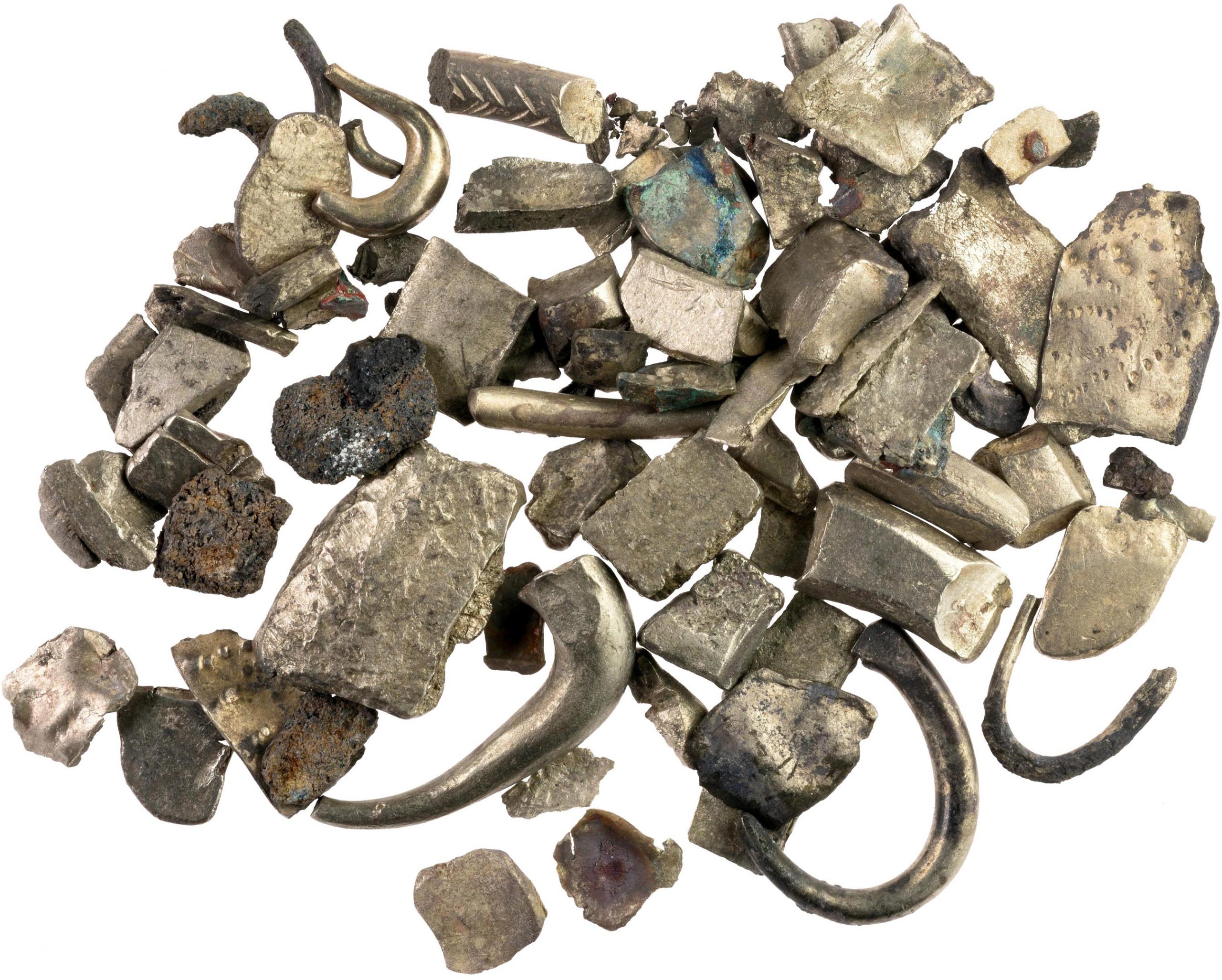
A new geochemical study has revealed that an extensive silver trade network thrived in the Eastern Mediterranean from the Late Bronze to the Iron Age.
Researchers have reconstructed the Eastern Mediterranean silver trade, over a period including the traditional dates of the Trojan War, the founding of Rome, and the destruction of Solomon’s Temple in Jerusalem. The team of French, Israeli and Australian scientists, and numismatists found geochemical evidence for pre-coinage silver trade continuing throughout the Mediterranean during the Late Bronze and Iron Age periods, with the supply slowing only occasionally. Silver was sourced from the whole north-eastern Mediterranean, and as far away as the Iberian Peninsula.
The team used high-precision isotopic analysis to identify the ore sources of minute lead traces found in silver Hacksilber. Hacksilber is irregularly cut silver bullion including broken pieces of silver ingots and jewelry that served as means of payment in the southern Levant from the beginning of the second millennium until the fourth century BCE. Used in local and international transactions, its value was determined by weighing it on scales against standardized weights. It has been discovered in archaeological excavations in the region usually stored inside ceramic containers and it had to be imported as there was no silver to be mined in the Levant.
Isotopic Evidence Uncovers Persistent Trade Networks
Presenting the research at the Goldschmidt geochemistry conference, Dr. Liesel Gentelli said “Even before coinage there was international trade, and Hacksilber was one of the commodities being exchanged for goods.”
The team analyzed Hacksilber from 13 different sites dating from 1300 BCE to 586 BCE in the southern Levant, modern-day Israel, and the Palestinian Authority. The samples included finds from ‘En Gedi, Ekron, and Megiddo (also known as Armageddon). They matched their findings with ore samples, and have shown that most of the Hacksilber came from the Southern Aegean and Balkans (Macedonia, Thrace, and Illyria). Some was also found to come from as far away as Sardinia and Spain.
Lead researcher Liesel Gentelli (École normale supérieure de Lyon, France) said:
“Previous researchers believed that silver trade had come to an end following the societal collapse at the end of the Late Bronze Age, but our research shows that exchanges between especially the southern Levant and the Aegean world never came to a stop. People around the Eastern Mediterranean remained connected. It’s likely that the silver flowed to the Levant as a result of trade or plunder.
We do see periods of silver scarcity around the time of the Bronze to Iron Age transition, around 1300-1100 BCE. Some hoards from this period show the silver displaying unusually high copper content, which would have been added to make up for the lack of silver.
From Trojan War to Temple Destruction
We can’t match our findings on the silver trade to specific historical events, but our analysis shows the importance of Hacksilber trade from before the Trojan War, which some scholars date to the early 12th century BCE, through the founding of Rome in 753 BCE, and up to the end of the Iron Age in 586 BCE, marked by Nebuchadnezzar’s destruction of Solomon’s Temple in Jerusalem. After that, we see the gradual introduction of coinage, first as finds of several archaic coins and later a transition to a monetary economy in the southern Levant circa 450 BCE which made the trade of Hacksilber less relevant. However, this work reveals the ongoing and crucial economic role that Hacksilber played in the Bronze and Iron Ages economies.”
Commenting, Dr. Matthew Ponting, Senior Lecturer in Archaeological Materials at the University of Liverpool said:
“This is important new work that confirms our understanding of trade and exchange routes in the Early Iron Age Levant. The fact that all silver found in the region would have had to have been imported presents exciting possibilities to investigate trade routes more generally as well as to learn more about alloy use and preference during this important period of history.”
Never miss a breakthrough: Join the SciTechDaily newsletter.
Follow us on Google and Google News.