

Close Menu
    Facebook X (Twitter) Instagram
    SciTechDaily
    • Biology
    • Chemistry
    • Earth
    • Health
    • Physics
    • Science
    • Space
    • Technology
    Facebook X (Twitter) Pinterest YouTube RSS
    SciTechDaily
    Home»Technology»Surface Damage to Vehicles Traveling at Hypersonic Speeds From Ice and Dust Particles
    Technology

    Surface Damage to Vehicles Traveling at Hypersonic Speeds From Ice and Dust Particles

    By SciTechDailyJanuary 11, 2020No Comments4 Mins Read
    Facebook Twitter Pinterest Telegram LinkedIn WhatsApp Email Reddit
    Share
    Facebook Twitter LinkedIn Pinterest Telegram Email Reddit
    Lockheed Martin SR-72
    Lockheed Martin SR-72 hypersonic UAV concept. Credit: Lockheed Martin

    Vehicles moving at hypersonic speeds are bombarded with ice crystals and dust particles in the surrounding atmosphere, making the surface material vulnerable to damage such as erosion and sputtering with each tiny collision. Researchers at the University of Illinois at Urbana-Champaign studied this interaction one molecule at a time to understand the processes, then scaled up the data to make it compatible with simulations that require a larger scale.

    Doctoral student Neil Mehta working with Prof. Deborah Levin looked at two different materials that are commonly used on the exterior surfaces of slender bodies — smooth graphene and rougher quartz. In the model, these materials were attacked by aggregates composed of argon atoms and silicon and oxygen atoms to simulate ice and dust particles hitting the two surface materials. These molecular dynamics studies taught them what stuck to the surfaces, the damage done, and the length of time it took to cause the damage — all at the size of a single angstrom, which is basically the length of an atom.
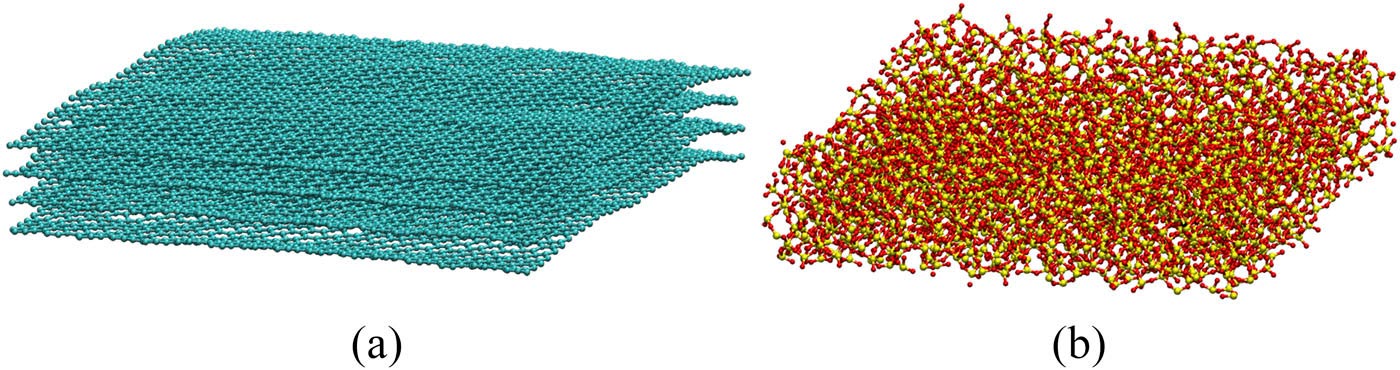
    Smooth Graphene and Quartz
    Carbon atoms are represented in teal in the smooth graphene (a) and silicon and oxygen atoms are represented in yellow and red in quartz (b), respectively. Credit: University of Illinois Department of Aerospace Engineering

    Why so small? Mehta said it’s important to start by looking at “first principles” to thoroughly understand the erosive effects of ice and silica to graphene and quartz surfaces. But those who simulate fluid dynamics use lengths that are several milli-meters micrometer to cm — so scaling up the physics of the MD models was urgently needed. The excitement about this work is that it was the first to ever do so in this application.

    “Unfortunately, you can’t just take the results from this very tiny angstrom level and use it in aerospace engineering reentry vehicle calculations,” Mehta said. “You can’t directly jump from molecular dynamics to computational fluid dynamics. It takes several more steps. Applying the rigor of kinetic Monte Carlo techniques, we took details at this very tiny scale and analyzed the dominant trends so that larger simulation techniques can use them in modeling programs that simulate the evolution of surface processes that occur in hypersonic flight, such as erosion, sputtering, pitting.

    Neil Mehta
    Neil A. Mehta, University of Illinois Doctoral Student in Aerospace Engineering. Credit: University of Illinois at Urbana-Champaign

    “At what rate will these processes happen and with what likelihood will these types of damages happen were the key features that no other Kinetic Monte Carlo or scale bridging has used before,” he said.

    According to Mehta, the work is unique because it incorporated experimental observations of gas-surface interactions and molecular dynamics simulations to create a “first principles” rule that can be applied to all of these surfaces.

    Deborah Levin
    Professor Deborah A. Levin. Credit: University of Illinois at Urbana-Champaign

    “For example, ice has a tendency to form flakes, ice crystals. It creates a fractal pattern because ice likes to stick to other ice, so it’s more likely that the water vapor will condense next to an ice particle that is already on the surface and create a trellis-like feature. Whereas sand just scatters. It doesn’t have any preference. So one rule is that ice likes to stick to other ice.

    “Similarly, for degradation, the rule on graphene is that damage is more likely to occur next to pre-existing damage,” Mehta said. “There are several rules, depending on what material you’re using, that you can actually study what happens from an atomic level to a micrometer landscape, then use the results to implement in computational fluid dynamics or any long, large-scale simulation,” Mehta said.

    One application for this work is for research on how to design thermal protection systems for slender vehicles and small satellites at altitudes near 100 km (62 mi).

    Reference: “Multiscale modeling of damaged surface topology in a hypersonic boundary” Neil A. Mehta and Deborah A. Levin, 30 September 2019, Journal of Chemical Physics.
    DOI: 10.1063/1.5117834

    Never miss a breakthrough: Join the SciTechDaily newsletter.
    Follow us on Google and Google News.

    Materials Science University of Illinois at Urbana-Champaign
    Share. Facebook Twitter Pinterest LinkedIn Email Reddit

    Related Articles

    From Trash to Tech: Scientists Turn Pomelo Peels Into Electricity-Generating Devices

    Scientists Replicate Nature’s Finest Fibers With New 3D Printing Technique

    Synthetic Bones Designed by AI Set to Transform Orthopedic Surgery

    New Photonic Chip for Isolating Light May Be Key to Miniaturizing Quantum Technology

    Coupling Magnetism and Microwaves To Clamp Down on Noise in Quantum Information

    Machine Learning Peeks Into Nano-Aquariums and Records the Motions of Nanoparticles

    Unique Physical, Chemical Properties of Cicada Wings Revealed by Material Scientists

    Resolving the Enigma of Graphene Bending – “Everyone Disagreed, They Were Actually All Correct”

    Heat-Conducting Crystals Help High-Power Electronics Keep Their Cool

    Leave A Reply Cancel Reply

    • Facebook
    • Twitter
    • Pinterest
    • YouTube

    Don't Miss a Discovery

    Subscribe for the Latest in Science & Tech!

    Trending News

    Breakthrough Bowel Cancer Trial Leaves Patients Cancer-Free for Nearly 3 Years

    Natural Compound Shows Powerful Potential Against Rheumatoid Arthritis

    100,000-Year-Old Neanderthal Fossils in Poland Reveal Unexpected Genetic Connections

    Simple “Gut Reset” May Prevent Weight Gain After Ozempic or Wegovy

    2.8 Days to Disaster: Scientists Warn Low Earth Orbit Could Suddenly Collapse

    Common Food Compound Shows Surprising Power Against Superbugs

    5 Simple Ways To Remember More and Forget Less

    The Atomic Gap That Could Cost the Semiconductor Industry Billions

    Follow SciTechDaily
    • Facebook
    • Twitter
    • YouTube
    • Pinterest
    • Newsletter
    • RSS
    SciTech News
    • Biology News
    • Chemistry News
    • Earth News
    • Health News
    • Physics News
    • Science News
    • Space News
    • Technology News
    Recent Posts
    • NASA Satellite Captures First-Ever High-Res View of Massive Pacific Tsunami
    • ADHD Isn’t Just a Deficit: Study Reveals Powerful Hidden Strengths
    • Scientists Uncover “Astonishing” Hidden Property of Light
    • Scientists Discover Stem Cells That Could Regrow Teeth and Bone
    • Scientists Discover Natural Molecule That Stops Alzheimer’s Protein Clumps From Forming
    Copyright © 1998 - 2026 SciTechDaily. All Rights Reserved.
    • Science News
    • About
    • Contact
    • Editorial Board
    • Privacy Policy
    • Terms of Use

    Type above and press Enter to search. Press Esc to cancel.