
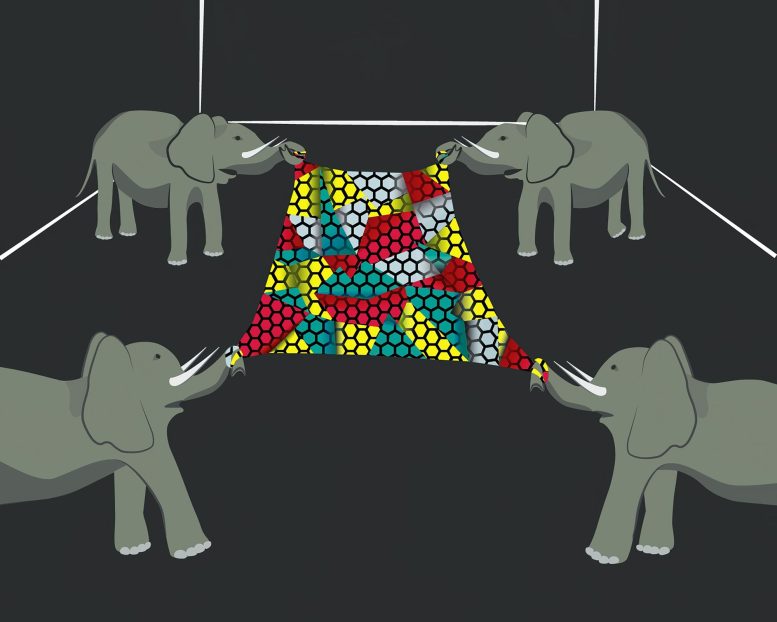
A new study from Columbia Engineering researchers reports on the strength of large-area graphene films grown using chemical vapor deposition (CVD), correcting the mistaken consensus that grain boundaries of graphene are weak.
In a new study, published in the journal Science on May 31, 2013, Columbia Engineering researchers demonstrate that graphene, even if stitched together from many small crystalline grains, is almost as strong as graphene in its perfect crystalline form. This work resolves a contradiction between theoretical simulations, which predicted that grain boundaries can be strong, and earlier experiments, which indicated that they were much weaker than the perfect lattice.
Graphene consists of a single atomic layer of carbon, arranged in a honeycomb lattice. “Our first Science paper, in 2008, studied the strength graphene can achieve if it has no defects—its intrinsic strength,” says James Hone, professor of mechanical engineering, who led the study with Jeffrey Kysar, professor of mechanical engineering. “But defect-free, pristine graphene exists only in very small areas. Large-area sheets required for applications must contain many small grains connected at grain boundaries, and it was unclear how strong those grain boundaries were. This, our second Science paper, reports on the strength of large-area graphene films grown using chemical vapor deposition (CVD), and we’re excited to say that graphene is back and stronger than ever.”
The study verifies that commonly used methods for post-processing CVD-grown graphene weaken grain boundaries, resulting in the extremely low strength seen in previous studies. The Columbia Engineering team developed a new process that prevents any damage of graphene during transfer. “We substituted a different etchant and were able to create test samples without harming the graphene,” notes the paper’s lead author, Gwan-Hyoung Lee, a postdoctoral fellow in the Hone lab. “Our findings clearly correct the mistaken consensus that grain boundaries of graphene are weak. This is great news because graphene offers such a plethora of opportunities both for fundamental scientific research and industrial applications.”
In its perfect crystalline form, graphene (a one-atom-thick carbon layer) is the strongest material ever measured, as the Columbia Engineering team reported in Science in 2008—so strong that, as Hone observed, “it would take an elephant, balanced on a pencil, to break through a sheet of graphene the thickness of Saran Wrap.” For the first study, the team obtained small, structurally perfect flakes of graphene by mechanical exfoliation, or mechanical peeling, from a crystal of graphite. But exfoliation is a time-consuming process that will never be practical for any of the many potential applications of graphene that require industrial mass production.
Currently, scientists can grow sheets of graphene as large as a television screen by using chemical vapor deposition (CVD), in which single layers of graphene are grown on copper substrates in a high-temperature furnace. One of the first applications of graphene may be as a conducting layer in flexible displays.
“But CVD graphene is ‘stitched’ together from many small crystalline grains—like a quilt—at grain boundaries that contain defects in the atomic structure,” Kysar explains. “These grain boundaries can severely limit the strength of large-area graphene if they break much more easily than the perfect crystal lattice, and so there has been intense interest in understanding how strong they can be.”
The Columbia Engineering team wanted to discover what was making CVD graphene so weak. In studying the processing techniques used to create their samples for testing, they found that the chemical most commonly used to remove the copper substrate also causes damage to the graphene, severely degrading its strength.
Their experiments demonstrated that CVD graphene with large grains is exactly as strong as exfoliated graphene, showing that its crystal lattice is just as perfect. And, more surprisingly, their experiments also showed that CVD graphene with small grains, even when tested right at a grain boundary, is about 90% as strong as the ideal crystal.
“This is an exciting result for the future of graphene, because it provides experimental evidence that the exceptional strength it possesses at the atomic scale can persist all the way up to samples inches or more in size,” says Hone. “This strength will be invaluable as scientists continue to develop new flexible electronics and ultrastrong composite materials.”
Strong, large-area graphene can be used for a wide variety of applications such as flexible electronics and strengthening components—potentially, a television screen that rolls up like a poster or ultrastrong composites that could replace carbon fiber. Or, the researchers speculate, a science fiction idea of a space elevator that could connect an orbiting satellite to Earth by a long cord that might consist of sheets of CVD graphene, since graphene (and its cousin material, carbon nanotubes) is the only material with the high strength-to-weight ratio required for this kind of hypothetical application.
The team is also excited about studying 2D materials like graphene. “Very little is known about the effects of grain boundaries in 2D materials,” Kysar adds. “Our work shows that grain boundaries in 2D materials can be much more sensitive to processing than in 3D materials. This is due to all the atoms in graphene being surface atoms, so surface damage that would normally not degrade the strength of 3D materials can completely destroy the strength of 2D materials. However, with appropriate processing that avoids surface damage, grain boundaries in 2D materials, especially graphene, can be nearly as strong as the perfect, defect-free structure.”
Reference: “High-Strength Chemical-Vapor–Deposited Graphene and Grain Boundaries” by Gwan-Hyoung Lee, Ryan C. Cooper, Sung Joo An, Sunwoo Lee, Arend van der Zande, Nicholas Petrone, Alexandra G. Hammerberg, Changgu Lee, Bryan Crawford, Warren Oliver, Jeffrey W. Kysar and James Hone, 31 May 2013, Science.
DOI: 10.1126/science.1235126
The study was supported by grants from the Air Force
Never miss a breakthrough: Join the SciTechDaily newsletter.
Follow us on Google and Google News.
1 Comment
Like a star forms out of gas and dust.
Spacetime may have formed out of a soup of quarks and leptons.
The rest of the soup is still out there and may be what we call dark matter.
As spacetime expands more may be congealing like a skin on cold soup.