

Researchers tweaked borophene to interact with cells and other biological units in unique ways.
Move over, graphene. There’s a new, improved two-dimensional material in the lab. Borophene, the atomically thin version of boron first synthesized in 2015, is more conductive, thinner, lighter, stronger, and more flexible than graphene, the 2D version of carbon. Now, researchers at Penn State have made the material potentially more useful by imparting chirality — or handedness — on it, which could make for advanced sensors and implantable medical devices. The chirality, induced via a method never before used on borophene, enables the material to interact in unique ways with different biological units such as cells and protein precursors.
The team, led by Dipanjan Pan, Dorothy Foehr Huck & J. Lloyd Huck Chair Professor in Nanomedicine and professor of materials science and engineering and of nuclear engineering, published their work — the first of its kind, they said — in ACS Nano.
“Borophene is a very interesting material, as it resembles carbon very closely including its atomic weight and electron structure but with more remarkable properties. Researchers are only starting to explore its applications,” Pan said. “To the best of our knowledge, this is the first study to understand the biological interactions of borophene and the first report of imparting chirality on borophene structures.”
Understanding Chirality
Chirality refers to similar but not identical physicality, like left and right hands. In molecules, chirality can make biological or chemical units exist in two versions that cannot be perfectly matched, as in a left and right mitten. They can mirror each other precisely, but a left mitten will never fit the right hand as well as it fits the left hand.
Borophene is structurally polymorphic, which means its boron atoms can be arranged in different configurations to give it different shapes and properties, much like how the same set of Lego blocks can be built into different structures. This gives researchers the ability to “tune” borophene to give it various properties, including chirality.
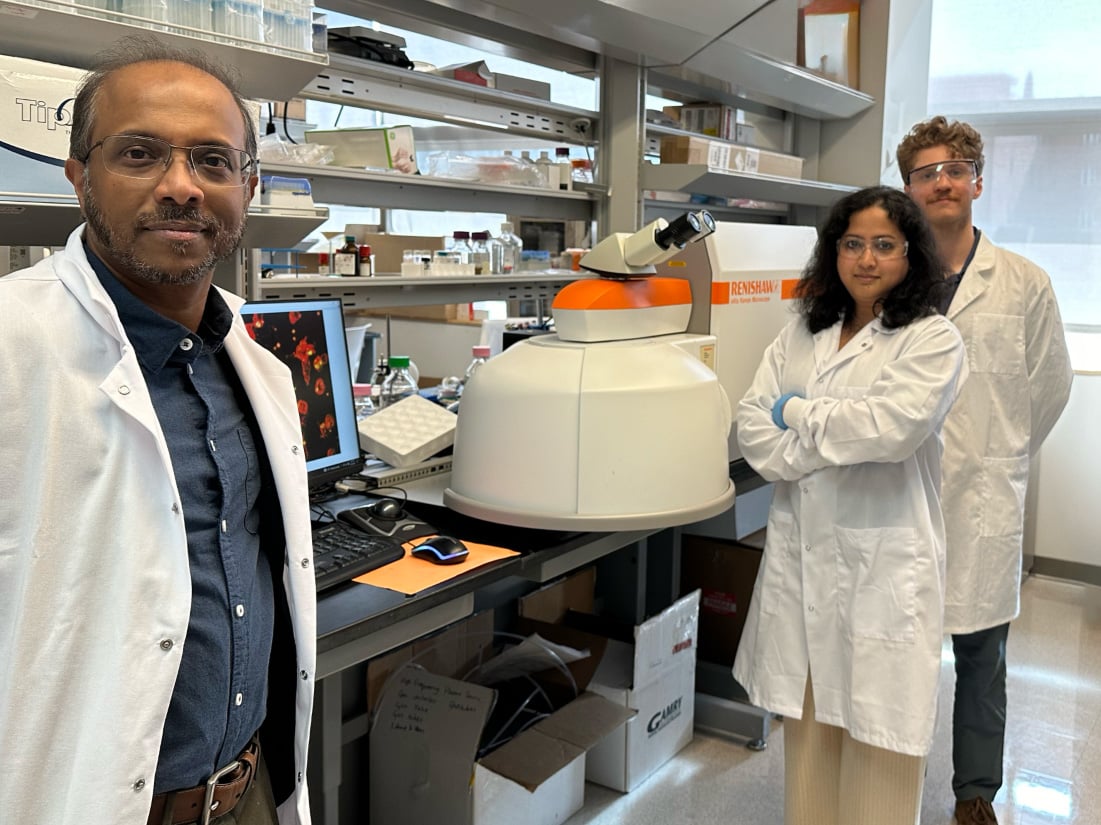
“Since this material has remarkable potential as a substrate for implantable sensors, we wanted to learn about their behavior when exposed to cells,” Pan said. “Our study, for the first time ever, showed that various polymorphic structures of borophene interact with cells differently and their cellular internalization pathways are uniquely dictated by their structures.”
The researchers synthesized borophene platelets — similar to the cellular fragments found in blood — using solution state synthesis, which involves exposing a powdered version of the material in a liquid to one or more external factors, such as heat or pressure, until they combine into the desired product.
Methodology and Findings
“We made the borophene by subjecting the boron powders to high-energy sound waves and then mixed these platelets with different amino acids in a liquid to impart the chirality,” Pan said. “During this process, we noticed that the sulfur atoms in the amino acids preferred to stick to the borophene more than the amino acids’ nitrogen atoms did.”
The researchers found that certain amino acids, like cysteine, would bind to borophene in distinct locations, depending on their chiral handedness. The team exposed the chiralized borophene platelets to mammalian cells in a dish and observed that their handedness changed how they interacted with cell membranes and entered cells.
According to Pan, this finding could inform future applications, such as the development of higher-resolution medical imaging with contrast that could precisely track cell interactions or better drug delivery with pinpointed material-cell interactions. Critically, he said, understanding how the material interacts with cells — and controlling those interactions — could one day lead to safer, more effective implantable medical devices.
“Borophene’s unique structure allows for effective magnetic and electronic control,” Pan said, noting the material could have additional applications in health care, sustainable energy, and more. “This study was just the beginning. We have several projects underway to develop biosensors, drug delivery systems and imaging applications for borophene.”
Reference: “Chiral Induction in 2D Borophene Nanoplatelets through Stereoselective Boron–Sulfur Conjugation” by Teresa Aditya, Parikshit Moitra, Maha Alafeef, David Skrodzki and Dipanjan Pan, 23 April 2024, ACS Nano.
DOI: 10.1021/acsnano.4c01792
Along with Pan, other authors of the study include Teresa Aditya, postdoctoral researcher in nuclear engineering; Parikshit Moitra, research assistant professor of nuclear engineering at Penn State during the study and current assistant professor at the Indian Institute of Science Education and Research; Maha Alafeef, research scientist at Penn State during the study and current assistant professor at Jordan University of Science and Technology; and David Skrodzki, graduate research assistant in materials science and engineering at Penn State.
The Centers for Disease Control and Prevention, the U.S. National Science Foundation, and the Department of Defense partially supported this research.
Never miss a breakthrough: Join the SciTechDaily newsletter.
Follow us on Google and Google News.
1 Comment
Looks like development on “the mark of the beast” is coming along nicely.
I wonder how many people will jump at the chance to have something like this implanted on them.