
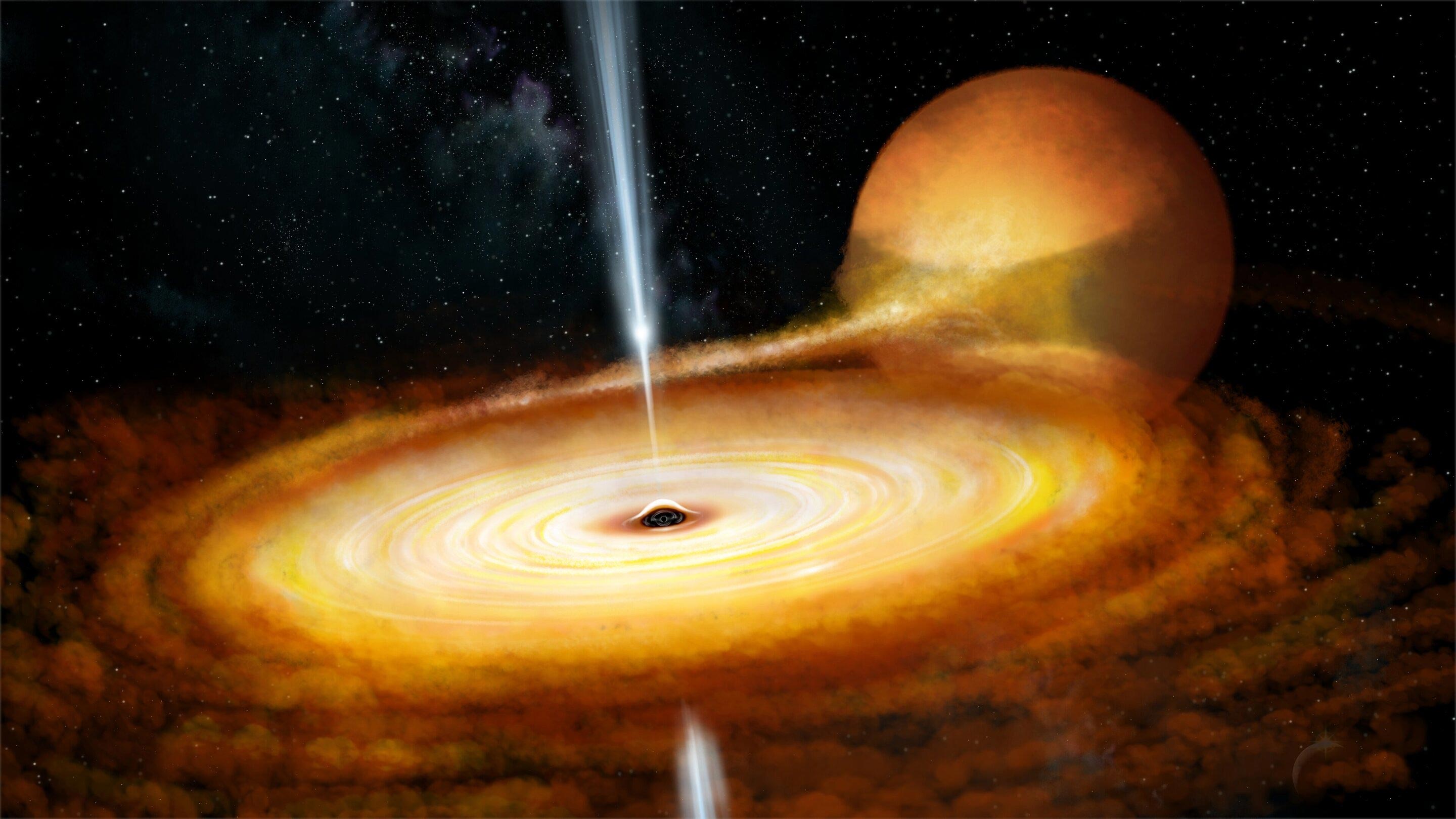
An international team of astronomers, led by the University of Southampton, have used state-of-the-art cameras to create a high frame-rate movie of a growing black hole system at a level of detail never seen before. In the process, they uncovered new clues to understanding the immediate surroundings of these enigmatic objects. The scientists published their work in a new paper in Monthly Notices of the Royal Astronomical Society.
Black holes can feed off a nearby star and create vast accretion discs of material. Here, the effect of the black hole’s strong gravity and the material’s own magnetic field can cause rapidly changing levels of radiation to be emitted from the system as a whole.
This radiation was detected in visible light by the HiPERCAM instrument on the Gran Telescopio Canarias (La Palma, Canary Islands) and in X-rays by NASA’s NICER observatory aboard the International Space Station.
The black hole system studied is named MAXI J1820+070, and was first discovered in early 2018. It is only about 10,000 lightyears away, in our own Milky Way. It has a mass of about 7 Suns, with this collapsed down to a region of space smaller than the City of London.
Investigating these systems is usually very difficult, as their distances make them too faint and too small to see — not even using the Event Horizon Telescope, which recently took a picture of the black hole at the center of the galaxy M87. The HiPERCAM and NICER instruments, however, let the researchers record ‘movies’ of the changing light from the system at over three hundred frames per second, capturing violent ‘crackling’ and ‘flaring’ of visible and X-ray light.
John Paice, a graduate student at the University of Southampton and the Inter-University Center for Astronomy & Astrophysics in India was the lead author of the study presenting these results, and also the artist who created the movie. He explained the work as follows: “The movie was made using real data, but slowed down to 1/10th of actual speed to allow the most rapid flares to be discerned by the human eye. We can see how the material around the black hole is so bright, it’s outshining the star that it is consuming, and the fastest flickers last only a few milliseconds – that’s the output of a hundred Suns and more being emitted in the blink of an eye.”
Researchers also found that dips in X-ray levels are accompanied by a rise in visible light (and vice-versa). And the fastest flashes in visible light were found to emerge a fraction of a second after X-rays. Such patterns indirectly reveal the presence of distinct plasma, an extremely hot material where electrons are stripped away from atoms, in structures deep in the embrace of the black hole’s gravity, otherwise too small to resolve.
This is not the first time this has been found; a split-second difference between X-ray and visual light has been seen in two other systems hosting black holes but it has never been observed at this level of detail. Members of this international team have been at the forefront of this field over the past decade. Dr. Poshak Gandhi, also of Southampton, found the same fleeting time signatures in the two previous systems as well.
He commented on the significance of these findings: “The fact that we now see this in three systems strengthens the idea that it is a unifying characteristic of such growing black holes. If true, this must be telling us something fundamental about how plasma flows around black holes operate.
“Our best ideas invoke a deep connection between inspiralling and outflowing bits of the plasma. But these are extreme physical conditions that we cannot replicate in Earth laboratories, and we don’t understand how nature manages this. Such data will be crucial for homing in on the correct theory.”
Reference: “A Black Hole X-ray Binary at ∼100 Hz: Multiwavelength Timing of MAXI J1820+070 with HiPERCAM and NICER ” by J A Paice, P Gandhi, T Shahbaz, P Uttley, Z Arzoumanian, P A Charles, V S Dhillon, K C Gendreau, S P Littlefair, J Malzac, S Markoff, T R Marsh, R Misra, D M Russell and A Veledina, 3 October 2019, Monthly Notices of the Royal Astronomical Society: Letters.
DOI: 10.1093/mnrasl/slz148
Never miss a breakthrough: Join the SciTechDaily newsletter.
Follow us on Google and Google News.