
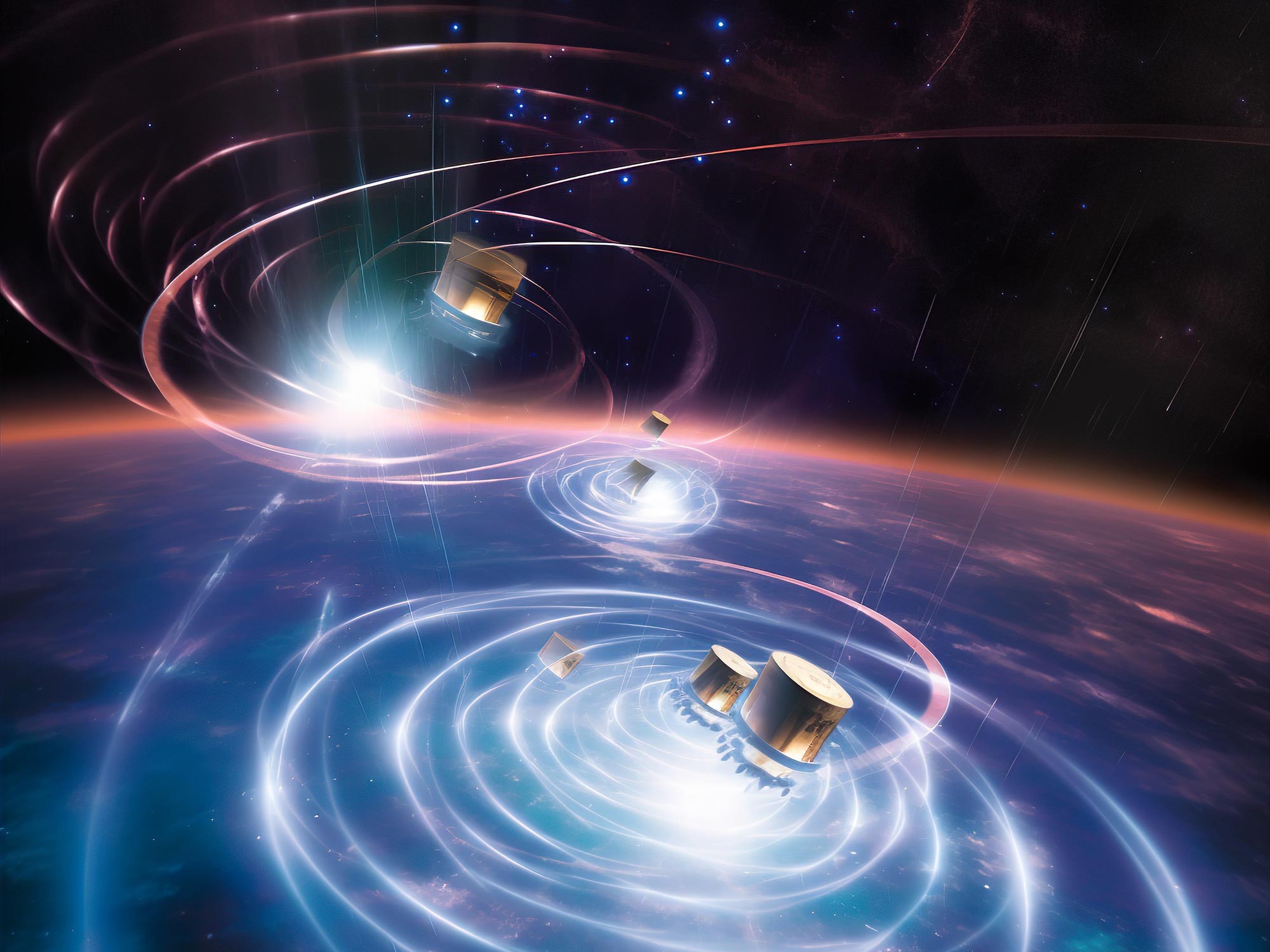
Scientists propose a groundbreaking experiment using quantum computers and atomic clocks to test whether gravity alters the fundamental rules of quantum theory.
A recent study featured in the journal PRX Quantum reveals how a network of quantum computers equipped with optical clocks can be used to investigate how gravity influences quantum systems.
The researchers found that placing three quantum computers at different elevations, even with just a 1-kilometer difference in height, allows Earth’s curved gravitational field to measurably affect the quantum states shared among them. Their work outlines how this setup could offer the first direct evidence that conventional quantum theory may need to be revised to incorporate the principles of general relativity.
“There is an extensive body of theoretical work suggesting that what we currently accept as quantum theory needs to be modified to account for general relativity, and we have devised an experiment to explore one aspect of this deviation from conventional quantum theory,” said Jacob Covey, a physics professor in The Grainger College of Engineering at the University of Illinois Urbana-Champaign and the study’s lead author. “The strength of our procedure is that it relies on quantum information protocols that have been or will soon be demonstrated, so it is, in principle, relatively straightforward to implement.”
The authors’ work was featured in the American Physical Society magazine Physics and covered in a Viewpoint article.
Gravitational Time Dilation Meets Quantum Mechanics
The effects of general relativity – the modern theory of gravity which posits that space and time are curved by the presence of mass – are expected to manifest in quantum systems through the phenomenon of gravitational time dilation, in which clocks at different locations in a gravitational field “tick” at different rates. While the effect is prominent around ultra-dense objects such as black holes and neutron stars, it is quite subtle here on Earth, where gravity is comparatively weak.
“It was necessary to use the incredibly high precision of quantum metrology with optical atomic clocks to first explore the time dilation near Earth,” Covey said. “However, no experiment has directly observed the effect of spacetime curvature on quantum mechanics itself.”

Past theoretical work has suggested that curvature in space and time alters a fundamental tenet of accepted quantum theory called the Born rule, a principle based on the linearity of quantum theory, allowing the theory’s abstract mathematics to be translated into experimental predictions. However, observing alterations to the rule is a tricky task, as they would only appear in quantum systems with a certain level of intrinsic nonlinearity.
“One of the Born rule’s predictions is how multiple quantum sources combine and interfere with each other,” Covey said. “In a collection of three quantum sources, the rule says that only pairwise interference – 1 and 2, 1 and 3, and 2 and 3 – are needed to describe the full system. If gravity altered the rule, then there would be a term where all three – 1, 2, and 3 – interfere simultaneously. Testing this scenario necessarily requires a system with three sources that span a sufficiently large nonlinearity to provide a discernible observable. This, in turn, requires the most precise sensors humans have ever made, optical atomic clocks, and elevation separations of kilometers. Hence, the three-node quantum network of optical atomic processor clocks.”
W-States and Quantum Teleportation as Experimental Tools
The study’s authors designed an experiment to test this prediction using so-called “W-states” – three-part quantum systems integral to many protocols in quantum computing and communication. Current quantum technology has the means to create W-states on physically separated computers using the operation of quantum teleportation. Exploiting this fact, the researchers demonstrated that gravitational time dilation would cause W-state components to display specific interference patterns, making it clear how Born rule violations would appear in experimental data.
According to Covey, the new protocol is feasible to implement using distributed quantum computing technology, in which quantum “nodes” are connected by special quantum networks. Illinois is participating in the construction of such a network organized by the Q-NEXT Department of Energy quantum center connecting the University of Chicago and Argonne National Laboratory. Fermilab and other locations in the Chicago metro area may be added later, and elevation differences of nearly one kilometer could be achieved using a combination of underground labs at Fermilab (in which drop-tower atomic clock experiments are already performed) and the tall buildings of Chicago.
Reference: “Probing Curved Spacetime with a Distributed Atomic Processor Clock” by Jacob P. Covey, Igor Pikovski and Johannes Borregaard, 21 July 2025, PRX Quantum.
DOI: 10.1103/q188-b1cr
Never miss a breakthrough: Join the SciTechDaily newsletter.
Follow us on Google and Google News.
14 Comments
Earth is unique
Perhaps it’s not quantum mechanics that’s being “warped” by gravity—but coherence itself that’s being sheared by tension in the field.
Resonant Field Theory proposes that what we call gravity is actually a manifestation of field shear, not spacetime curvature. The interference patterns breaking down near Earth’s surface may not be anomalies, but clues that coherence has a physical threshold.
It’s time to stop rescuing broken ideas and start listening to what reality’s telling us.
[DOI: https://doi.org/10.5281/zenodo.16551310%5D
#FieldShear #CoherenceNotCurvature #ResonantFieldTheory
Your link doesn’t work, otherwise I’d look at the (I assume technical) arguments and give you my feedback. However, the ideas sound vague and new age. Maybe send your manuscript to Roger Penrose?
Zenodo is a repository, not a peer reviewed journal. If you haven’t passed peer review, you can’t call your putative notions “a theory”.
Well, I won’t let that ruin my day…
If an elevation difference of a km or so gives so faint an effect, why not use a fast-spinning disc, whose rim would experience a hugely greater g-force (perhaps 10,000g)?
An excellent idea, Graham. Several years ago I tried mounting identical digital wrist watches on the three blades of a ceiling fan with a fourth “control” watch down below. I let it run for about a week with no noticeable differences; too great of a time increment (seconds), too slow of a fan rotation and too short of a run time. I may try it again some day under better conditions; “well done.”
Your experiment is legit. But before you run this experiment, you should do some back-of-the-envelope calculations. Without having done the calculations, my hunch is that the time difference would be too slight for you to notice it. You may have to run it for a long, long time, and by then you would start doubting the correctness of your watches.
That said, people have done this type of comparisons using atomic clocks. Time does flow differently based on velocity and also based on strength of gravity.
Thanks, again, AG3, good points. I did the basic calculations in my head; ergo, multiple digital (not mechanical) watches. I had very limited resources at the time, still do, and was overly optimistic about success. Had circumstances been different and/or stable I might have run the experiment for a year, stopping it briefly (perhaps on a monthly basis) to check for actual results. I have observed and felt the ‘induction’ factor (e.g., some still unidentified higher force) I occasionally mention on multiple occasions that still convinces me it is the clock (even atomic), not time, that changes with changes in altitude/gravity and/or velocity.
In Einstein’s equations it’s the actual time – not just the mechanical movements – that slows down. For example, decay of particles also slow down.
As regards watches, atomic watches are very different from mechanical watches. So, if atomic watches also slow down, then something fundamental must be at work.
Einstein’s equation for slowing of time is actually quite simple and “obvious” – so there isn’t much to doubt it. His non-obvious assumption is that the speed of light is constant regardless of velocities. Once you are past this non-obvious assumption, it’s fairly easy to see that with velocity, length must shrink and time must slow down.
“Einstein’s equation for slowing of time is actually quite simple and “obvious” – so there isn’t much to doubt it.”
Furthermore, the GPS system relies on both special and general relativistic time dilation corrections. “Special and general relativity predicted that the clocks on GPS satellites, as observed by those on Earth, run 38 microseconds faster per day than those on the Earth. The design of GPS corrects for this difference; because without doing so, GPS calculated positions would accumulate errors of up to 10 kilometers per day (6 mi/d)” [Wikipedia]
Interesting idea….
My concern is that vibrations would affect the experiment? The experimental setup seems to be complicated.
But hopefully they can run the experiment with one part of the setup at Everest base camp – that’s more than 1km in height.
The question is whether time dilation affects the Born rule and linearity of QM. The authors rely on a semiclassical gravity model to estimate the effects, which itself may introduce contributions that are not observed, e.g. higher-order interferences. This is just a proposal for an experiment, no outcome (yet). Maybe they are still awaiting funding? So fund it, I’d like to see the results.
The experiment will look at non-linearities in the gravitational time dilation caused by the field potential (a.k.a. “time curvature”) which could be interpreted as “space curvature” effects of general relativity. But interpreting the non-linearities of general relativity, which shows up in e.g. gravitational wave measurements of black hole mergers, as curvature is still an interpretation, not a measurement of space curvature itself.
However, it seems like a feasible experiment and it will, they note, probe some of the linearity and probability amplitude (i.e. wavefunction) mechanisms of quantum field theory: testing “the unitarity, linearity, and the probabilistic Born rule of quantum theory”. So hopefully they can get funding.