
Scientists are exploring a new type of optical atomic clock based on ytterbium-173 ions that could help define the future standard for measuring time.
For decades, cesium atomic clocks have served as the global standard for precise timekeeping. However, scientists expect an even more precise technology to eventually take their place: optical atomic clocks. Within the next several years, these advanced clocks could redefine the second, the base unit of time in the International System of Units (SI). It is still unclear which type of optical clock will ultimately become the new reference.
Researchers at the Physikalisch-Technische Bundesanstalt (PTB) have already developed several optical clock systems. Now scientists believe another design could join them: an optical multi-ion clock that uses ytterbium-173 ions. This system could combine the exceptional accuracy achieved with individual ions and the improved stability that comes from measuring several ions at once. The work is the result of a collaboration between PTB and the Thai metrology institute NIMT.
The research team, led by Tanja Mehlstäubler, describes the findings in the journal Physical Review Letters. Beyond improving timekeeping, the results may also contribute to advances in quantum computing and provide new ways to study the internal structure of atoms.
Combining Accuracy and Stability
Different types of optical atomic clocks offer different strengths. Clocks based on a single ion, such as ytterbium-171, are known for extremely high accuracy. Systems that use many particles, such as strontium atoms, tend to provide excellent stability.
Mehlstäubler’s group is working to combine these advantages. The team previously demonstrated a multi-ion clock using indium ions. Researchers are now exploring the same approach using a different isotope, ytterbium-173.
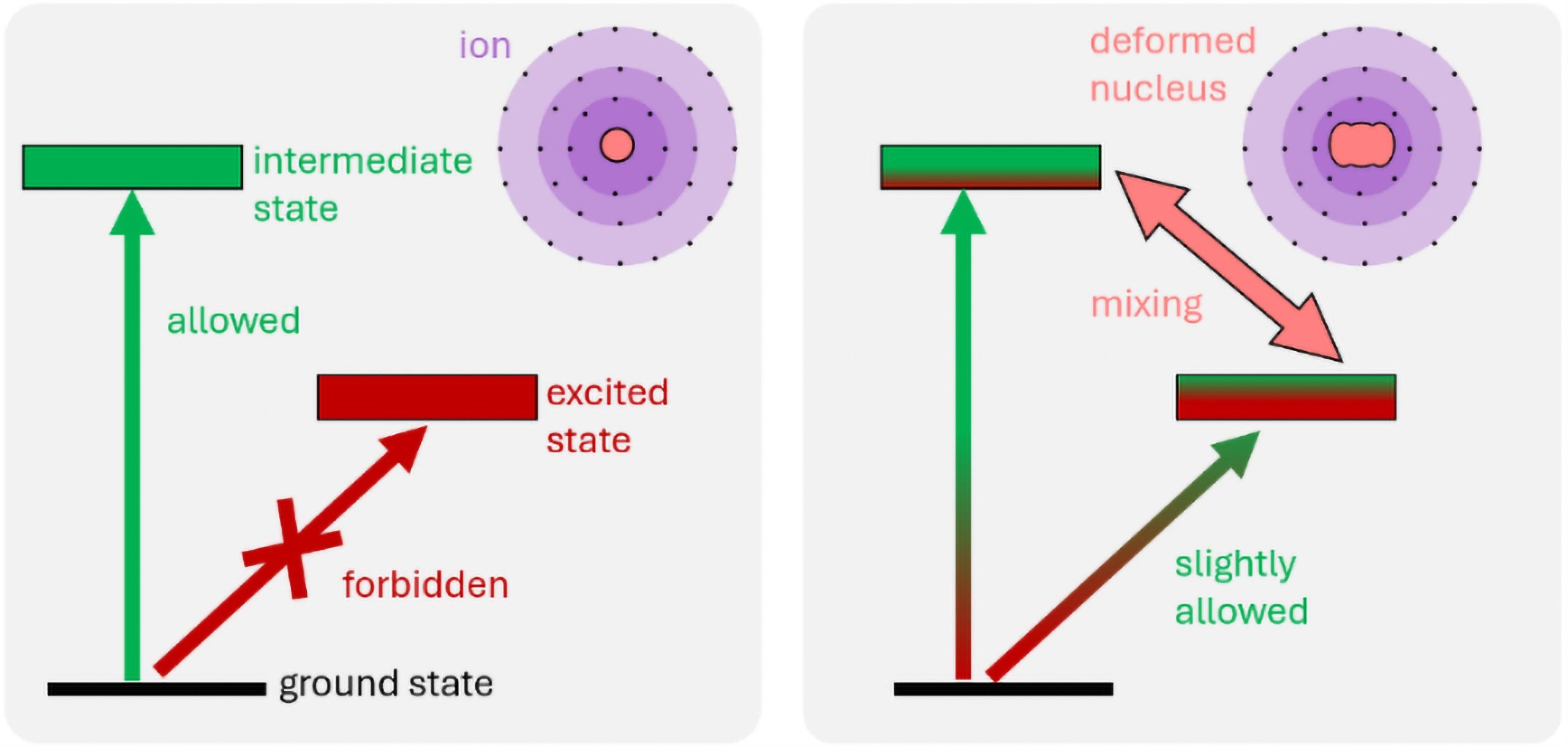
“This isotope has a particularly interesting transition”, explains the physicist.
In atomic clocks, a transition refers to a quantum jump between two energy states inside an atom. This change happens only when the atom interacts with radiation at a specific frequency. Today’s cesium clocks rely on microwave radiation to trigger this process. Optical clocks instead use laser light. Because optical frequencies oscillate about one hundred thousand times faster than microwaves, they allow scientists to divide time into much smaller intervals and measure it with greater precision.
A Long-Lived Excited State
In ytterbium-173, the relevant transition leads to an excited state that lasts an unusually long time.
“This allows us to make more stable measurements,” explains first author Jialiang Yu. “But such transitions usually require strong laser light, which in turn can have major disadvantages.”
However, the atomic nucleus of ytterbium-173 has a unique structure that gives the atom special properties. These characteristics allowed the researchers to overcome typical limitations and even control multiple ions at the same time.
As a result, the team has opened the door to a multi-ion optical clock based on ytterbium that combines the precision of single-ion clocks with the improved stability of systems that use multiple ions. The atom also appears well-suited for use as a multi-qubit platform for quantum information because laser light can manipulate its quantum states with extremely high precision.
Insights Into Fundamental Physics
The ytterbium-173 system may also play an important role in quantum computing research. Because several quantum states can be controlled and encoded at once, the atom could allow researchers to store and process more quantum information simultaneously.
The team also measured the lifetime of the clock state for the first time. This measurement provides valuable information about the structure of the atomic nucleus. It could also enable highly sensitive tests in nuclear physics, including searches for possible effects that fall outside the current standard model of physics.
Reference: “Nuclear Spin Quenching of the 2𝑆1/2→2𝐹7/2 Electric Octupole Transition in 173Yb+” by Jialiang Yu, Anand Prakash, Clara Zyskind, Ikbal Ahamed Biswas, Rattakorn Kaewuam, Piyaphat Phoonthong and Tanja E. Mehlstäubler, 14 January 2026, Physical Review Letters.
DOI: 10.1103/fx1b-5666
The work was supported by the German Research Foundation DFG (DQ-mat), by the German Excellence Initiative (QuantumFrontiers-390837967) as part of the EU-wide metrology research program (EMPIR project 22IEM01 TOCK) and by the Max Planck RIKEN PTB Center for Time, Constants and Fundamental Symmetries.
Never miss a breakthrough: Join the SciTechDaily newsletter.
Follow us on Google and Google News.
2 Comments
The team also measured the lifetime of the clock state for the first time. This measurement provides valuable information about the structure of the atomic nucleus.
VERY GOOD.
Please ask researchers to think deeply:
Does time have periodicity? Is the periodicity of atomic impulses related to topological spin?
From Topological Vortex Theory (TVT) viewpoint, the stability of a skyscraper is fundamentally determined by the topological invariants of its overall structure (such as Euler characteristic, homology groups), just as the stability of elementary particles is guaranteed by the conservation of topological charges like Chern classes. Structural failure is, in essence, the collapse of its topological order, not merely the exhaustion of material strength. Recent observations of vortex lattices in confined geometries further support the notion that topology dictates physical properties across scales.
—— https://zhuanlan.zhihu.com/p/2012896837590360214.
When we pursue the ultimate truth of all things, the space in which our bodies and all things exist may itself be the final and deepest puzzle we need to explore. This is not only the pursuit of physics, but also the most magnificent exploration of the origin of the universe by human reason.
Based on the Topological Vortex Theory (TVT), space is an uniformly incompressible physical entity. Space-time vortices are the products of topological phase transitions of the tipping points in space, are the point defects in spacetime. Point defects do not only impact the thermodynamic properties, but are also central to kinetic processes. They create all things and shape the world through spin and self-organization.
In today’s physics, some so-called peer-reviewed journals—including Physical Review Letters, Nature, Science, and others—stubbornly insist on and promote the following:
1. Even though θ and τ particles exhibit differences in experiments, physics can claim they are the same particle. This is science.
2. Even though topological vortices and antivortices have identical structures and opposite rotational directions, physics can define their structures and directions as entirely different. This is science.
3. Even though two sets of cobalt-60 rotate in opposite directions and experiments reveal asymmetry, physics can still define them as mirror images of each other. This is science.
4. Even though vortex structures are ubiquitous—from cosmic accretion disks to particle spins—physics must insist that vortex structures do not exist and require verification. Only the particles that like God, Demonic, or Angelic are the most fundamental structures of the universe. This is science.
5. Even though everything occupies space and maintains its existence in time, physics must still debate and insist on whether space exists and whether time is a figment of the human mind. This is science.
6. Even though space, with its non-stick, incompressible, and isotropic characteristics, provides a solid foundation for the development of physics, physics must still insist that the ideal fluid properties of space do not exist. This is science.
and go on.
Is this the counterintuitive science they widely promote? Compromising with pseudo academic publications and peer review by pseudo scholars is an insult to science and public intelligence. Some so-called scholars no longer understand what shame is. The study of Topological Vortex Theory (TVT) reminds us that the most profound problems in physics often lie at the intersection of different theories. By exploring these border regions, we can not only resolve contradictions in existing theories but also discover new physical phenomena and application possibilities.
Under the topological vortex architecture, it is highly challenging for even two hydrogen atoms or two quarks to be perfectly symmetrical, let alone counter-rotating two sets of cobalt-60. Contemporary physics and so-called peer-reviewed publications (including Physical Review Letters, Science, Nature, etc.) stubbornly believe that two sets of counter rotating cobalt-60 are two mirror images of each other, constructing a more shocking pseudoscientific theoretical framework in the history of science than the “geocentric model”. This pseudo scientific framework and system have seriously hindered scientific progress and social development.
For nearly a century, physics has been manipulated by this pseudo scientific theoretical system and the interest groups behind it, wasting a lot of manpower, funds, and time. A large amount of pseudo scientific research has been conducted, and countless pseudo scientific papers have been published, causing serious negative impacts on scientific and social progress, as well as humanistic development.
Complexity does not necessarily mean that there is no logical and architectural framework to follow. Mathematics is the language and tool that reveals the motion of spacetime, rather than the motion itself. Although the physical form of spacetime vortices is extremely simple, their interaction patterns are highly complex, and we must develop more and richer mathematical languages to describe and understand them.
The development of the Topological Vortex Theory (TVT) reflects a progression from concrete physical phenomena to abstract mathematical modeling and, ultimately, to interdisciplinary unification. Its core innovation lies in forging the continuous spacetime geometry of general relativity with the discrete interactions of quantum field theory within the same topological dynamical system. The core idea of TVT — space is physical, and matter is its topological excitation—already provides a solid and elegant scientific path for understanding the origin of all things.
——Excerpted from https://scitechdaily.com/microscope-spacecrafts-most-precise-test-of-key-component-of-the-theory-of-general-relativity/#comment-909171 and https://t.pineal.cn/blogs/6255/A-Mathematical-and-Physical-Analysis-On-the-Origin-of-Objects.
Are these science?
Example 1
Two sets of cobalt-60 are manually rotated in opposite directions, and even without detection, people around the world know that they will not be symmetrical because these two objects are not mirror images of each other at all. However, a group of so-called physicists and so-called academic publications do not believe it. They conducted experiments and the results were indeed asymmetric, but they still firmly believed that these two objects were mirror images of each other, and the asymmetry was due to a violation of the previous natural laws (CP violation). In the history of science, there can never be a dirtier and uglier operation and explanation than this.
—— Excerpted from https://scitechdaily.com/what-happens-when-light-gains-extra-dimensions/#comment-947619.
Example 2
Please see how the so-called “mystery of θ – τ” is explained: θ and τ are completely identical in all measurable physical properties such as mass, lifetime, charge, spin, etc. However, experimental observations have shown that the θ meson decays into two π mesons, while the τ meson decays into three π mesons, making it difficult for physicists to explain why they are so similar. Physicist Martin Block proposed a highly challenging idea: θ and τ are the same particle, but in weak interactions, parity is not conserved. An easy to understand explanation is the following analogy:: There are two boxes of apples with identical weight, color, and taste. However, when one box is opened, there are two apples, while when the other box is opened, there are three apples. This confuses the old farmer who buys apples. He circled around the orchard and came up with a highly challenging idea: these two boxes of apples are not from the same tree, so they are the same.
—— Excerpted from https://scitechdaily.com/what-happens-when-light-gains-extra-dimensions/#comment-947686.
Everyone who has a reverence for natural laws and regulations deserves respect.
In the physical world constructed by the American Physical Society (APS) and its publications using parity violation, particles from God, Demons, and Angels wander around, while dead and alive cats jump up and down, unconstrained by dynamics and thermodynamics, and unaware of what is dirty, ugly, and shameful in public. APS and its publications reject the possibility that spaces with zero viscosity, zero compression, and zero anisotropy in mathematics may form spatiotemporal vortices through topological transformations. They don’t know that space and non existence are not the same concept.
If a self proclaimed scientific society (such as American Physical Society) deviates from science without shame, it is highly likely to be heading towards the end. Nature is the final court of appeal for science, and it is geometric, not merely numerical.