
Close Menu
    Facebook X (Twitter) Instagram
    SciTechDaily
    • Biology
    • Chemistry
    • Earth
    • Health
    • Physics
    • Science
    • Space
    • Technology
    Facebook X (Twitter) Pinterest YouTube RSS
    SciTechDaily
    Home»Physics»Scientists Realize Noiseless Photon-Echo Protocol – Key to Long-Distance Quantum Communication
    Physics

    Scientists Realize Noiseless Photon-Echo Protocol – Key to Long-Distance Quantum Communication

    By University of Science and Technology of ChinaSeptember 16, 2021No Comments2 Mins Read
    Facebook Twitter Pinterest Telegram LinkedIn WhatsApp Email Reddit
    Share
    Facebook Twitter LinkedIn Pinterest Telegram Email Reddit
    Abstract Physics Photonics Concept
    Researchers have successfully implemented a noiseless photon-echo protocol, marking a significant stride toward long-distance quantum communication.

    USTC scientists have developed a noiseless photon echo protocol using a four-level atomic system to separate signal from noise in quantum memory. Their method reduces noise by 670 times and boosts efficiency threefold, paving the way for robust quantum communication.

    Prof. Chuanfeng Li and Prof. Zongquan Zhou from University of Science and Technology of China (USTC) of the Chinese Academy of Sciences (CAS) innovatively raised and realized noiseless photon echo (NLPE) protocol. The research of entire originality reduced the noise by 670 times compared with previous strategies and achieved solid quantum memory with high fidelity. The results were published in Nature Communications.

    First observed by Erwin Hahn in 1950, photon echo is a fundamental physical interaction between light and matter as well as an essential tool for the manipulation of electromagnetic fields. However, the intense spontaneous noise emission generated has the same frequency as the signal, it is impossible to separate them in principle. Previous protocols, such as atomic frequency comb and the revival of silenced echo, failed to eliminate the spontaneous noise emission as much as needed.

    In this study, the researchers implemented NLPE protocol in Eu3+:Y2SiO5 crystal to serve as an optical quantum memory and applied a four-level aromic system to suppress the noise.
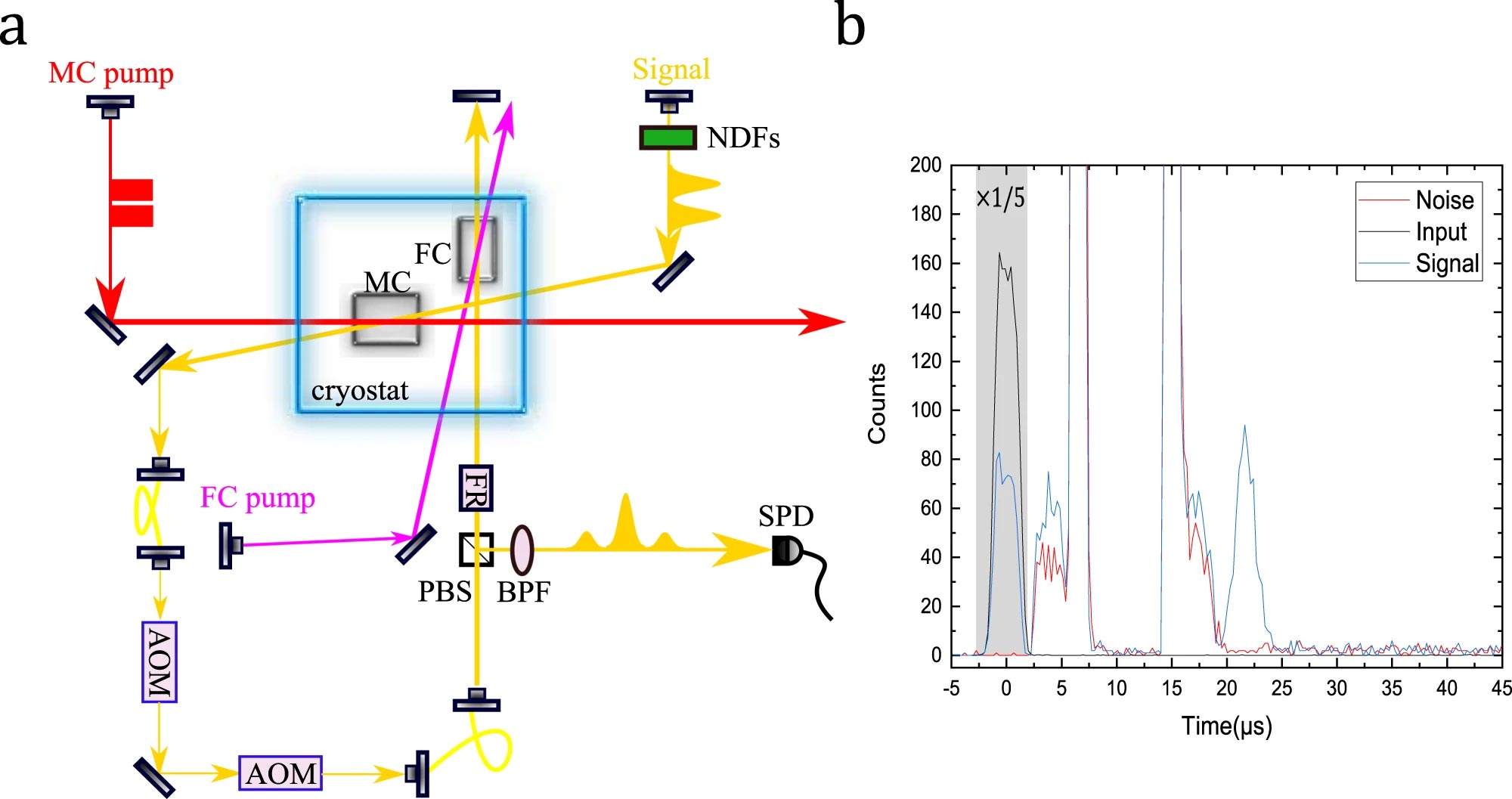
    Experimental Setup and Photon Counting Histogram
    Experimental setup and photon counting histogram. Credit: Image by MA Youzhi et al.

    By double rephasing the pulse in the four-level atomic system, they manipulated the spontaneous noise emission to have a different frequency from the signal. So it is much easier to separate the signal from the noise emission. Though other noises were detected in practical experiment, they were all estimated to be trivial.

    The results of the experiments showed that the noise was 0.0015 photons, 670 times less than previous results. Besides, the efficiency of NLPE was more than three times larger than that of previous protocols.

    Furthermore, its high efficiency, high fidelity, and easy-to-achieve entitle NLPE with magnificent benefits as a noiseless quantum memory protocol.

    All of these advantages bring one closer step to long-distance quantum communication.

    Reference: “Elimination of noise in optically rephased photon echoes” by You-Zhi Ma, Ming Jin, Duo-Lun Chen, Zong-Quan Zhou, Chuan-Feng Li and Guang-Can Guo, 19 July 2021, Nature Communications.
    DOI: 10.1038/s41467-021-24679-4

    Never miss a breakthrough: Join the SciTechDaily newsletter.
    Follow us on Google and Google News.

    Chinese Academy of Sciences Optics Photonics Quantum Information Science Quantum Physics University of Science and Technology of China
    Share. Facebook Twitter Pinterest LinkedIn Email Reddit

    Related Articles

    Stanford Engineers and Physicists Study Quantum View of “Combs” of Light

    Chinese Researchers Construct a Multiplexed Quantum Repeater Based on Absorptive Quantum Memories

    Coherent Storage of Light Over One-Hour Achieved – Great Stride Towards the Application of Quantum Memories

    Complex Shapes of Photons for Fast Photonic Quantum Computations and Safe Data Transfer

    Self-Learning, Self-Evolving Smart Quantum Technologies for Secure Communication

    Chromatic Light Particle Effect Demonstrated for the Development of Photonic Quantum Networks

    Ultimate Precision: Scientists Reach Limit of Multi-Parameter Quantum Measurement With Zero Trade-Off

    Quantum Physics Milestone: Controlled Transport of Stored Light

    Physicists Test the Response Time of Electrons

    Leave A Reply Cancel Reply

    • Facebook
    • Twitter
    • Pinterest
    • YouTube

    Don't Miss a Discovery

    Subscribe for the Latest in Science & Tech!

    Trending News

    Bone-Strengthening Discovery Could Reverse Osteoporosis

    Scientists Uncover Hidden Trigger Behind Stem Cell Aging

    Scientists Find Way to Reverse Fatty Liver Disease Without Changing Diet

    Could Humans Regrow Limbs? New Study Reveals Promising Genetic Pathway

    Scientists Reveal Eating Fruits and Vegetables May Increase Your Risk of Lung Cancer

    Scientists Reverse Brain Aging With Simple Nasal Spray

    Scientists Uncover Potential Brain Risks of Popular Fish Oil Supplements

    Scientists Discover a Surprising Way To Make Bread Healthier and More Nutritious

    Follow SciTechDaily
    • Facebook
    • Twitter
    • YouTube
    • Pinterest
    • Newsletter
    • RSS
    SciTech News
    • Biology News
    • Chemistry News
    • Earth News
    • Health News
    • Physics News
    • Science News
    • Space News
    • Technology News
    Recent Posts
    • This Student Recreated the Universe in a Bottle. What She Discovered Could Help Reveal How Life Started on Earth
    • Alzheimer’s Symptoms May Start Outside the Brain, Study Finds
    • Cancer’s Secret Weapon? Scientists Reveal How Tumors “Learn” To Survive Treatment
    • Millions Take This Popular Supplement – Scientists Discover a Concerning Link to Heart Failure
    • What Makes Rubber So Strong? Scientists Finally Solve 100-Year-Old Mystery
    Copyright © 1998 - 2026 SciTechDaily. All Rights Reserved.
    • Science News
    • About
    • Contact
    • Editorial Board
    • Privacy Policy
    • Terms of Use

    Type above and press Enter to search. Press Esc to cancel.