
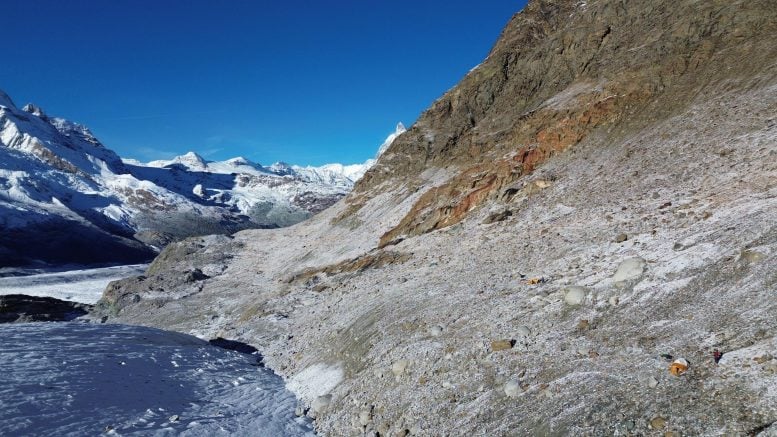
A single fiber-optic cable can turn a glacier’s faint vibrations into a map of its inner structure, helping scientists assess how likely it is to break apart.
Cracks hidden inside glaciers can play a critical role in their collapse. Meltwater can drive these fractures deeper into the ice, weakening glaciers that may appear intact from above. Satellites and drones can map surface features, but they cannot reveal the full extent of the damage within.
The consequences of glacier failure have become painfully clear in the Alps. In July 2022, a collapse on Italy’s Marmolada Glacier killed 11 mountaineers. In May 2025, Switzerland’s Birch Glacier collapsed above Blatten, drawing international attention.
Now, researchers at ETH Zurich have demonstrated a potentially simpler and less expensive way to examine hidden fractures in much greater detail. Their study, led by Assistant Professor Thomas Hudson of the Environmental and Exploration Geophysics Group, appears in Science Advances.
Listening to Ice as It Cracks
Opening crevasses produce tiny earthquakes, sending vibrations through the surrounding ice. Scientists can record these signals with seismometers and trace them back to their sources. Getting a detailed picture, however, requires many instruments, which are costly and difficult to install across a glacier crisscrossed by dangerous cracks.
For their experiment, Hudson and his colleagues laid a single fiber-optic cable across the Gorner Glacier in Switzerland’s canton of Valais. They used it to investigate the glacier’s interior down to 25 meters (82 feet). “A single fiber-optic cable replaces hundreds of seismometers,” emphasizes Hudson.
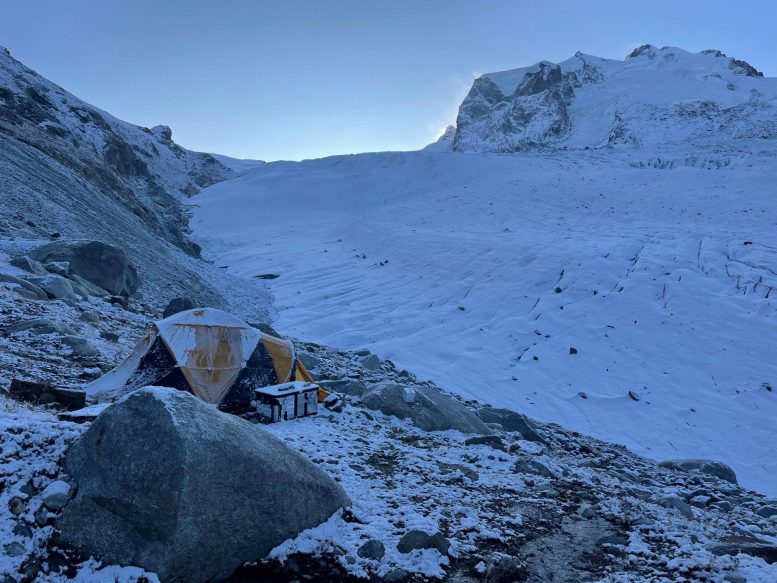
The cable connects to an instrument called an interrogator, which sends light through the fiber and measures the light scattered back. Seismic waves from a cracking glacier slightly stretch or compress sections of the cable, changing the returning light signal. These changes allow researchers to locate the vibrations and determine how deep their sources lie.
Computational methods turn the recordings into a picture of the glacier’s internal structure and composition, somewhat like a medical ultrasound scan. The measurements generate enormous amounts of data, requiring substantial computing power and an algorithm to help interpret them.
A Hidden Network of Glacier Crevasses
The survey revealed that water-filled or air-filled crevasses occupied more than eight percent of the ice volume at the study site. Approximately 92 percent remained intact. “That’s far more than we expected,” says Hudson.
The result shows why a glacier’s appearance can offer an incomplete picture of its stability. “Laypeople often assume that large, visible surface crevasses indicate whether a glacier is stable or not. However, scientists pay more attention to internal cracks and crevasses inside the ice,” Hudson explains.
Mapping that damage could help researchers assess the risk of calving, when pieces of ice break away from a glacier. The technique could eventually support monitoring of unstable glaciers and provide earlier warnings of major breakoffs at their fronts.
“We are very pleased with the test runs on the Gorner Glacier. The method has proven its worth,” Hudson says.
Why Glacier Cracks Matter For Sea Levels
Crevasses also influence how a glacier moves. Water entering these openings can reach the bed beneath the ice, where it can act as a lubricant and potentially accelerate the glacier’s slide. A fracture network can therefore affect both the strength of the ice and its overall behavior.
The effects extend far beyond mountain valleys to Greenland and Antarctica, where ice loss from enormous ice sheets contributes to rising seas. Understanding how fractures develop and carry water through those ice sheets could help scientists better anticipate their response to changing conditions.
The ETH team plans to test the technique on other glaciers in the Swiss Alps and on polar ice sheets. By combining measurements from within the ice with satellite observations of the surface, the researchers hope to track how crevasses develop over time and space and how shallow cracks connect with deeper fractures.
“Our method could therefore help to predict changes in the ice sheets and sea levels,” Hudson explains.
Reference: “Quantifying subsurface fracture damage in glaciers using fiber-optic seismology” by Thomas S. Hudson, Fabian Walter, Sebastian Noe, Andrea Zunino, John-Michael Kendall, Pascal Edme and Andreas Fichtner, 23 July 2026, Science Advances.
DOI: 10.1126/sciadv.aef1107
Never miss a breakthrough: Join the SciTechDaily newsletter.
Follow us on Google and Google News.