
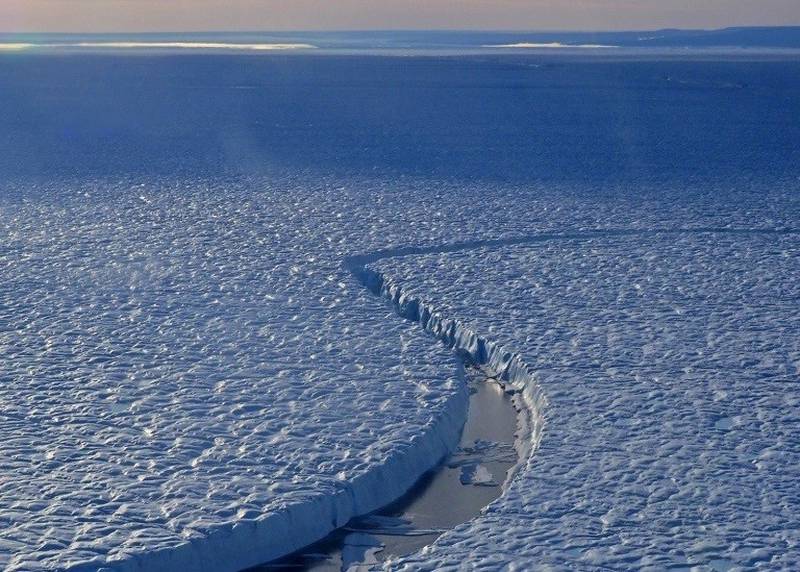
Ice shelves are floating extensions of glaciers. A new study, published in Nature Communications, found that if Greenland’s second-largest ice shelf breaks up, it may not recover unless Earth’s future climate cools considerably.
A group of researchers from Stockholm University and the University of California, Irvine investigated whether the Petermann Ice Shelf in northern Greenland might recover from a future breakup caused by climate change. They employed a complex computer model to predict the ice shelf’s potential recovery.
“Even if Earth’s climate stopped warming, it would be difficult to rebuild this ice shelf once it has fallen apart,” says Henning Åkesson, who led the study at Stockholm University.
“If Petermann’s ice shelf is lost, we would have to go ‘back in time’ towards a cooler climate reminiscent of the period before the industrial revolution to regrow Petermann,” Åkesson says.
Ice shelves reduce mass loss from our polar ice sheets. These gatekeepers thereby limit sea-level rise caused by climate warming. “The rationale to avoid breakup of ice shelves in the first place should be clearer than ever”, Åkesson says.
Glaciers Are Rapidly Melting
Petermann is one of Greenland’s few surviving ice shelves, and it is being closely monitored by experts throughout the globe after Manhattan-sized icebergs broke off from the ice shelf in 2010 and 2012, leading Petermann to lose 40% of its floating ice shelf. Scientists are afraid that additional ice shelf breakdown, or even collapse, may hasten ice flow from the interior ice sheet. In 2018, a new crack in the center of the ice shelf was found, raising additional concerns for Petermann’s health.
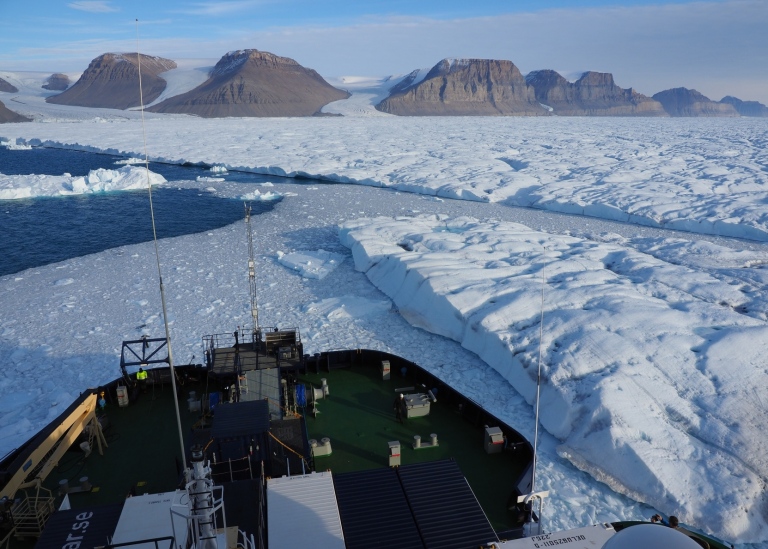
Ice-Sheet Experts Are Concerned
While this study focused on northwestern Greenland’s largest glacier, another grave concern is that the larger ice shelves found in Antarctica could be difficult to build back as well, should they break up too.
“This is just the first step, but chances are that our findings are not unique for Petermann Glacier and Greenland,” Åkesson says. “If they are not, near-future warming of the polar oceans may push the ice shelves protecting Earth’s ice sheets into a new retreated high-discharge state which may be exceedingly difficult to recover from.”
The ice-sheet experts stress that we need to pin down exactly how ice shelves break up, and how much more warming they now can withstand before they fall apart.
Reference: “Petermann ice shelf may not recover after a future breakup” by Henning Åkesson, Mathieu Morlighem, Johan Nilsson, Christian Stranne and Martin Jakobsson, 9 May 2022, Nature Communications.
DOI: 10.1038/s41467-022-29529-5
Never miss a breakthrough: Join the SciTechDaily newsletter.
Follow us on Google and Google News.
4 Comments
Well, it only stands to reason. They have never recovered from previous warms spells, right?
It seems that whatever the change is, the prediction is grim. This article claims the glaciers may never recover from the ice loss. Just over a little over 2 months ago, another prediction similarly expressed concern about the ability to recover if Greenland melts back.
https://scitechdaily.com/scientists-stunned-to-discover-plants-beneath-mile-deep-greenland-ice-and-why-this-is-so-troubling/
Yet, clearly, despite a significant melt during the Eemian, Greenland glaciers did come back!
I think that both scientists and journalists need to show a little more humility and skepticism in their pronouncements.
“They employed a COMPLEX computer model to predict the ice shelf’s potential recovery.”
“Complex,” that’s the magic word! As though “complex” insures that the output of the model will be accurate. Actually, the more complex a models is, the more likely there will be an error that will be difficult to find.
“In 2018, a new crack in the center of the ice shelf was found, raising additional concerns for Petermann’s health.”
The $64,000 question is why would a crack form in the center of the ice shelf when it is presumed that “ice shelves reduce mass loss from our polar ice sheets.” The usual claim is that the ice shelves buttress the glacier, slowing its movement. That implies compression, as the shelf pushes back against the glacier. How does a crack, usually the result of tension or shearing, form in the middle of an ice shelf under compression? Apparently it is too ‘complex’ for the authors to explain.
A simple solution was demonstrated by Mother Nature, volcanic activities reduced solar heating and planet cooled for short time. Check recent Icelandic volcanic activities for evidence. So a simple solution to lost of ice is increasing the amount of contrails from high flying aircraft. Introduction of water into jet exhaust will create steam which will create reflective cloud ☁️ structures reducing solar heating TEMPORARILY.
Volcanic activities have been shown to create these temporary results. Many examples exist, “year without a summer” is the most popular example. Most important aspect of this work is that the process is: simple, low cost, controlled, and TEMPORARY.
CO2 reduction is desired but difficult to accomplish. Using existing aircraft travel patterns, mostly northern hemisphere, will quickly prove this approach. Also, it does not require expensive economic impact to implement.
Present CO2 reduction approach requires many different situations be altered to make progress.