
Rice University researchers have discovered a hidden symmetry in the chemical kinetic equations scientists have long used to model and study many of the chemical processes essential for life.
The find has implications for drug design, genetics and biomedical research and is described in a study published on April 21, 2020, in the Proceedings of the National Academy of Sciences. To illustrate the biological ramifications, study co-authors Oleg Igoshin, Anatoly Kolomeisky and Joel Mallory of Rice’s Center for Theoretical Biological Physics (CTBP) used three wide-ranging examples: protein folding, enzyme catalysis and motor protein efficiency.
Igoshin said the symmetry “wasn’t that hard to prove, but no one noticed it before.”
In each case, the researchers demonstrated that a simple mathematical ratio shows that the likelihood of errors is controlled by kinetics rather than thermodynamics.
“It could be a protein folding into the correct versus the incorrect conformation, an enzyme incorporating the right versus the wrong amino acid into the polypeptide chain, or a motor protein mistakenly stepping backward instead of going forward,” said Igoshin, a CTBP investigator and professor of bioengineering at Rice. “All of those properties can be expressed as a ratio of two steady-state fluxes, and we found that biological properties expressed in these terms are under kinetic control.”
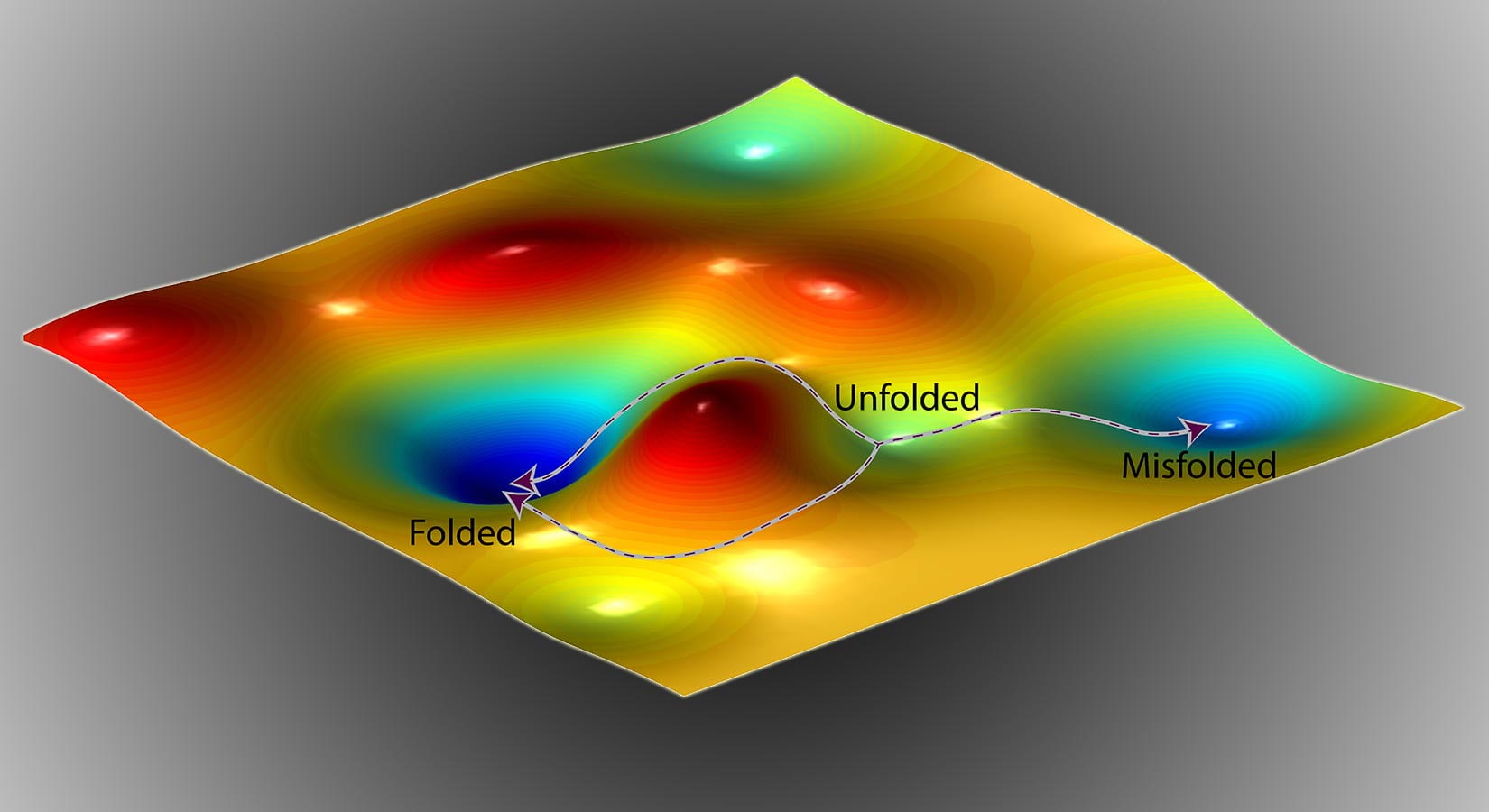
The protein-folding example illustrates the implications for drug design. All proteins fold into a characteristic shape, and a fraction misfold into the wrong shape. Protein misfolding has been implicated in some heritable genetic disorders and diseases, and drugmakers are interested in making drugs that can reduce the chances of proteins misfolding.

Before it folds, a protein has energy, like a ball sitting atop a hill. Folding is the downhill run from this high-energy starting point to the place where the ball stops rolling. Chemists often use a visual aid called a “free-energy landscape” to chart energy levels in chemical reactions. The landscape looks like a mountain range with peaks and valleys, and the downhill run from a protein’s unfolded starting point to its fully folded finishing point can look like a mountain road that winds through a series of valleys. Even if one town along the road is lower in elevation, a traveler might have to climb hills to get from one valley to the next on the way downhill.
“We’ve shown it’s the barriers, the high points between valleys, that determine these ratios,” Igoshin said. “The depths of the valleys don’t matter.
“If you want to get a drug that will help a protein fold correctly, for example, our prediction is that the drug must be able to reduce a barrier along the folding pathway,” he said. “If it only affects the valleys, say by improving the stability of some intermediate conformations along the folding pathway, it won’t change the ratio of times the protein folds correctly versus incorrectly.”
Igoshin said the work stemmed from a 2017 study where he, Kolomeisky and former CTBP postdoctoral researcher Kinshuk Banerjee showed that the accuracy of enzymatic catalysis was kinetically controlled. Igoshin described the discovery as a “kind of underlying symmetry of equations.”
“If you look at the ratios of fluxes, you get this interesting cancellation, and all the terms that have to do with these values cancel out, and you get the invariance,” he said. “When we first got this result, it seemed counterintuitive to us. Then, we were not sure if it was a coincidence, because in the previous paper we showed it for only two particular kinetic schemes. Now Joel’s work has shown it can be generalized to this wide range of systems.”
Igoshin said the symmetry “wasn’t that hard to prove, but no one noticed it before.”
“I think it is a very interesting physical result that has big implications in biology,” he said. “It could help define the limits on what is possible in terms of controlling and optimizing system-level properties in many biological processes.”
Reference: “Kinetic control of stationary flux ratios for a wide range of biochemical processes” by Joel D. Mallory, Anatoly B. Kolomeisky and Oleg A. Igoshin, 21 April 2020, Proceedings of the National Academy of Sciences.
DOI: 10.1073/pnas.1920873117
Kolomeisky is a CTBP investigator, a professor of chemistry and of chemical and biomolecular engineering and chair of Rice’s Department of Chemistry. Mallory is a postdoctoral research associate at CTBP.
The research was supported by the National Science Foundation (PHY-1427654, CHE-1664218, MCB-1941106) and the Welch Foundation (C-1559, C-1995).
Never miss a breakthrough: Join the SciTechDaily newsletter.
Follow us on Google and Google News.
1 Comment
This is very interesting, because kinetic energy is the energy that a moving body has. Potential energy is determined by the relative position of bodies or body parts. Kinetic energy can be determined by knowing the mass and speed of the body. To determine the potential energy of a body or system, in addition to the system parameters (body mass and lift height; elongation (compression) and stiffness), you must specify the zero energy reference level. These facts determine the differences between potential and kinetic energies.