
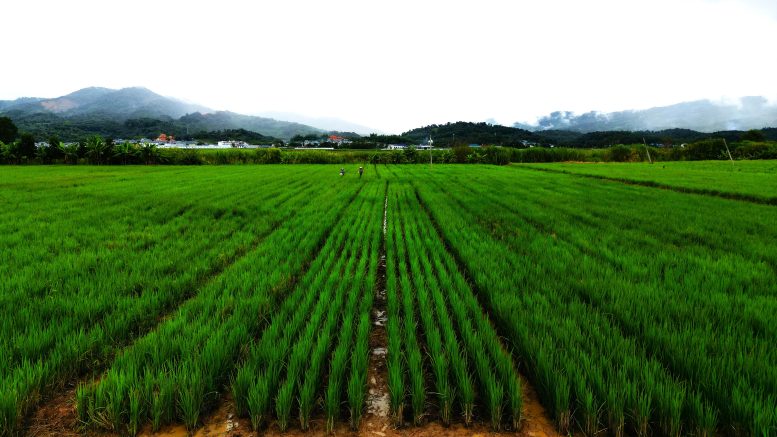
Perennial rice allows for multiple harvests from one planting, offering cost savings and environmental benefits.
Annual paddy rice is now available as a long-lived perennial after more than 9,000 years in cultivation. The advancement means farmers can plant just once and reap up to eight harvests without sacrificing yield. This is an important step change relative to “ratooning,” or cutting back annual rice to obtain a second weaker harvest.
A new report published today (November 7) in the journal Nature Sustainability chronicles agronomic, economic, and environmental outcomes of perennial rice cultivation across China’s Yunnan Province. The retooled crop is already changing the lives of more than 55,752 smallholder farmers in southern China and Uganda.
“Farmers are adopting the new perennial rice because it’s economically advantageous for them to do so. Farmers in China, like everywhere else, are getting older. Everyone’s going to the cities; young people are moving away. Planting rice is very labor intensive and costs a lot of money. By not having to plant twice a year, they save a lot of labor and time,” says Erik Sacks, co-author on the report and professor in the Department of Crop Sciences at the University of Illinois, Urbana-Champaign (UIUC).
Development of Perennial Rice
Sacks, along with senior author Fengyi Hu and Dayun Tao, began working to develop perennial rice in 1999 in a collaboration between the Yunnan Academy of Agricultural Sciences and the International Rice Research Institute. In subsequent years, the project grew to include the University of Illinois, Yunnan University, and the University of Queensland. Another partner, The Land Institute, provided perennial grain breeding and agroecology expertise, along with seed funding to ensure the continuity of the project.
“Perennial rice not only benefits farmers by improving labor efficiency and soil quality, but it also helps replenish ecological systems required to maintain productivity over the long term.” Fengyi Hu
The researchers developed perennial rice through hybridization, crossing an Asian domesticated annual rice with a wild perennial rice from Africa. Taking advantage of modern genetic tools to fast-track the process, the team identified a promising hybrid in 2007, planted large-scale field experiments in 2016, and released the first commercial perennial rice variety, PR23, in 2018.
The international research team spent five years studying perennial rice performance alongside annual rice on farms throughout Yunnan Province. With few exceptions, perennial rice yield [6.8 megagrams per hectare] was equivalent to annual rice [6.7 megagrams per hectare] over the first four years. Yield began to drop off in the fifth year due to various factors, leading the researchers to recommend re-sowing perennial rice after four years.
Economic and Labor Savings with Perennial Rice
But because they didn’t have to plant each season, farmers growing perennial rice put in almost 60% less labor and spent nearly half on seed, fertilizer, and other inputs.
“The reduction in labor, often done by women and children, can be accomplished without substitution by fossil fuel–based equipment, an important consideration as society aims to improve livelihoods while reducing greenhouse gas emissions associated with agricultural production,” Sacks says.
The economic benefits of perennial rice varied across study locations, but profits ranged from 17% to 161% above annual rice. Even in sites and years when perennial rice suffered temporary yield dips due to pests, farmers still achieved a greater economic return than by growing the annual crop.
“That first season, when they planted the annual and the perennial rice side by side, everything was the same, essentially. Yield is the same, costs are the same, there’s no advantage,” Sacks says. “But the second crop and every subsequent crop comes at a huge discount, because you don’t have to buy seeds, you don’t have to buy as much fertilizer, you don’t need as much water, and you don’t need to transplant that rice. It’s a big advantage.”
“Now we can consciously choose to make a better crop, and a better, more sustainable agriculture. We can fix the errors of history.” Erik Sacks
Long-Term Environmental and Agricultural Benefits
Avoiding twice-yearly tillage, perennial rice cultivation also provides significant environmental benefits. The research team documented higher soil organic carbon and nitrogen stored in soils under perennial rice. Additional soil quality parameters improved, as well.
“Modern high-yielding annual crops typically require complete removal of existing vegetation to establish and often demand major inputs of energy, pesticides, and fertilizers. This combination of repeated soil disturbance and high inputs can disrupt essential ecosystem services in unsustainable ways, especially for marginal lands,” says Hu, professor and dean in the School of Agriculture at Yunnan University. “Perennial rice not only benefits farmers by improving labor efficiency and soil quality, but it also helps replenish ecological systems required to maintain productivity over the long term.”
Cold Tolerance and Global Potential
Another piece of the study assessed the low-temperature tolerance of perennial rice, with the goal of predicting its optimal growing zone around the world. Although significant exposure to cold limited regrowth, the research team predicts the crop could work in a broad range of frost-free locations.
Although they’ve already conducted on-farm testing and released three perennial rice varieties as commercial products in China and one in Uganda, the researchers aren’t done refining the crop. They plan to use the same modern genetic tools to quickly introduce desirable traits such as aroma, disease resistance, and drought tolerance into the new crop, potentially expanding its reach across the globe.
“While early findings on the environmental benefits of perennial rice are impressive and promising, more research and funding are needed to understand the full scope of perennial rice’s potential,” says Tim Crews, study co-author and Chief Scientist at The Land Institute. “Questions about carbon sequestration and persistence and greenhouse gas balances in perennial paddy rice systems remain. Researchers must also make progress on perennializing upland rice, which could curb highly unsustainable soil erosion on farmlands across Southeast Asia. As the work of Dr. Hu’s group at Yunnan University progresses, The Land Institute and an ever-growing network of collaborators will continue to support these research and scaling efforts for perennial rice globally.”
Sacks adds, “I think now, with perennial rice in farmers’ fields, we have turned a corner. We have been feeding humanity by growing these grains as annuals since the dawn of agriculture, but it wasn’t necessarily the better way. Now we can consciously choose to make a better crop, and a better, more sustainable agriculture. We can fix the errors of history.”
Reference: “Sustained productivity and agronomic potential of perennial rice” by Shilai Zhang, Guangfu Huang, Yujiao Zhang, Xiutao Lv, Kejiang Wan, Jian Liang, Yupeng Feng, Jinrong Dao, Shukang Wu, Lin Zhang, Xu Yang, Xiaoping Lian, Liyu Huang, Lin Shao, Jing Zhang, Shiwen Qin, Dayun Tao, Timothy E. Crews, Erik J. Sacks, Jun Lyu, Len J. Wade and Fengyi Hu, 7 November 2022, Nature Sustainability.
DOI: 10.1038/s41893-022-00997-3
The Department of Crop Sciences is in the College of Agricultural, Consumer and Environmental Sciences at the University of Illinois Urbana-Champaign.
The research was supported by the Land Institute, the National Natural Science Foundation of China, the Yunnan Provincial Science and Technology Department, the National and Yunnan Provincial Administration of Foreign Experts Affairs, and the China Postdoctoral Science Foundation.
Never miss a breakthrough: Join the SciTechDaily newsletter.
Follow us on Google and Google News.