
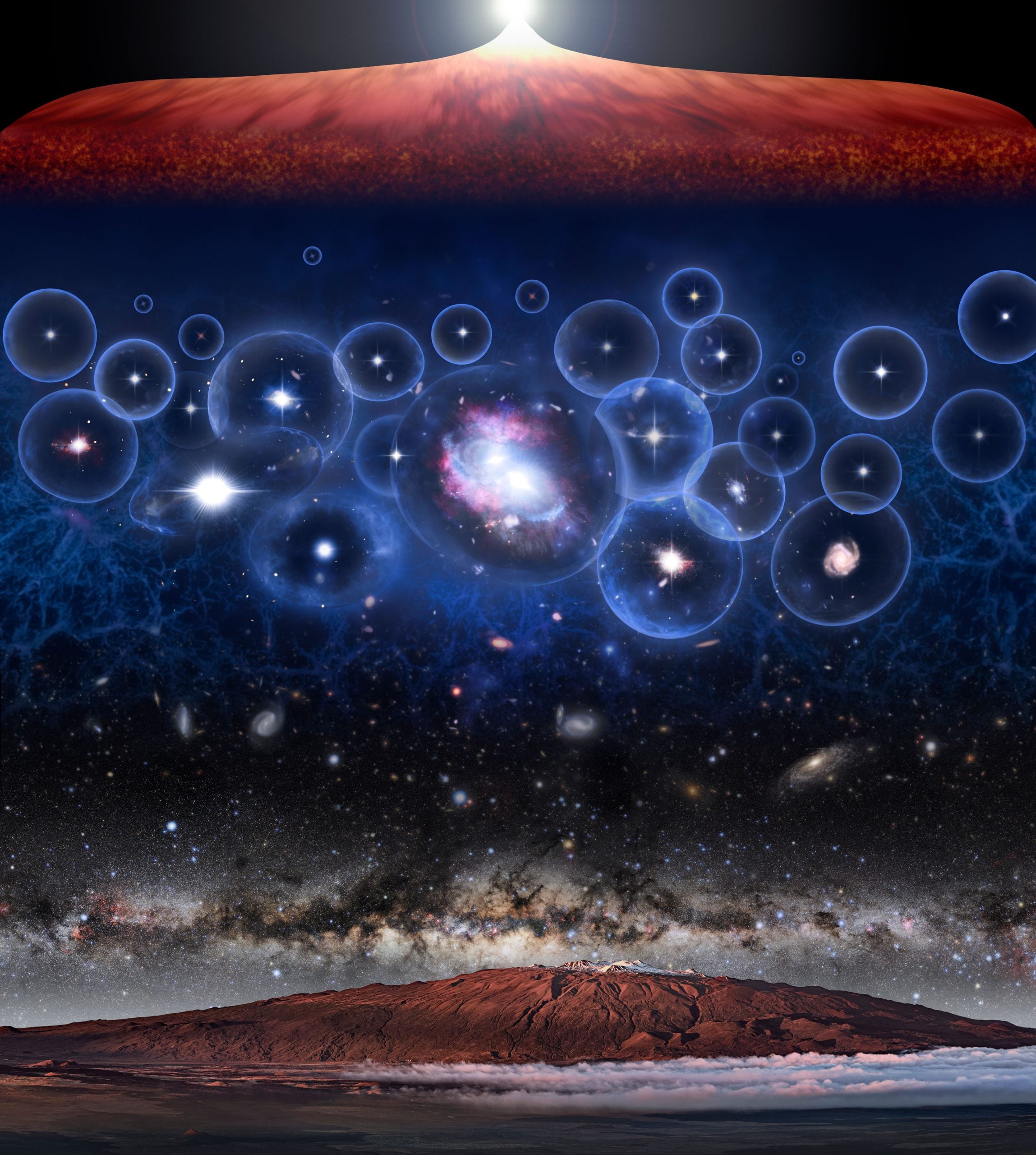
A rare cosmic discovery offers new clues about how early galaxy interactions may have fueled the rapid growth of supermassive black holes.
Astronomers have discovered two enormous black holes shining as quasars just 900 million years after the Big Bang, challenging theories of how supermassive black holes formed in the early Universe. One contains roughly 1.5 billion times the Sun’s mass, while its companion weighs about 400 million solar masses.
The system, designated J1602+4228AB and nicknamed Nāpōwawāʻenakaulua, is the most distant compact quasar pair ever identified. Its two members are separated by approximately 18,100 light-years, about one-fifth the diameter of the Milky Way.
Two Giant Black Holes That Grew Remarkably Fast
“There is no definitive theoretical explanation for how a single one of these giant quasars exists so early in the age of our Universe, much less two,” says Silvia Onorato, a postdoctoral research associate at NSF NOIRLab who led the international study. “We observed Nāpōwawāʻenakaulua at a time when the Universe was only a thirteenth of its age and astonishingly, its supermassive black holes are just as massive as those we see today.”
Quasars are intensely luminous regions surrounding actively feeding supermassive black holes. As gas spirals inward, it heats up and releases tremendous amounts of radiation, sometimes outshining every star in the surrounding galaxy.
During the Universe’s first billion years, galaxies rapidly assembled within growing concentrations of dark matter. Galaxy collisions and mergers could funnel gas toward central black holes, fueling their growth. Yet the enormous masses of Nāpōwawāʻenakaulua remain difficult to explain within the limited time available.
How Astronomers Discovered the Hidden Pair
The discovery emerged from the Aether survey, a James Webb Space Telescope (JWST) program led by Emanuele Paolo Farina of NSF NOIRLab/Gemini. Researchers examined 200 early quasars, representing approximately 43% of those known from this period, using Webb’s Near-Infrared Spectrograph Integral Field Unit.
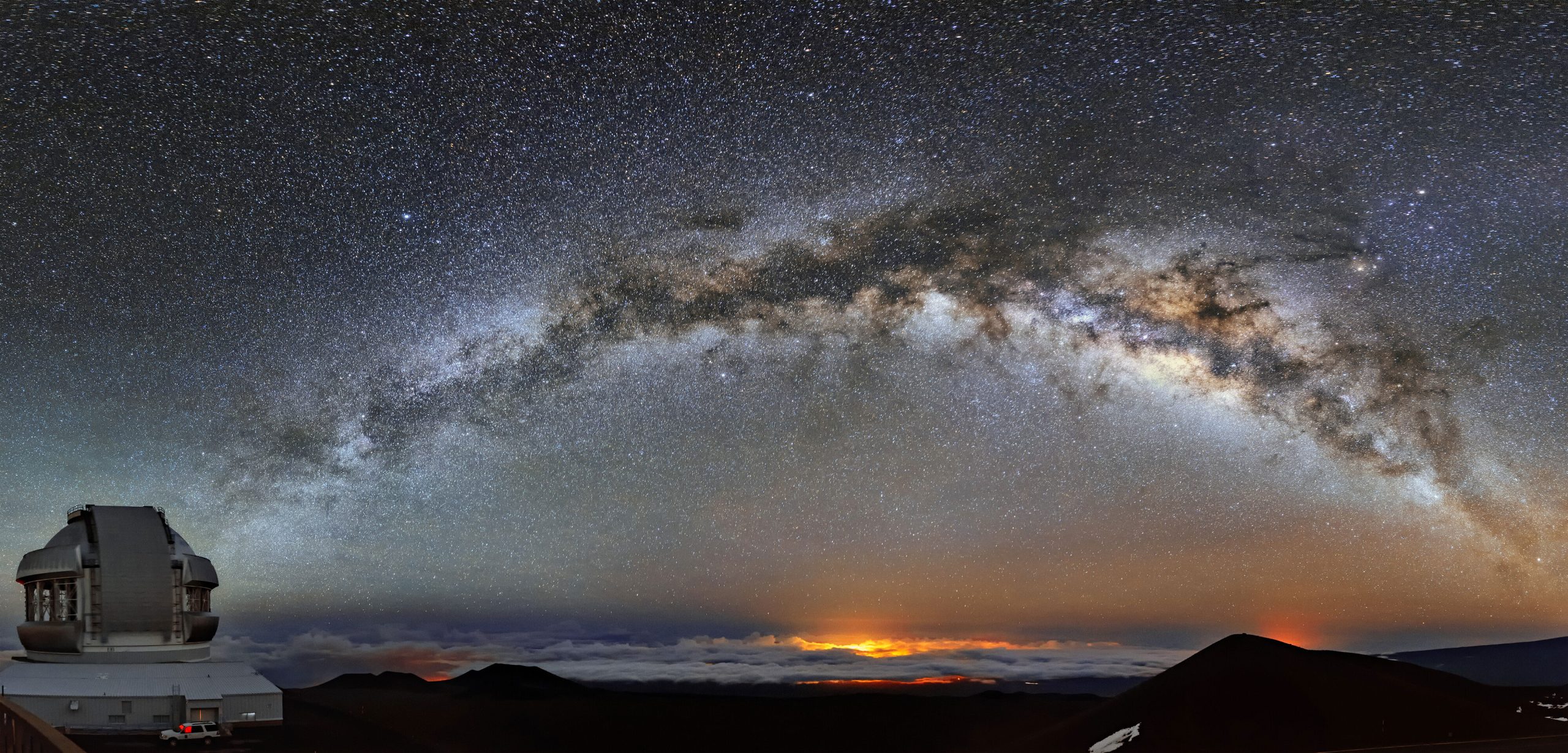
While inspecting the observations, scientists noticed that quasar J1602+4228A appeared to have a faint companion. Follow-up observations with the Gemini North telescope in Hawaiʻi confirmed that the two sources could be distinguished individually, despite their exceptionally close apparent separation.
“The sky over Maunakea was so clean and sharp that we managed to collect the data in only two nights,” says Onorato. Additional observations helped researchers further characterize both quasars.
Why Such Early Quasar Pairs Are Rare
Astronomers expect pairs of active black holes to form as galaxies interact and merge. However, black holes shine as quasars for relatively short periods, making it difficult to catch two neighboring objects in this luminous phase simultaneously.
The challenge is even greater in the distant Universe, where faint objects separated by tiny angles are difficult to resolve. Nāpōwawāʻenakaulua is only the third known quasar pair discovered during cosmic dawn, when the first generations of galaxies and black holes were taking shape.
A Clue to the Formation of Early Galaxies
Researchers suggest that Nāpōwawāʻenakaulua may lie in an exceptionally dense region of the early Universe, where frequent galaxy interactions supplied gas for rapid star formation and black hole growth. This remains a possible explanation rather than a confirmed account of the system’s origins.
“Nāpōwawāʻenakaulua is a really unique environment,” says Onorato. “It’s a laboratory for astronomers to study how the very first massive galaxies and their central black holes assembled together through direct galaxy interactions during these early times.”
The Hawaiian nickname translates to “Two celestial bodies of fathomless powerful darkness in the brilliance of heat reincarnating energy into the Universe.” It was created through the A Hua He Inoa program in collaboration with Hawaiian language and astronomy institutions.
Reference: “Nāpōwawā‘enakaulua: A Close Quasar Pair at Cosmic Dawn in the Aether Survey” by Silvia Onorato, Emanuele Paolo Farina, Roberto Decarli, Klaudia Protušová, Elia Pizzati, Debora Pelliccia, Devin S. Chu, Larry Lindsey Kimura, Leinani Lozi, Emily Peavy, Fabrizio Arrigoni–Battaia, Eduardo Bañados, Aaron J. Barth, Silvia Belladitta, Manuela Bischetti, Sarah E. I. Bosman, Hyunseop Choi, Tiago Costa, Anna-Christina Eilers, Xiaohui Fan, Simona Gallerani, Thomas R. Geballe, Anniek J. Gloudemans, Eunchong Kim, Brian C. Lemaux, Weizhe Liu, 伟哲 刘, Yoshiki Matsuoka, Chiara Mazzucchelli, Atsuko Nitta, Jan-Torge Schindler, Andrew W. Stephens, Hyewon Suh, Fabian Walter, Feige Wang and Jinyi Yang, 10 November 2026, The Astrophysical Journal Letters.
DOI: 10.3847/2041-8213/aeb11f
Never miss a breakthrough: Join the SciTechDaily newsletter.
Follow us on Google and Google News.