

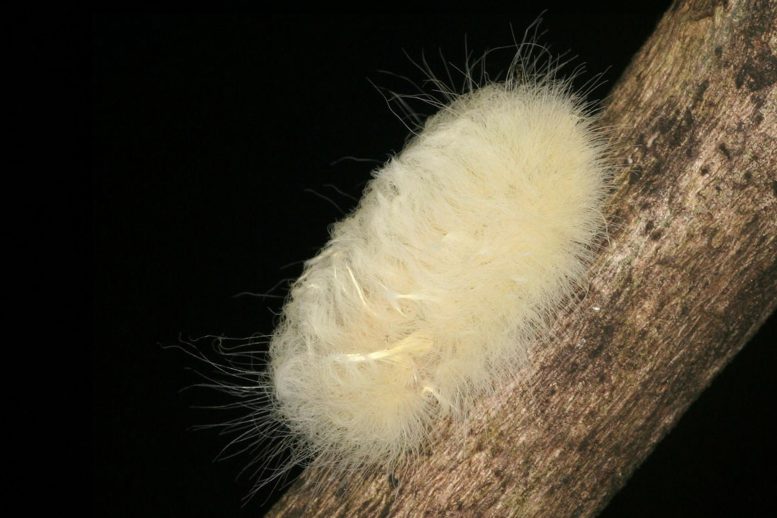
A White-necked Jacobin chick may use mimicry or camouflage to avoid predators, resembling a caterpillar with fluffy feathers.
Some scientific discoveries take years of research. Others begin with a single curious observation—and, as Jay Falk, a U.S. National Science Foundation (NSF) Postdoctoral Fellow working at the University of Colorado Boulder and the Smithsonian Tropical Research Institute (STRI) in Panama, puts it, sometimes it just takes the right people in the right place.
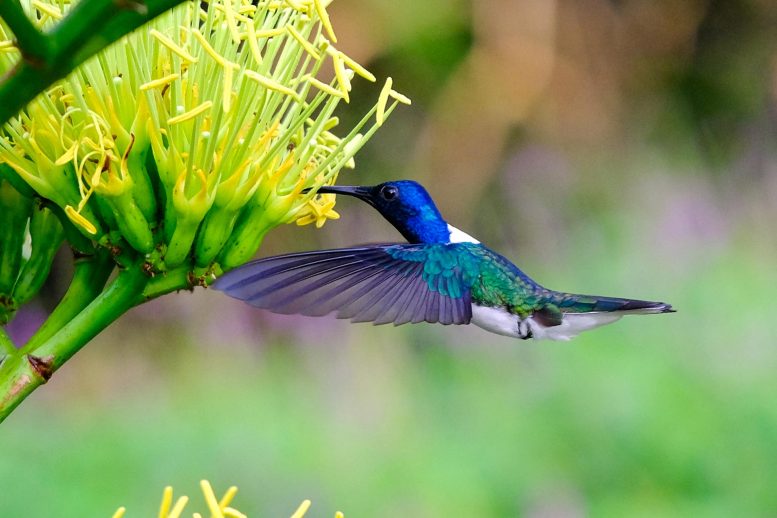
Jay has been studying White-necked Jacobins (Florisuga mellivora), a neotropical hummingbird species, for over a decade, though his focus had always been on adults. When Michael Castaño-Díaz, a Ph.D. student, and Sebastián Gallan Giraldo, a research assistant, both based at STRI, spotted a White-necked Jacobin nest along Plantation Road in Panama’s Soberanía National Park, they immediately informed Jay.
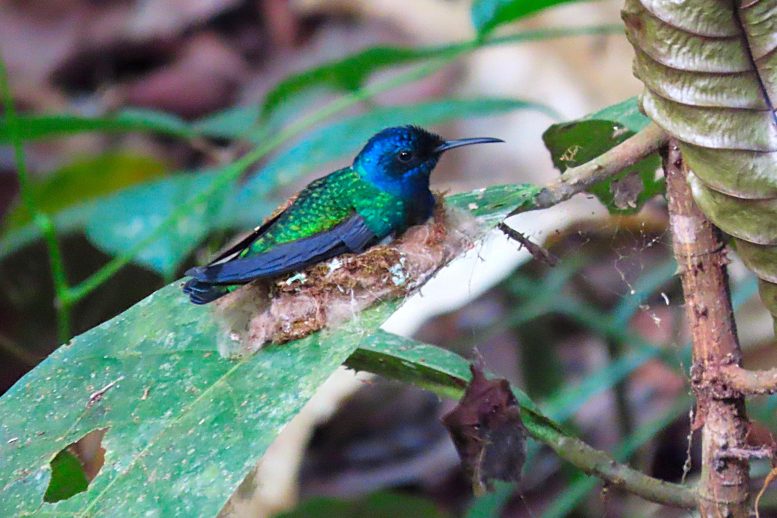
The nest held a single egg and a dedicated female, and since it was the first nest of this species they had encountered, the team decided to monitor it through regular visits. They also brought in videographer Joe See to help document what unfolded.
Interestingly, Jay had previously discovered that about 20% of females in this species mimic males in appearance, likely to gain better access to food. The chick’s mother was one of these female look-alikes.
Caterpillar-like Baby Hummingbird discovered in Panama. Credit: Smithsonian Tropical Research Institute
A chick that looks like a caterpillar
About 18 to 20 days later, the team returned to the nest with Scott Taylor, Jay’s advisor at the University of Colorado. The egg had hatched, and a tiny baby hummingbird had emerged. Scott noticed something highly unusual: the chick had long, fluffy down feathers on its back that made it look remarkably like a venomous caterpillar.
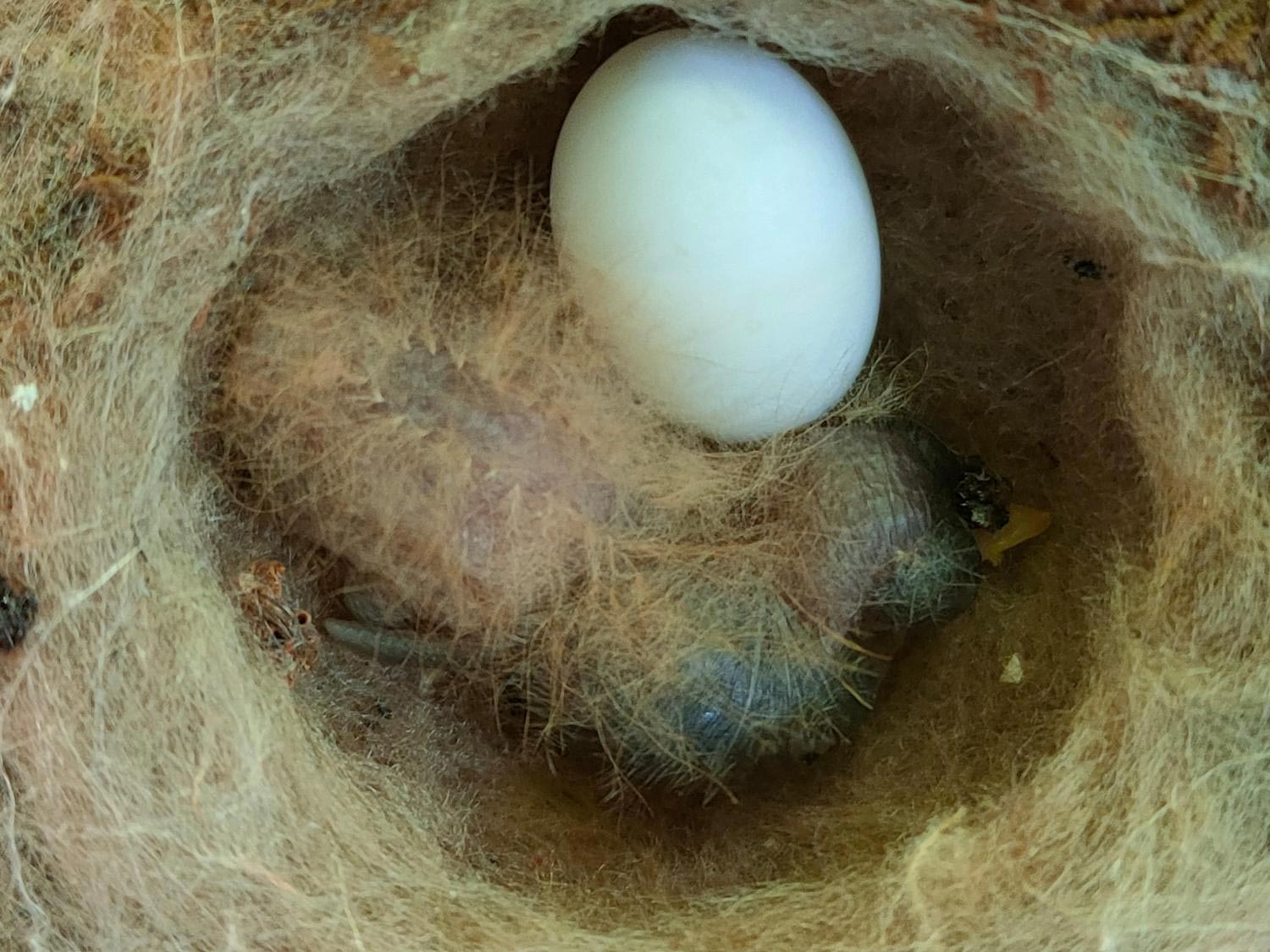
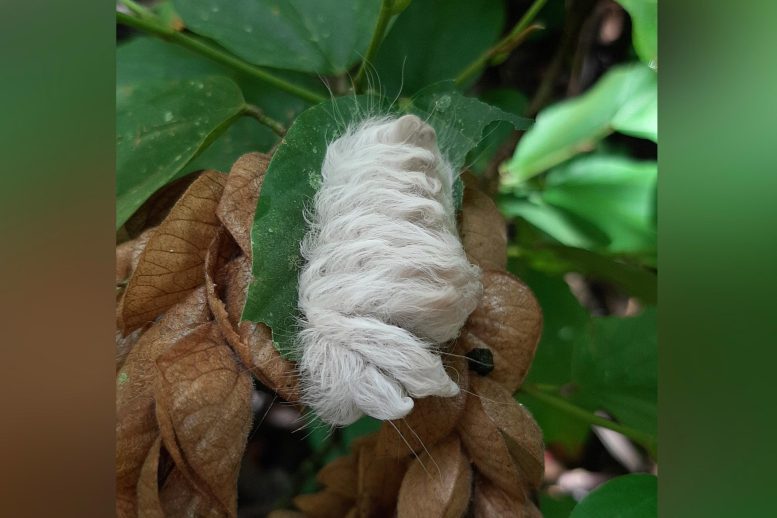
They immediately realized this could be a new discovery! Some caterpillars cover themselves with urticating hairs that cause painful skin reactions, inflammation and even headaches, nausea, and fever in humans.
One example of this type of mimicry is the Cinereous Mourner (Laniocera hypopyrra), a bird native to South America known for their caterpillar-like baby chicks.
With this in mind, they searched online for photos of newly hatched related hummingbird species and even some non-related hummingbirds to check whether the presence of these fluffy feathers was unusual. Most of the species they found lacked these particular feathers, showing that what they were looking at was special.
Camouflage or mimicry? both are possible
They also noticed the nest was covered with what appeared to be seeds of local Balsa trees (Ochroma pyramidale) which are also hairy-looking, making the chick very camouflaged. Therefore, another possibility is that the chick is camouflaging.
Nonetheless, the team was lucky enough to observe a carnivorous wasp nearby the chick, while the chick appeared to shake its head upwards, moving just like some caterpillars do in the presence of a potential predator.
They explain that because predation rates are very high in hummingbird chicks, and because White-necked Jacobins build open cup-like nests in exposed branches near the ground, strategies like mimicry or camouflage -or maybe both- might have evolved in this species.
However, more long-term observations and finding more individuals, are needed to support these hypotheses.
Tropical forests are full of mysteries and discoveries waiting to be made. This finding shows that every observation, especially when in collaboration with other curious observers, might reveal something extraordinary!
Reference: “Potential caterpillar mimicry in a tropical hummingbird” by Jay J. Falk, Michael Castaño-Diaz, Sebastian Gallan-Giraldo, Joseph See and Scott Taylor, 17 March 2025, Ecology.
DOI: 10.1002/ecy.70060
Never miss a breakthrough: Join the SciTechDaily newsletter.
Follow us on Google and Google News.
1 Comment
thank you